Digital Renaissance of the Classroom.
- The Transformation of the Integration into the Shift.
- Defining the 2026 AI Landscape in EdTech
- The Argument of AI: Productivity and Hyperpersonalization.
- Adaptive Learning Algorithms: Tutor for Everybody.
- Shattering Geographical and Economic Divides.
- Data Streak AI vs. Conventional Education Reach.
- The Case of Tradition: The Overvalued Human Element.
- Mentorship and Social-Emotional Learning (SEL).
- The Hidden Curriculum: Ethics, Fine Art, and Conflict Management.
- The Hybrid Reality: Augmented vs. Artificial Intelligence.
- Case Studies: Successful AI-Human Partnerships
- AI-Assisted Classrooms
- Individualized Learning Applications.
- Automation of Administrative Systems.
- Skill-Based Learning Ecosystems.
- AI in Education: Technical and Ethical Roadblocks.
- The Digital Divide: Will AI Continue to Increase the Achievement Gap?
- Economic Global Education System Impact.
- Comparison of AI Infrastructure to Physical Schools: Cost-Benefit Analysis.
- Comparative Cost Structure
- Short-Term Challenges
- Long-Term Advantages
- Impact on the Workforce
- Future Outlook: What Schools Will Look Like in 2030.
- Summary: Teamwork, Not Competition.
- Frequently Asked Questions
The debate on AI in education has changed radically. What began as a basic adoption process of technologies such as smart boards and Internet-based platforms has now changed into an entire revolution in the way of knowledge creation, sharing, and consumption. To crypto-natives accustomed to the concept of decentralization, this change is not new—education is not becoming decentralized but programmable and intelligent.
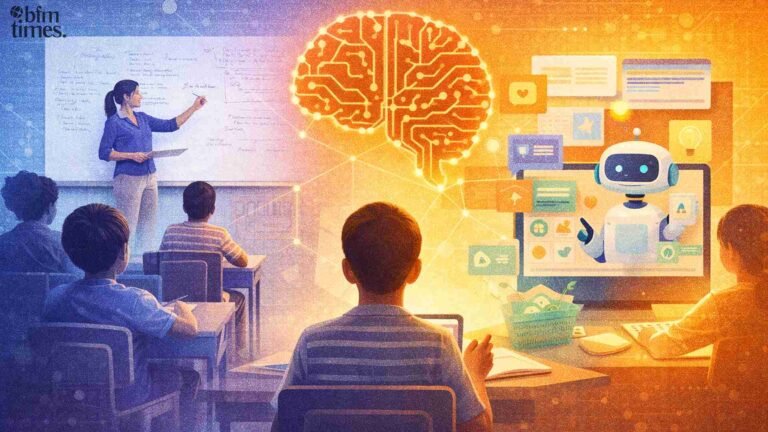
Future AI in education is not merely rescuing the classroom; it is transforming the classroom. Adaptive learning engines have given way to autonomous tutoring systems, making education algorithm-driven, data-informed, and more personalized.
Whether AI in education will have an influence on the traditional systems is no longer the question. Whether or not it can basically substitute them, or co-exist in a hybrid form. With the dynamic nature of digital economies, education itself is beginning to be an infrastructure, just like a financial system, in which efficiency and scalability are the measures of long-term value.
The Transformation of the Integration into the Shift.
Previously, educational technology was aimed at the digitalization of the existing systems. Tools were introduced to schools, and the framework was the same. The AI in education is altering the very fabric of education today.
This change could be broken into two phases.
Integration Phase:
- Digital classrooms
- Online assignments
- Learning management systems.
Transformation Phase:
- AI-based custom learning journeys.
- Hands off grading systems.
- Anticipatory student performance analytics.
Similarly to how DeFi is replacing the financial layers, AI in education is substituting the inflexible academic framework with adaptable and data-driven systems.
It is not a cosmetic transformation but an architectural one. Learning is being decentralized, constant, and user-managed, and institutions are no longer the exclusive knowledge gatekeepers.
Defining the 2026 AI Landscape in EdTech
The existing AI in education is premised on three fundamental pillars:
Adaptive Learning Systems
Dynamic platforms that can customize the content according to a student’s pattern of behavior, performance, and student engagement.
Educational Automation
AI software to deal with grading, scheduling, attendance, and even curriculum suggestions.
Intelligent Tutoring Systems.
24/7 AI-based tutors that can explain concepts, test knowledge, and optimize learning and strategies.
To crypto believers, we would approximate this as smart contracts to learn: automated, transparent, and scalable. The system is self-running; it learns based on the data it receives and develops without having to be constantly controlled by a human operator.
Furthermore, the emergence of decentralized identity systems can go even further to combine with AI in the education sector, enabling learners to have verifiable credentials, learning histories, and skill proofs across platforms.
The Argument of AI: Productivity and Hyperpersonalization.
The most compelling case of AI in education is that it is able to personalize on a large scale without the cost rising.
Conventional education is one-to-many. This is inverted by AI at scale from one-on-one.
Adaptive Learning Algorithms: Tutor for Everybody.
The AI approach to education is based on adaptive learning. Thousands of micro-interactions are analyzed by these systems on a student-to-student basis:
- Time spent on questions
- Error patterns
- Learning speed
- Content preferences
According to this, AI develops a personalized course of learning.
In contrast to a teacher who has to deal with 30-40 children, AI has the capacity to
- Real-time difficulty adjustment.
- Enforce feeble ideas immediately.
- Skip mastered topics.
This results in scaled personalized learning, which is not effectively done by traditional systems. These systems are also more precise over time since they gather more behavioral data, and this creates a feedback mechanism that keeps enhancing learning results.
Shattering Geographical and Economic Divides.
One of the greatest effects of AI in education is accessibility.
Remote or underdeveloped areas of students can now obtain the following:
- AI tutors via mobile devices
- Multilingual curriculum implementation.
- Educational material of high quality and without physical facilities.
This is similar to the way that crypto eliminated banking barriers. In the same way, AI in education eliminates institutional barriers.
Data Streak AI vs. Conventional Education Reach.
| Factor | Traditional Education | AI in Education |
| Accessibility | Limited by location | Global access via the internet |
| Cost per student | High | Scalable, lower marginal cost |
| Teacher availability | Shortage in many regions | Unlimited AI tutors |
| Personalization | Minimal | High (real-time adaptation) |
| Learning pace | Fixed | Individualized |
Outside access, AI in education, also facilitates lifelong learning. In contrast to the traditional systems, which are tied to semesters and schedules, AI-based platforms enable learners to upskill at any time, which fits education to the rapidly changing needs of digital and crypto economies.
The Case of Tradition: The Overvalued Human Element.
Regardless of this, AI in education is also subject to a severe limitation, namely the lack of human profundity.
Mentorship and Social-Emotional Learning (SEL).
The transfer of information is not all about education. It is emotional and social development.
- Teachers are very critical of the following:
- Motivating students
- Overcoming emotional hardships.
- Building confidence
- Encouraging curiosity
Artificial intelligence is capable of imitating communication, but it is not capable of feeling or empathy.
To crypto audiences, this can be considered the difference between the following:
- Automated smart contracts
- Ruling and decision by man.
They are important, not interchangeable. The human mentorship can either ensure that a learner will survive in the face of difficulties or they will become totally disinterested.
The Hidden Curriculum: Ethics, Fine Art, and Conflict Management.
Conventional classrooms impart knowledge that is not found in textbooks:
- Ethical reasoning
- Teamwork
- Conflict resolution
- Cultural awareness
This unofficial curriculum is very human.
AI in education will be able to provide content effectively, but it cannot:
- Behave morally in a genuine way.
- Deal with intricate social processes.
- Substitute real-life human contact.
This creates a fundamental gap between the transmission of information and human development.
The Hybrid Reality: Augmented vs. Artificial Intelligence.
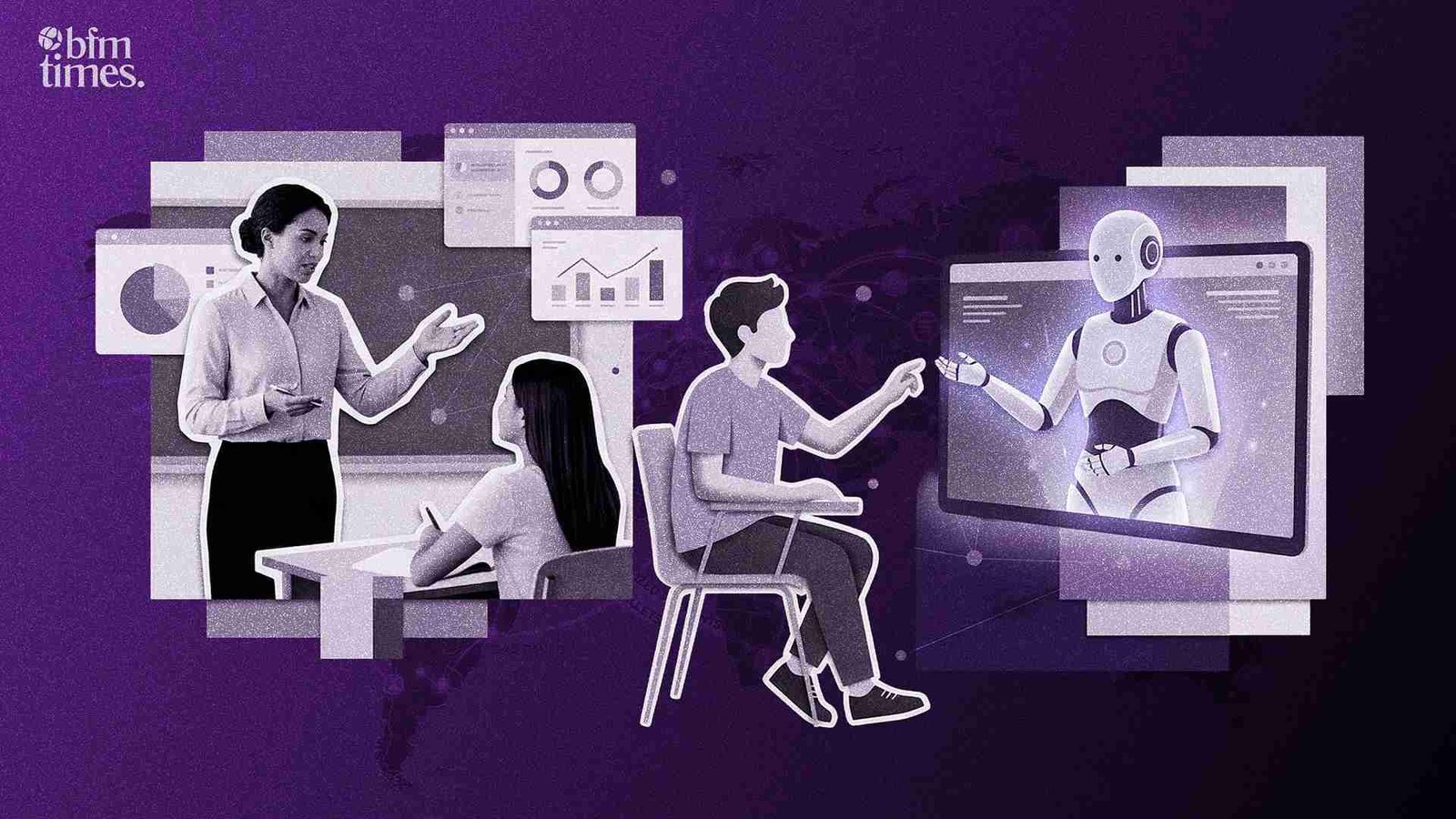
Replacing teachers is not the future; it is about making them better.
Replacing the Teacher with the role of a Lecturer with that of a Facilitator.
In the case of AI in teaching, the teachers have become the secondary source of information. Instead, they become:
- Guides
- Mentors
- Critical thinkers.
AI handles:
- Repetitive tasks
- Data analysis
- Content delivery
Teachers focus on:
- Creativity
- Emotional intelligence
- Complex problem-solving
This move is comparable to the execution by algorithm, but uses a strategy based on human insight used by crypto traders. It establishes a moderate system where efficiency and human judgment coexist.
Case Studies: Successful AI-Human Partnerships
Several education systems are already showing the hybrid one:
AI-Assisted Classrooms
AI dashboards are used by teachers to monitor student performance and take interventions when needed.
Individualized Learning Applications.
Students take individualized paths, and teachers give assistance and background.
Automation of Administrative Systems.
AI also decreases the amount of workload, which means that teachers can spend more time with students.
Skill-Based Learning Ecosystems.
AI-powered solutions can match the education to the real-life experience, especially in the fields of technology and crypto, where the learning cycles need to be fast.
The outcome is not substitution but optimization, with AI systems and human teachers playing their part to make the learning process more productive and meaningful.
AI in Education: Technical and Ethical Roadblocks.
With the growing pace of adoption, AI in the educational sector is accompanied by severe technical and ethical issues to be taken into consideration. Although their benefits are efficiency and personalization, new risks are brought along by these systems—especially on the side of data, fairness, and accountability.
In comparison to the ordinary classrooms, where decisions are made by humans and can be explained, AI in education can be executed by a combination of complicated algorithms that can hardly be explained. This develops a system in which results can be effective, yet not necessarily transparent.
The Privacy of Data and the Algorithms’ Bias in Grading.
Data privacy is one of the largest issues of AI in education. Such systems are based on a huge amount of data, such as
- Records of students’ performance.
- Behavioral patterns
- Learning speeds
- Interaction history
This brings up some basic issues:
- Who owns student data?
- How securely is it stored?
- Is it marketable or abusable?
With crypto audiences used to self-custody and decentralization, it is similar to the question of data sovereignty. Similarly to how digital citizens need to exercise control over their digital assets, learners might need to have ownership of their learning data.
Algorithm bias is another important problem.
AI systems are conditioned on historical data. In case such datasets are biased, the system can:
- Prefer some types of learning.
- Misjudge student potential.
- Strengthen the prevailing inequalities.
This is very dangerous in grading systems. Possibly, a prejudiced algorithm will always underestimate the abilities of some students without obvious reasons.
A lack of trust is caused by this black box problem. In traditional education, a teacher can justify a grade. In AI in education, the logic can not always be apparent or comprehensible.
The Digital Divide: Will AI Continue to Increase the Achievement Gap?
Although AI in education is said to bring accessibility, it is also likely to increase inequality.
AI-driven learning is available based on the following:
- Internet connectivity
- Device availability
- Digital literacy
Learners in developed schools have access to and use advanced tools, whereas those in underserved schools can face the challenge of having access to even basic infrastructure.
This creates a paradox:
- Artificial intelligence in education can make learning democratic.
- But also, it can enhance existing inequalities.
- The disconnect is not only technological, but it is also cognitive.
Students brought up with AI-related tools develop:
- More rapid adaptation to learning.
- Improved online navigation.
- Presentation on individualized education.
In the meantime, some stand in inflexible systems.
In crypto-native terms, this can be compared to the early adoption of blockchains, where the people with access enjoyed benefits that were disproportionate.
Unless applied well, AI in education might cause a two-level system:
- AI-enhanced learners
- Conventional system trainees.
The infrastructure, policy intervention, and inclusive design will be needed to bridge this divide.
Economic Global Education System Impact.
The creation of AI in education is not only a technological change, but it is also an economic one.
Comparison of AI Infrastructure to Physical Schools: Cost-Benefit Analysis.
The conventional education systems are resource-consuming. They require:
- Constructions and infrastructure.
- Teaching staff
- Administrative systems
- Maintenance costs
Conversely, AI education is based on scaling infrastructure:
- Cloud computing
- Software platforms
- Digital content
Comparative Cost Structure
| Component | Traditional Education | AI in Education |
| Infrastructure | High (schools, campuses) | Moderate (servers, cloud) |
| Teacher dependency | High | Reduced (AI support) |
| Scalability | Limited | Extremely high |
| Operational cost per student | Increasing | Decreasing over time |
| Accessibility | Location-bound | Global |
The marginal cost of education of an additional student using AI in education goes close to zero over time.
Nonetheless, the change is not instantaneous.
Short-Term Challenges
- The expensive startup costs of AI systems.
- Requirements of retraining of teachers.
- Institutional opposition.
Long-Term Advantages
- Reduced operational costs
- Scalable education models
- Ecosystems of continuous learning.
To crypto believers, this would be like switching between the old financial systems and blockchain networks—short-term disruptive cost but long-term efficiency payoff.
Impact on the Workforce
The second popular concern is that AI in education will destroy teachers. Nevertheless, role evolution is the more realistic outcome.
The future teachers will have to:
- Work alongside AI tools
- Process data-driven insights.
- Pay attention to mentoring and innovativeness.
New roles may emerge:
- Learning experience designers.
- AI curriculum specialists
- Data-driven education analysts.
Instead of job loss, AI in education will transform the concept of what it is to become an educator.
Future Outlook: What Schools Will Look Like in 2030.
In the next ten years,s there is a high likelihood of a hybrid form where the education process can be seen as a combination of AI and traditional systems.
Major Features of Classrooms in 2030.
Individualized Learning Roadmaps.
Each student works under their own curriculum depending on strengths, weaknesses, and objectives.
AI Tutors as Standard
Learning, revision, and assessment. Students use AI assistants every day.
Real-Time Performance Analytics.
It provides teachers with real-time information about the progress of students and proactive intervention.
Skill-guided Education Paradigms.
Degrees are becoming unimportant, and skills take their place, which is characteristic of rapidly developing spheres such as crypto and AI.
Decentralized Credentials
This means that students will possess verifiable academic records that are blockchain-based.
Human educators give context and meaning to AI in education, which becomes the infrastructure in this system.
Learning will cease to be classroom-based; it will be ongoing, modular, and dynamic.
Summary: Teamwork, Not Competition.
Displacement is one focus of the argument of AI in education. But the inquiry into the matter shows otherwise.
AI excels at:
- Scalability
- Personalization
- Automation
Conventional systems are good at:
- Human connection
- Ethical development
- Social learning
AI vs. teachers: Not in the future. It is AI + teachers.
To crypto-native thinkers, it is obvious:
- Blockchain has not killed the financial sphere; it has redefined it.
- AI will not kill education—it will transform it.
A hybrid system is the best, where:
- AI handles efficiency.
- Humans provide meaning.
As a part of this partnership, AI in education turns into a potent resource, not a substitute but a booster of human capability.
The institutions that evolve on this model shall determine the new generation of learning.
Frequently Asked Questions
Will AI replace teachers in the future?
AI will not replace teachers but will work alongside them to improve learning outcomes.
What are the main benefits of AI in education?
AI offers personalization, automation, and global accessibility for learners.
What are the challenges of AI in education?
Challenges include data privacy concerns, algorithm bias, and the digital divide.
Disclaimer: BFM Times acts as a source of information for knowledge purposes and does not claim to be a financial advisor. Kindly consult your financial advisor before investing.