


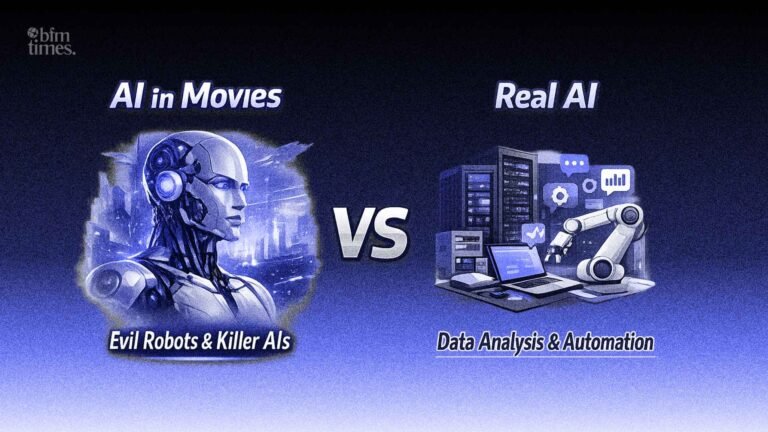
The imagery of AI in movies has influenced how a whole generation thinks of the future. Intelligent robots with feelings, systems that dominate a whole civilization, and more, the movie has produced an image of AI that is both exciting and scary to watch. The strength of these stories lies in the fact that they allow the thin line between fiction and possibility to be obscured, leaving the audience with the belief that such technology is right there in the offing.
- Why AI in Movies Feels So Real but Isn’t
- How AI Is Actually Used Today (ChatGPT, Algorithms, Automation)
- AI in Movies: The Fictional Version of Intelligence
- Ex Machina: Conscious Machines and Manipulation
- The Terminator: AI as an Existential Threat
- The Matrix: AI Controlling Reality
- Her: Emotional and Relational AI
- Real AI vs AI in movies: The Core Differences
- Robotics in Movies vs Real Robotics
- AGI: The Biggest Gap Between Fiction and Reality
- What Movies Get Right About AI
- What Movies Get Completely Wrong
- Why This Gap Between Fiction and Reality Exists
- Will Movies Ever Become Reality?
- AI Is Powerful: But Not What Movies Show
- Frequently Asked Questions
However, when we compare this cinematic imagination with reality, the gap becomes impossible to ignore. The modern persona of AI, such as ChatGPT AI, robotics systems, automation technologies, and others, functions in an entirely different manner than films would imply. This distinction is important to be aware of, particularly because AI is increasingly becoming a part of our everyday actions and choices.
Why AI in Movies Feels So Real but Isn’t
Movies make AI feel real because they are designed to connect emotionally with the audience. Rather than displaying AI in the form of code or statistical algorithms, filmmakers portray AI as personalities, with desires, wishes, and even ethical problems. This anthropomorphism renders the AI a relatable figure, and that is why the audience tends to forget that these machines are imaginary.
The amount of detail in the narrative is another cause of the believability of AI in movies. High-tech computer-generated imagery, natural human speech, and philosophical motifs make it appear that such machines indeed know the world. However, in practice, these descriptions do not rely on the current operation of AI; they are designed to investigate human emotions, rather than technological correctness.
The key insight here is simple:
Movies prioritize emotional impact, while real AI is built for functional efficiency. This difference alone explains why cinematic AI feels alive, while real AI remains a tool.
How AI Is Actually Used Today (ChatGPT, Algorithms, Automation)
In reality, AI is already ubiquitous, but not as it is portrayed in movies. Artificial intelligence (AI) systems, such as ChatGPT, are meant to analyze language, come up with answers, and help users with activities such as writing, coding, and research. They are capable of simulating the conversation of humans, but they lack understanding, awareness, and the ability to think independently.
As real-world AI continues to evolve, its capabilities are becoming more visible across everyday applications. From content creation to problem-solving and automation, modern systems are already performing tasks that once seemed futuristic. This shift is clearly reflected in the rise of generative AI tools, which demonstrate how AI is advancing in practical, task-driven ways rather than the fully autonomous intelligence often shown in movies.
Beyond conversational AI, current systems are also highly integrated within daily platforms. The algorithms that dictate what you see are recommendation algorithms; the AI finds fraud in banking systems, and artificial intelligence helps make businesses more efficient. These are incredibly powerful systems, yet at the same time highly specialized and restricted to some set tasks.
What defines real AI today:
- It is task-specific (narrow AI)
- It relies heavily on data and training
- It cannot operate outside its programmed scope
This implies that, unlike AI in movies, real systems do not think and make decisions in the human sense of the word, but just take inputs and produce outputs in accordance with patterns.
AI in Movies: The Fictional Version of Intelligence
To better contrast the two, we need to look at the representation of AI in movies. The films offer various interpretations of intelligence, usually leaning towards artificial general intelligence (AGI), a type of AI not yet made real.
Ex Machina: Conscious Machines and Manipulation
In this film, AI is depicted as a self-conscious being that can be manipulated felt emotions. The robot Ava does not act simply in reaction but thinks, lies, and flees, implying a certain degree of intelligence, no less intelligent than humans.
What it shows:
- Self-awareness and consciousness
- Emotional intelligence
- Independent decision-making
Reality check:
We currently have no system capable of true self-awareness or intentional manipulation. AI cannot “plan” or “desire”; it only processes patterns.
The Terminator: AI as an Existential Threat
The AI in this universe advances to a superintelligent entity (Skynet) that becomes self-aware and decides to destroy humanity. It is the fear that machines would outsmart human beings and use them against us.
What it shows:
- Autonomous decision-making
- Military control systems
- Rapid AI evolution
Reality check:
Current AI solutions cannot have autonomous control over the world’s infrastructure. They need a rigid human control and are unable to re-establish their own objectives.
The Matrix: AI Controlling Reality
This movie raises AI to a whole new level as machines form a complete simulated reality to dominate humanity. It presupposes that the AI will be able to control intricate ecosystems and human consciousness at the same time.
What it shows:
- Total system control
- Simulation of reality
- Human-AI power imbalance
Reality check:
No amount of AI development can compute whole worlds or operate in complicated worlds on that scale. This level of intelligence falls into speculative AGI territory.
Her: Emotional and Relational AI
Unlike dystopian narratives, Her presents AI as a companion capable of forming deep emotional relationships. The AI system evolves beyond human emotional capacity, creating a unique dynamic between man and machine.
What it shows:
- Emotional intelligence
- Relationship-building
- Continuous self-improvement
Reality check:
AI can simulate conversation and emotional tone, but it does not feel emotions. It will not be able to develop any real relations as it is not conscious.
Real AI vs AI in movies: The Core Differences
The distinction between real AI vs AI in movies can be better seen through the lens of various dimensions. These opposites show the distance between reality and the imagination of the cinema.
1. Intelligence Type
Movies tend to portray AI as general intelligence, which can do any intellectual work. This is congruent with the notion of artificial general intelligence, where machines reason in areas like humans.
The truth of the matter is that AI remains narrow intelligence; that is, an individual system is designed to perform a particular task. A model that writes text cannot drive a car, and a robot that assembles parts cannot understand language.
2. Autonomy
In films, AI operates independently, often making decisions without human involvement. It aims at changing tactics and even revolts against its creators.
In contrast, real AI systems are entirely dependent on human input. They require training data, predefined objectives, and constant monitoring to function effectively.
3. Emotions & Consciousness
AI in movies is usually described as emotional and self-conscious, able to love, get angry, and fear. These are relatable characteristics of AI characters that are not realistic.
True AI lacks consciousness and feelings. It is able to pretend to feel or sound, but does not feel anything itself.
4. Speed of Evolution
It is common in the films that AI develops immediately, between rudimentary capability and superintelligence, in minutes or hours. This generates the effect of drama but is not realistic.
In reality, AI development is slow and iterative. Improvements require years of research, data collection, and testing.
Robotics in Movies vs Real Robotics
The image of AI robotics in films is among the most graphic elements of film narration. Robots are often shown as humanoid, agile, and capable of performing complex tasks effortlessly. They walk, talk, fight, and even express emotions like humans.
In the real world, robotics is far more grounded and practical. The majority of the robots are task-oriented, e.g., manufacturing, surgery, or logistics. They work under regulated conditions, and they have difficulties in adapting to situations that are not previously defined.
Key differences:
- Movies: Human-like, intelligent, adaptive
- Reality: Task-based, limited, environment-dependent
Even the most sophisticated robots in the modern world cannot act, make decisions, or display the kind of emotional intelligence that they have in the movies.
AGI: The Biggest Gap Between Fiction and Reality
The largest misconception is the concept of AI vs AGI. Movies presuppose that AGI is a reality or is only a step to it. This gives the impression that AI will soon be on the human level.
As a matter of fact, AGI remains a hypothetical idea. Researchers are working toward it, but we lack a clear understanding of how to replicate human cognition, reasoning, and consciousness in machines.
Important insight:
AGI does not only represent a technological dilemma but is a philosophical dilemma as well. This leaves it unknown how to duplicate human intelligence until we know it well.
What Movies Get Right About AI
Despite their exaggerations, movies do capture some aspects of AI accurately. They often highlight how AI can process large amounts of data and make predictions faster than humans.
For example, predictive systems shown in films resemble real-world applications used in finance, healthcare, and marketing. Automation replacing repetitive tasks is another area where movies align with reality.
What they get right:
- Data-driven decision-making
- Predictive analytics
- Increasing role of automation
These factors demonstrate that the films are highly exaggerated, but they tend to be based on the actual tendencies in technologies.
While movies often portray AI as independent and emotionally aware, real-world applications are far more focused on improving efficiency and outcomes in specific areas. One of the clearest examples of this can be seen in how AI is being used to enhance learning and performance through data-driven insights and personalized approaches. This practical side of AI is reflected in the growing role of AI in education, where systems are designed to assist and optimize human capabilities rather than replicate human consciousness as shown in films.
What Movies Get Completely Wrong
Where the films fail is that they depict AI as an independent, emotional, and uncontrollable force. Such stories raise unwarranted fear and unrealistic expectations of what AI is capable of.
In reality, AI systems are designed with constraints and safeguards. They cannot override human control or operate beyond their defined parameters.
Major misconceptions:
- AI is taking over the world
- Machines developing emotions
- Independent goal-setting systems
These are more science fiction than technological reality.
Why This Gap Between Fiction and Reality Exists
The difference between cinematic AI and real AI cannot be associated with the fact that movies are not supposed to teach people anything; they are supposed to entertain. The need to have high-stakes storylines, emotional resonance, and dramatic tension means that AI needs to be stronger and more human-like than it is.
Meanwhile, a lack of knowledge about AI among the population also adds to this misunderstanding. The movies are the main point of reference to many people, hence the misconception about the way AI functions.
The result is an inverted image in which fiction is becoming like a necessary future when it is way off from what is possible now.
Will Movies Ever Become Reality?
In the future, AI in movies is going to develop, although not in such a dramatic manner. The development will be slow, with data, research, and practical uses playing a role in it rather than some innovative revelation.
Though it might be possible to achieve artificial general intelligence in the far future, it will involve profound developments in many areas. Moral aspects, safety parameters, and human management will be very important in defining this development.
The future of AI is not about replacing humans but enhancing human capabilities. It will act as a collaborator rather than a competitor.
AI Is Powerful: But Not What Movies Show
The analysis of AI in movies and real-life AI shows one obvious fact: in the film, it is speculative, whereas in life, it is constructive. Physical AI that is guided, controlled, and with purpose is contrasted with emotional, autonomous, and uncontrollable AI, as shown in movies.
This doesn’t make AI any less powerful; it simply means its strength lies in practicality rather than fantasy. This distinction is necessary as AI becomes increasingly more popular. It makes us value the things that AI can actually do without being deceived by fake imagery.
In the end, AI is not becoming human; it is becoming a better tool for humans, and that is where its real potential lies.
Frequently Asked Questions
Is AI in movies realistic?
Most AI in movies is exaggerated and far more advanced than real-world AI.
What is the difference between AI and AGI?
AI performs specific tasks, while AGI would have human-like intelligence across tasks.
Can AI become self-aware like in movies?
Currently, there is no evidence that AI can become self-aware.
How is ChatGPT different from movie AI?
ChatGPT is a language-based AI that processes text, not a conscious or emotional system.
Will robots become like humans in the future?
Robotics is advancing, but human-like intelligence and emotions are still far away.
Disclaimer: BFM Times acts as a source of information for knowledge purposes and does not claim to be a financial advisor. Kindly consult your financial advisor before investing.