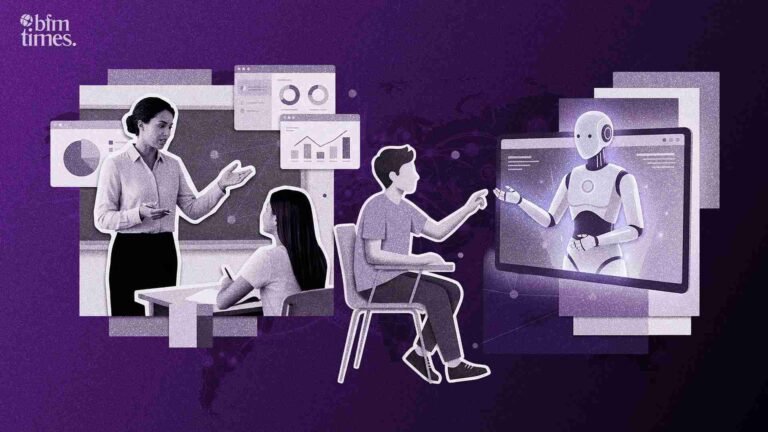
The argument on AI tutors vs human teachers is not theoretical anymore. It is occurring in actual, online, and even self-learning assemblies. Similar to the effect that crypto changed finance by eliminating intermediaries, AI is changing education by decentralizing access to knowledge.
- The Emergence of AI-Personalized Learning.
- AI: the Decentralized Brain of Education.
- Adaptive Learning: Specificity and Not Generality.
- Quick Feedback = Easier Learning.
- The Lasting Tradition of Human Mentorship.
- The Case AI Tutors: Efficiency and Customization.
- 24/7 Availability and Infinite Patience.
- Adaptive Learning Paths Based on Data.
- The Resolution to the One-on-One Learning Problem.
- Consistency and Standardization.
- The Case of Human Teachers: The Social-Emotional Ground.
- Student Motivation and Emotional Intelligence (EQ).
- Managing Multifaceted Ethical and Cultural Subtleties.
- Mentorship Beyond the Curriculum.
- Artificial Intelligence versus Human Instruction: Direct Competition.
- Productivity vs. Intensity: Strategic Perspective.
- Education as a System: Crypto-Lens Insight.
- Strengths and Weaknesses: Comparative Analysis.
- The Hybrid Reality: The Cyborg Classroom.
- Artificial Intelligence (AI) as the Teaching Assistant (TA); Humans as the Mentors.
- Moral Implications and Data Security.
- Artificial Intelligence: Ethics and AI Decision-Making.
- Striking a Fit between Innovation and Responsibility.
- Conclusion: Why is the Answer Both?
- Final Insight
Institutions are no longer the sole source relied upon by the learners. They are AI-equipped tools, flexible learning engines, and custom tutoring engines. Meanwhile, to some extent, human instructors still offer mentorship, emotional intelligence, and organized guidance.
The actual question is not as much about AI tutors vs human teachers as it is about how each of them influences the learning efficiency, scalability, and intellectual growth in the long term.
Related: Generative AI vs Traditional AI: What’s the Difference?
The Emergence of AI-Personalized Learning.
AI: the Decentralized Brain of Education.
Blockchain likewise dispenses control; AI dispenses knowledge. Students no longer have to rely on set schedules and a standardized pace.
AI-driven systems now:
- Flex to a personal rate of learning.
- Knowledge gaps are discovered immediately.
- Show time corrections in real time.
- Provide tailored learning experiences.
This is where the alignment of AI tutors vs human teachers becomes a structural analogy—AI is an automated process, whereas human instruction is more of a governance.
Adaptive Learning: Specificity and Not Generality.
The conventional classrooms educate towards mediocrity. AI teaches the individual.
The important AI learning capabilities include:
- Dynamic difficulty adjustment.
- Performance-based progression
- Individual revision processes.
This accuracy is one of the most effective points that can be made to support the idea of AI tutors over human teachers in contemporary education.
Quick Feedback = Easier Learning.
Instant response is one of the greatest benefits of the AI tutors.
Students:
- Don’t wait for evaluation.
- Mistakes should be learned instantly.
- Reinforce concepts faster.
This forms a feedback loop like real-time trading systems—responsive, fast, and continuously optimized.
The Lasting Tradition of Human Mentorship.
Learning Is Not Data—It Is Human Experience.
During the process of information processing, AI identifies information, but human beings create meaning.
Human teachers:
- Recognize emotional situations.
- Ensure motivation through attachment.
- Teaching in response to behavior.
This is the place where AI tutors vs human teachers change efficiency to depth.
Organized Coaching vs. Unorganized Anarchy.
AI gives freedom. Humans give direction.
Learners can miss out on the following without appropriate direction:
- Skip foundational concepts.
- Over-focus on easy topics
- Lose discipline
Human teachers create:
- Learning structure
- Accountability systems
- Long-term development paths
The Case AI Tutors: Efficiency and Customization.
24/7 Availability and Infinite Patience.
Artificially intelligent tutors can be accessed at any time.
They:
- Never get tired.
- Endless explanations are repeated.
- It should be judgment-free learning.
To self-motivated learners, this is a big plus in the AI tutors vs human teachers debate.
Adaptive Learning Paths Based on Data.
AI tracks:
- Accuracy rates
- Learning speed
- Concept retention
On the basis of this information, it generates optimal learning tracks.
This resembles algorithmic trading plans—making decisions on the basis of data and not feelings.
The Resolution to the One-on-One Learning Problem.
Personalized tutoring in the past has been prohibitive and costly.
AI changes that by:
- Scaling one-on-one learning
- Reducing cost barriers
- Opening individual learning to everyone.
It is among the most compelling reasons as to why the comparison between AI tutors vs human teachers can no longer be fairly considered as one-to-one anymore: AI scales.
Suggested: Top 10 AI Tools for Students to Study Smarter (Free & Paid) in 2026 – A Guide
Consistency and Standardization.
AI delivers:
- Uniform explanations
- No bias in grading
- It is predictable in learning results.
It does not change depending on mood, fatigue, or due to external influences, like in human beings.
The Case of Human Teachers: The Social-Emotional Ground.
Student Motivation and Emotional Intelligence (EQ).
AI understands patterns. Humans understand people.
Teachers can:
- Detect disengagement.
- Motivate underachieving students.
- Build confidence.
This emotional aspect of the tutor is absent in the AI systems, and this is one of the main aspects of AI tutors vs human teachers.
Managing Multifaceted Ethical and Cultural Subtleties.
Education is no technical matter but cultural and ethical.
Human teachers:
- Interpret social context
- Address sensitive topics.
- Encourage ethical thinking.
AI does not have the lived experience, and hence, it is less effective in dealing with these areas.
Mentorship Beyond the Curriculum.
The role of a teacher is not just about the subjects.
They:
- Guide career decisions
- Inspire curiosity
- Build long-term thinking
This is where the problem of AI tutors vs human teachers lies in the purpose rather than the performance.
Artificial Intelligence versus Human Instruction: Direct Competition.
| Factor | AI Tutors | Human Teachers |
| Availability | 24/7 access | Fixed hours |
| Personalization | High (data-driven) | Moderate |
| Emotional Intelligence | None | High |
| Scalability | Unlimited | Limited |
| Consistency | High | Variable |
| Mentorship | Limited | Strong |
Productivity vs. Intensity: Strategic Perspective.
Where AI Dominates
- Repetitive learning
- Practice-based subjects
- Test preparation
- Language drills
Where Humans Lead
- Critical thinking
- Debate and discussion
- Emotional development
- Creative exploration
This is a clear indication that AI tutors vs. human teachers is not a question of superiority; it is a question of specialization.
Education as a System: Crypto-Lens Insight.
In case we apply the analogy to education:
- AI = Protocol layer (scalability, efficiency, automation)
- Human beings = Governance layer (decision-making, ethics, direction)
An ungoverned system goes wrong.
A non-protocol system is not scalable.
That is precisely why the AI tutors vs. human teachers debate is developing into a hybrid model debate.
The Importance of This Debate at This Time.
The movement to AI-based education is gaining momentum because:
- Digital-first learning is becoming a reality.
- The attention spans are becoming shorter.
- There is a growing demand for personalization.
At the same time:
- Social contact is necessary.
- Emotional intelligence is not automatable.
- Long-term success is still characterized by mentorship.
This is the central element of the debate between AI tutors and human teachers.
Strengths and Weaknesses: Comparative Analysis.
The arguments in support of or against AI tutors versus human teachers can be easier to understand once we reduce them to capabilities instead of opinions. The two systems are both tailored to suit dissimilar functions, and comprehending this dissimilarity is considered to provide an evaluation of the actual effect of the two systems in the real world.
AI works based on logic, information, and monotony. Human teachers work on intuition, experience, and emotional intelligence.
This has a natural gap between the delivery and absorption of learning.
Scalability vs. Empathy
The essential trade-off of the AI tutors vs. human teachers debate is the trade-off between scalability and empathy.
AI can reach millions. Man is capable of influencing people.
In this table, we can compare the two:
| Capability Area | AI Tutors | Human Teachers |
| Scalability | Extremely high (global access) | Limited by classroom size |
| Personalization | Algorithm-driven precision | Experience-based adjustment |
| Emotional Intelligence | None | High |
| Feedback Speed | Instant | Delayed |
| Adaptability | Data-driven | Context-driven |
| Motivation | Low | High |
| Ethical Judgment | Pre-trained logic | Real-world reasoning |
There is one important point that can be made through this table: AI tutors vs. human teachers are not competing to see who is better, but it is a contrast of design.
Strength-Based Breakdown
- Where AI Tutors Excel
- Large-scale instructional settings.
- Repetition and practice of a skill.
- Assessment and test preparation.
- Learning language and exercises.
- Take the correction systems straight away.
AI works well in a formal and quantifiable learning context.
Where Human Teachers Excel
- Theoretical profundity and description.
- Psychological support and emotional support.
- Live classroom dynamics.
- Ethical debates and arguments.
- Creativity and innovation
The most effective human teaching is when it comes to unpredictability and nuance.
The Hybrid Reality: The Cyborg Classroom.
The future of education is not one of making a decision on systems. It is about combining them.
It is here that the concept of the so-called cyborg classroom is to be mentioned, a model according to which AI and humans will be enclosed in the same learning environment.
There is no longer a debate in the AI tutor vs. human teacher in this model. It becomes a collaboration.
Why Hybrid Learning Is Inevitable
This hybrid model is being driven by several structural changes:
- Growing need for learning on top of existing knowledge.
- Lack of trained teachers in most of the areas.
- Quick expansion of online-based learning.
- Require scalable but relevant systems of education.
Complete education can not be achieved through AI only. Scaling cannot be efficiently done by human beings alone.
The combination of the two results in a balanced system.
Artificial Intelligence (AI) as the Teaching Assistant (TA); Humans as the Mentors.
AI as the Teaching Assistant
Within a hybrid classroom, AI replaces the routine and operational tasks.
These include:
- Grading and evaluation are automated.
- Question generation in practice.
- Performance tracking
- Personalized recommendations
- Revision scheduling
This allows for:
- Faster learning cycles
- Reduced teacher workload
- Uniform standards in evaluation.
In the AI tutors vs. human teachers paradigm, AI will be the implementation layer.
Humans as the Mentors
Educators, human ones, move to high-value positions:
- Facilitating discussions
- Promoting critical thinking.
- Providing emotional support.
- Guiding long-term goals
- Decoding complicated issues.
They focus on:
- “Why” instead of just “What.”
- Situation rather than mere content.
- Growth rather than delivery.
This development reinforces the thesis that AI tutors vs. human teachers are moving towards a role-based system.
Learning Flow in a Hybrid Model
An example of a hybrid learning cycle can be the following:
- AI presents ideas in the form of personalized modules.
- The students train on adaptive exercises.
- AI is used to assess performance immediately.
- Greater insight is provided with a human teacher.
- Teacher-mediated discussion and reflection.
- AI reinforces weak areas.
This loop forms an optimization system that is continuous.
Moral Implications and Data Security.
With the introduction of AI into education, the ethical issue is inevitable.
The AI tutors vs. human teachers is not only about the performance but also about the responsibility.
Data Privacy Risks
AI systems accumulate massive amounts of data on students:
- Learning behavior
- Performance metrics
- Interaction patterns
Risks include:
- Unauthorized data access
- Abuse of personal information.
- Inadequacy of transparency in the use of data.
Students, in effect, are turned into data points of a system.
Algorithmic Bias
The artificial intelligence systems are trained with existing data. This can lead to:
- Biased recommendations
- Disproportionate learning experiences.
- Support of the current disparities.
In comparison with human teachers, AI has no conscious ability to close its bias unless it is redesigned.
Over-Reliance on Automation
Overreliance on AI might:
- Minimize individual thinking.
- Limit human interaction
- Develop passive learning behavior.
This is one of the concerns of the AI tutors vs. human teachers debate.
Loss of Human Connection
Education is not only the transfer of knowledge. It is relationship-driven.
The elimination of human contact can cause the following:
- Lower engagement
- Reduced motivation
- Lack of social development
Here, the human teachers will still be necessary.
Artificial Intelligence: Ethics and AI Decision-Making.
AI cannot:
- Know moral ambiguity to the fullest extent.
- Managing delicate emotional challenges.
- Be situation-sensitive in ethical judgments.
- Human oversight is critical.
Striking a Fit between Innovation and Responsibility.
To render the hybrid model effective:
- AI should be supportive and not dictatorial.
- Human educators need to maintain the option of decision-making.
- The use of data should be regulated and transparent.
- The process of learning should still be human-oriented.
This will make sure that the development of AI tutors, as compared to human teachers, is not derailed from the long-term education objectives.
Also Read: Large Language Models Explained: How LLMs Work
Conclusion: Why is the Answer Both?
The antagonism between AI tutors and human teachers presupposes a winner in many cases. The truth is, however, more subtle.
AI is changing the educational field by:
- Making learning scalable
- Individualizing content presentation.
- Increasing efficiency
Human teachers continue to:
- Inspire and motivate
- Provide emotional depth
- Guide intellectual growth
Learning is in the future of integration, not replacement.
A system where:
- AI handles precision.
- Humans handle purpose.
The integrated strategy generates:
- Better outcomes
- Deeper understanding
- Better inclusive systems of education.
Finally, the problem of AI tutors and human teachers is not a fight. It is a blueprint of the future of learning.
Final Insight
Education is changing in the same way that decentralized systems did—the old centralized systems have become distributed intelligence.
And yet in the most perfect mechanisms, there is one fact:
- Learning can be improved using technology.
- But it is only human beings who can make it meaningful.
- And this is why it will always be both AI tutors and human teachers.
Disclaimer: BFM Times acts as a source of information for knowledge purposes and does not claim to be a financial advisor. Kindly consult your financial advisor before investing.
What are AI tutors in 2026?
AI tutors are smart systems that provide personalized learning support using data and adaptive technology.
Are AI tutors better than human teachers?
AI tutors offer flexibility and instant feedback while human teachers provide emotional support and deeper understanding.
Which is best for learning in 2026?
A combination of AI tutors and human teachers is often the most effective approach for balanced learning.