



Crypto staking is now one of the most viable methods for long-term crypto holders to gain passive income to take care of blockchain networks. The Best Platforms for Crypto Staking in 2026 has become more than mere lock-ups and has now developed into a flexible ecosystem, consisting of centralized exchanges, self-custodial wallets, and liquid staking platforms. The current state of selection of the best platforms for crypto staking implies the trade-off between the potential reward and the security, flexibility, and control over your assets. The guide outlines the principles of staking, the comparison of the leading platforms, and the beginner and advanced users’ need to comprehend staking rewards and risks and real-life applications without hype and investment promises.
- What Is Crypto Staking and How Does It Work
- Key Factors to Consider Before Choosing the Best Platforms for Crypto Staking
- Best Platforms for Crypto Staking in 2026
- Centralized Staking Platforms: Easy & Beginner-Friendly
- 1. Coinbase: Best for Beginners and Simplicity
- 2. Kraken: Best for Variety & Flexibility
- 3. Binance.US: High-Yield Centralized Staking
- 4. Nexo: No-Fee Staking with Competitive Rates
- Decentralized & Liquid Staking Platforms
- Wallets & Apps with Native Staking Options
- Staking vs Yield Farming: Understanding the Difference
- How to Choose the Best Platforms for Crypto Staking Strategy for Your Portfolio
- Risks Associated with Staking Crypto
- Practical Step-by-Step Guide to Start Staking
- Best Platforms for Crypto Staking at a Glance
- Staking vs Yield Farming Comparison
- Advanced Staking Mechanics in 2026: What’s Changed?
- 1. Flexible vs Bonded StakingFlexible
- Bonded staking:
- 2. Auto-Compounding and Reward Frequency
- 3. Validator Selection & Performance Metrics
- Regional Availability & Compliance in 2026
- Liquid Staking in 2026: Why It’s Growing So Fast
- Portfolio Allocation Models for Best Platforms for Crypto Staking
- Tax & Reporting Considerations for Staking Rewards
- Frequently Asked Questions
- What are the best platforms for crypto staking?
- Which crypto will make you rich in 2026?
- Which crypto has the highest staking reward?
- Conclusion
What Is Crypto Staking and How Does It Work
Cryptocurrency staking is a method of locking or delegating cryptocurrencies to assist in securing a Proof-of-Stake (PoS) blockchain. In its turn, users receive staking rewards in the form of the same token.
How staking works (simple view):
- You bet on a PoS (e.g., Ethereum, Solana, Cardano).
- Staked assets are used to verify transactions by the validators.
- Rewards are disseminated to the validators and delegators via networks.
- The users receive rewards depending on their stake size and time.
Key concepts:
- Validator: Network securing node operator.
- Delegation: Pinning your stake on a validator.
- Lock-up period: Lock-up time of your assets.
- APY and APR: APY incorporates compounding; APR does not.
- Auto-compounding: Rewards are re-staked automatically.
Key Factors to Consider Before Choosing the Best Platforms for Crypto Staking
Choose one of the best platforms for crypto staking before:
- Security model: Custodial vs. self-custodial.
- Supported assets: ETH, SOL, ATOM, ADA, DOT, etc.
- Transparency in rewards: Individual APY and payment frequency.
- Fees: Platform or commission to validators.
- Lock-in periods: Flexible staking versus bonded staking.
- Minimum stake: Other platforms are allowed with very small amounts.
- Usability: Mobile applications, dashboards, and tracking.
- Regional availability: Certain platforms are country-specific.
Best Platforms for Crypto Staking in 2026
Staking platforms can be divided into three broad categories now:
- Centralized exchanges: Basic, new, and user-friendly.
- Decentralized liquid staking applications: Adaptable DeFi applications.
- Wallet-based staking: Self-custody and on-network staking.
The two methods cater to the needs of various users, including passive earners who do not want to engage in the process and expert DeFi users.
Centralized Staking Platforms: Easy & Beginner-Friendly
1. Coinbase: Best for Beginners and Simplicity

- Overview: A controlled, friendly trade with native staking.
- Staking Support: ETH, SOL, ADA, ATOM, and so on.
- APY / Reward Notes: They are usually in the low-to-mid single-digit range based on asset and network performance.
- Ease of Use: automatic rewards, easy user interface, and easy-to-understand dashboards.
- Best Fit: New entrants and long-term holders.
- Risks / Limitations: Custodial platform; platform risk is applicable.
Want the full breakdown? Visit the official website: https://www.coinbase.com/en-in
2. Kraken: Best for Variety & Flexibility
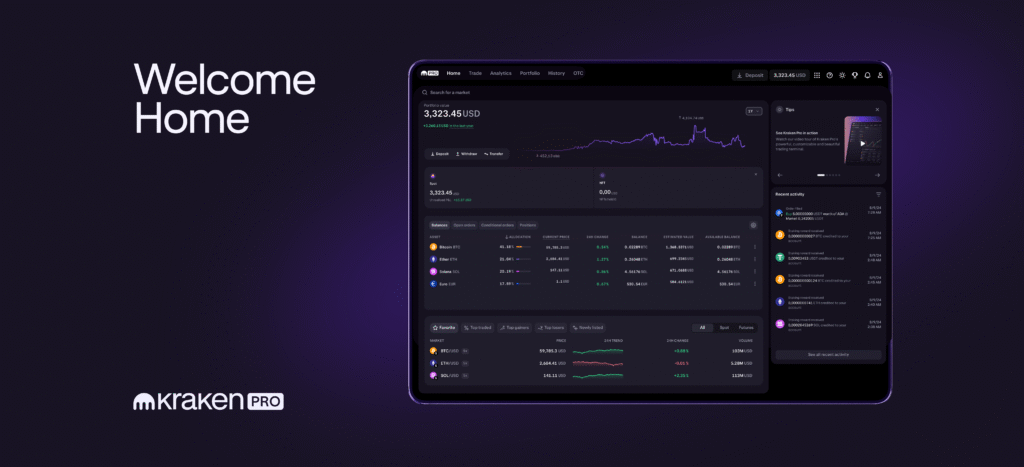
- Overview: Has a reputation for clear stakeholder initiatives.
- Staking Support: Large PoS asset coverage.
- APY / Reward Notes: Bonded and flexible stakes that offer various reward scales.
- Ease of Use: Easy to track rewards and easy to stake.
- Best Fit: Individuals who desire additional staking.
- Risks / Limitations: Custodial risk and region availability.
Want the full breakdown? Visit the official website: https://www.kraken.com
3. Binance.US: High-Yield Centralized Staking
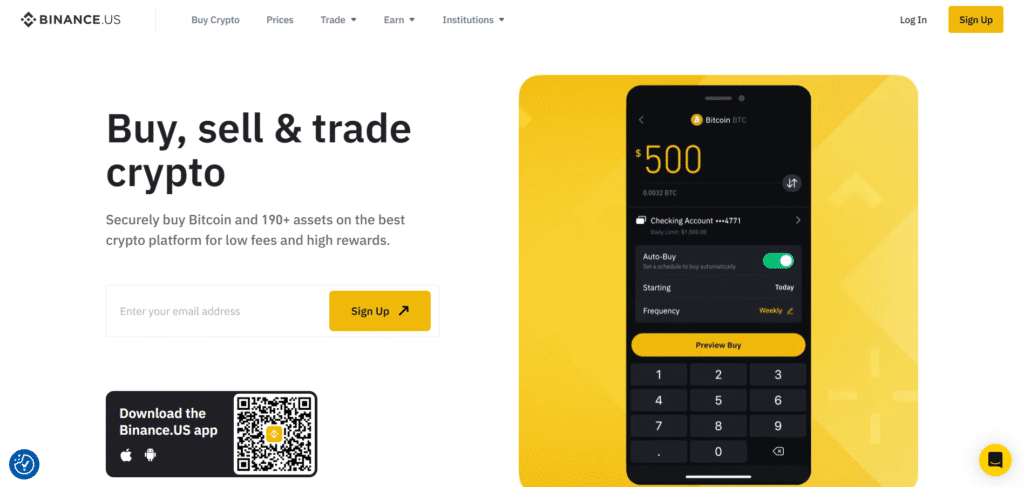
- Overview: Huge asset portfolio and yield products.
- Staking Support: ETH, SOL, DOT, ATOM, and others.
- APY / Reward Notes: Competitive crypto staking rewards based on asset demand.
- Ease of Use: One-Click Staking and Auto-Compounding.
- Best Fit: Yield-focused users.
- Risks/Limitations: Platform risk; availability to regulation varies.
Want the full breakdown? Visit the official website: https://www.binance.us/
4. Nexo: No-Fee Staking with Competitive Rates
- Overview: Provides uncomplicated, manual lock-up-free staking.
- Staking Support: Major PoS assets.
- APY / Reward Notes: Changing levels of loyalty.
- Ease of Use: Passive earning model.
- Best Fit: Customers who like passive staking.
- Risks/Limitations: Dependency on custodial platforms.
Want the full breakdown? Visit the official website: https://nexo.com/
Decentralized & Liquid Staking Platforms
1. Lido: Leading Liquid Staking for ETH & More
- Overview: It is one of the most popular liquid staking platforms.
- Staking Support: ETH and a few PoS chains.
- APY / Reward Notes: Reward ranges are based on networks, with lower protocol fees.
- Ease of Use: Easy staking of liquid tokens (e.g., stETH).
- Best Fit: Liquid users of DeFi.
- Risks/Limitations: Smart contract risk and protocol dependency.
Want the full breakdown? Visit the official website: https://lido.fi/
2. Phantom: Solana-Focused Self-Custodial Staking
- Overview: Solana ecosystem wallet staking.
- Staking Support: SOL staking.
- APY / Reward Notes: Staking rewards based on network effects.
- Ease of Use: Validator selection and clean UI.
- Best Fit: Solana users who want to self-custody.
- Risks/Limitations: Rewards are sensitive to the performance of the validators.
Want the full breakdown? Visit the official website: https://phantom.com/
Wallets & Apps with Native Staking Options
Wallets offering staking:
- Trust Wallet
- MetaMask (via staking integrations)
- Phantom
- Keplr (Cosmos ecosystem)
Pros: Full asset control
Cons: It needs technical sensitivity.
Staking vs Yield Farming: Understanding the Difference
| Feature | Staking | Yield Farming | Notes |
| Risk | Lower | Higher | DeFi exposure varies |
| Complexity | Simple | Advanced | Yield farming requires DeFi knowledge |
| Asset Custody | Often retained | Often pooled | Farming uses liquidity pools |
| Stability | Predictable | Variable | Farming yields fluctuate |
Staking vs. yield farming differs mainly in complexity and risk exposure. Staking supports networks; yield farming optimizes DeFi liquidity.
How to Choose the Best Platforms for Crypto Staking Strategy for Your Portfolio
- Beginners: Stake centralization.
- DeFi users: Liquid staking platforms
- Long-term investors: Wallet staking + compounding.
- Diversifiers: Split across 2–3 platforms
- Risk-aware users: Use an alternative to custody.
Risks Associated with Staking Crypto
- Slashing penalties
- Lock-up restrictions
- Validator downtime
- Smart contract risk
- Platform insolvency
- Regulatory changes
Practical Step-by-Step Guide to Start Staking
- Select one of the Best Platforms for Crypto Staking
- Set two-factor authentication on.
- Choose an asset and a staking technique.
- Check lock-up and reward conditions.
- Track incentives and provider well-being.
- Rebalance periodically
Best Platforms for Crypto Staking at a Glance
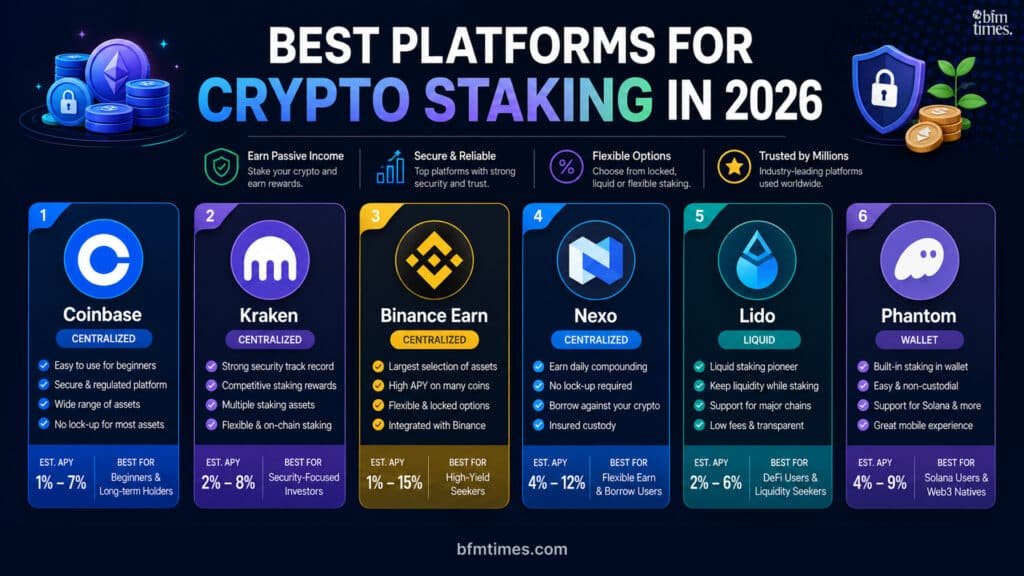
| Platform | Type | Supported Assets | Reward Estimate Range | Best For |
| Coinbase | Centralized | ETH, SOL, ADA | Low–Mid single digits | Beginners |
| Kraken | Centralized | Multiple PoS | Low–Mid single digits | Flexible staking |
| Binance Earn | Centralized | Wide selection | Mid-range | Yield seekers |
| Nexo | Centralized | Major PoS | Variable | Hands-off users |
| Lido | Liquid | ETH, others | Network-based | DeFi users |
| Phantom | Wallet | SOL | Network-based | Self-custody |
Staking vs Yield Farming Comparison
| Feature | Staking | Yield Farming | Notes |
| Complexity | Low | High | Farming requires DeFi knowledge |
| Risk Level | Moderate | Higher | Depends on protocol |
| Liquidity | Low–Medium | Medium–High | Liquid staking improves liquidity |
| Best For | Long-term holders | Active DeFi users | Strategy-dependent |
Advanced Staking Mechanics in 2026: What’s Changed?
Staking in 2026 is more developed, yet more complicated. Platforms currently have a variety of staking options that influence the liquidity, risk, and yield optimization. This knowledge of these mechanics allows users to select the best platforms for crypto staking depending on their level of activity in their crypto.
1. Flexible vs Bonded Staking
Flexible
- Withdraw anytime
- Lower crypto staking rewards
- Lower risk exposure
Bonded staking:
- Lock-up periods (7–28 days common)
- Higher reward potential
- Demands the planning of liquidity requirements.
Best for:
Bonded staking is more favorable to long-term holders of assets that do not require urgent liquidity. The short-term holders favor flexibility.
2. Auto-Compounding and Reward Frequency
Now modern staking platforms support:
- Reward payouts on a daily or weekly basis.
- Auto-compounding to maximize APY.
- Self-custody wallets reward claiming done manually.
Why this matters:
Auto-compounding enhances returns on experience without having to manage it. This is one of the features that is standard in most of the best platforms for crypto staking.
3. Validator Selection & Performance Metrics
On self-custodial platforms and wallets:
- The rewards are influenced by the uptime of the validators.
- Slashing history matters
- Net yield is lowered by commission rates.
- Network health is enhanced by geographic distribution.
Pro tip:
Decentralize 2-3 validators to minimize slashing risk.
Regional Availability & Compliance in 2026
Regulatory requirements have seen the staking platforms being geographically segmented. Access to platforms, assets suitable for the platform, and staking differ depending on jurisdiction.
What Users Should Check:
- Local compliance regulations.
- Availability of the platform in your country.
- Vesting of some tokens.
- Reporting and tax visibility tools
Why this matters:
The best platforms for crypto staking might not be provided with the same functionality even internationally. In other parts, custodial staking services are not allowed, but self-custody wallets and liquid staking protocols are permitted.
Liquid Staking in 2026: Why It’s Growing So Fast
The liquid staking platforms are currently one of the rapidly expanding staking models.
The reasons why liquid staking platforms are popular:
- Secure assets and still have cash.
- Liquid staking in DeFi.
- Avoid long lock-ups
- Improve capital efficiency
Trade-offs:
- Smart contract risk
- Protocol dependency
- Market risk of liquid tokens deviating from the peg
Liquid Best Platforms for Crypto Staking are between long-term staking and short-term liquidity requirements, but demand better risk awareness.
Portfolio Allocation Models for Best Platforms for Crypto Staking
Depending on the objectives, different staking allocation methods are used by different users.
1. Conservative Staker
- 70-80% centralized staking
- 20-30% wallet staking
- Focus: simplicity + stability
2. Balanced Staker
- 40% centralized staking
- 30% wallet staking
- 30% liquid staking platforms
- Focus: diversification
3. Advanced Staker
- 20% centralized
- 30% wallet staking
- 50% liquid staking + DeFi strategies.
- Focus: yield optimization
Tip:
Do not put 100% of assets on any platform (even the best platforms for Crypto Staking).
Tax & Reporting Considerations for Staking Rewards
Staking rewards are also considered taxable income in numerous areas. Platforms currently offer better reporting features, such as:
- Reward history exports
- Annual yield summaries
- Integrations for transaction tracking.
- Tax software wallet labeling.
Good practice:
- Track reward timestamps
- Value of record reward at receipt.
- Maintain reward records of validators.
Ignoring reporting can create compliance risk over time.
Frequently Asked Questions
What are the best platforms for crypto staking?
Best platforms for crypto staking in 2026 include Binance, Coinbase, Kraken, Coinbase Wallet/MetaMask for liquid staking, and dedicated liquid-staking protocols like Lido and Rocket Pool for strong yields and reliability.
Which crypto will make you rich in 2026?
Cryptos most likely to grow substantially through Best Platforms for Crypto Staking in 2026 include Bitcoin (BTC), Ethereum (ETH), Solana (SOL), and select high-utility Layer-2 or DeFi tokens, although “getting rich” is never guaranteed.
Which crypto has the highest staking reward?
Through Best Platforms for Crypto Staking In 2026, the highest staking rewards often come from smaller or emerging proof-of-stake networks, such as a couple of DeFi/Layer-1s and liquid staking tokens, while major chains like ETH, SOL, and ADA offer competitive but lower yields.
Conclusion
The best platforms for crypto staking in 2026 include centralized exchanges, liquid staking platforms, and self-custodial wallets. All of them are appropriate to various levels of experience and risk profiles. Whether it is a simple crypto staking reward offered by an exchange or the ability to flexibly have exposure to DeFi offered by a liquid staking platform, security, transparency, and an understanding of how the platform works are important. Small hands first, platform diversification where necessary, and focus on self-custody where feasible.
Disclaimer: BFM Times acts as a source of information for knowledge purposes and does not claim to be a financial advisor. Kindly consult your financial advisor before investing.