


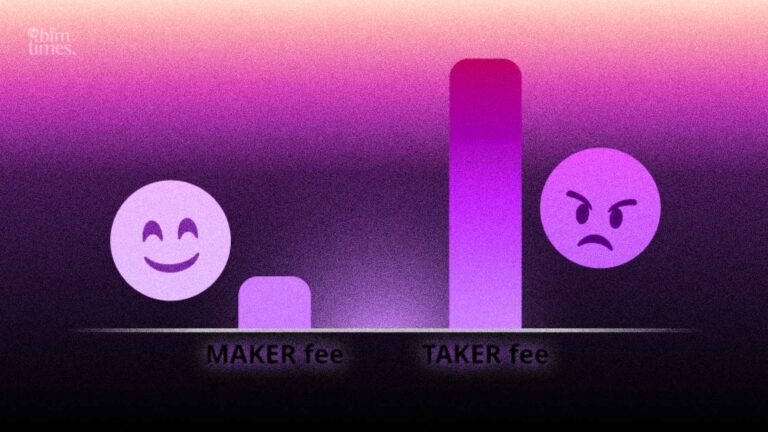
A maker taker fee is a pricing strategy in which cryptocurrency exchanges charge a different fee based on whether an order adds liquidity to the order book (maker) or removes liquidity (taker) from the order book. Knowledge of the operations of this system can save you a lot of money in your trade. This guide will teach you all the mechanics, provide you with real-world examples of calculations, and provide you with practical advice on how to save on fees.
- Maker vs Taker Fee: the basic idea
- How exchanges set maker/taker fees (tiered schedules & rebates)
- Worked examples: spot trade & futures/perps
- Why maker/taker fees matter: impact on traders & liquidity
- Maker vs Taker at a glance
- Tiered Exchange Fee Structure
- Practical tips to minimize fees
- Common pitfalls and quick checklist before you trade
- Frequently Asked Questions
- Conclusion
Main Topic: Best Crypto Exchanges
Maker vs Taker Fee: the basic idea
The maker vs taker model identifies two kinds of orders:
- Maker order: This is a limit order that is not accepted instantly by an existing order. It will inject liquidity into the order book.
- Taker order: An order (usually a market order) that is an immediate match with an existing order. It removes liquidity.
Simply put, a maker order vs. taker order is a matter of giving or taking liquidity.
Makers are usually favored with lower fees (and even rebates) since they enhance the depth of the market. Takers tend to charge an exceptional fee as they absorb available liquidity.
How exchanges set maker/taker fees (tiered schedules & rebates)
The majority of the exchanges have a tiered exchange fee structure that depends on the 30-day trading volume. The more the volume of your trading, the lower the fees.
As an example (spot trading, snapshot checked February 2026):
- Binance: The standard rate is approximately 0.10% maker/0.10% taker, not including any discounts.
- Kraken: Level of entry of approximately 0.16% maker / 0.26% taker.
- Coinbase Advanced: Tiered schedule beginning with higher and falling with volume.
Headline rates (e.g., 0.02% maker / 0.05% taker) tend to be lower on derivatives platforms, particularly on perpetual futures.
Some exchanges also:
- The offer fee is lower for holding native tokens.
- Give high market maker rebates.
- Lower charges on premium levels of VIP depending on the volume of the 30-day period.
The recalculation of your tier is done on a daily basis using the rolling 30-day volume in most instances.
Worked examples: spot trade & futures/perps
Understanding trading fee calculation is essential. We shall pass through two realistic cases.
Spot Trade Example
Assume an exchange charge:
- 0.10% maker
- 0.20% taker
You buy $10,000 worth of BTC.
Scenario 1: Market order (taker)
Fee = $10,000 × 0.20% = $20
Scenario 2: Limit order that posts to the book (maker)
Fee = $10,000 × 0.10% = $10
Difference: $10 saved just by placing a maker order, in case it is not executed right away.
When your limit order is crossed by the spread and filled immediately, it is a taker trade. This is why it is important to know how maker orders and taker orders work.
Futures / Perpetuals Example
Suppose a futures exchange fee:
- 0.02% maker
- 0.05% taker
You get a perpetual contract of $50,000 BTC.
Open Position (Market order, taker):
$50,000 × 0.05% = $25
Close Position (Market order, taker):
$50,000 × 0.05% = $25
Total round-trip fee = $50
If both orders were maker:
$50,000 × 0.02% × 2 = $20
Difference = $30
On high-frequency strategies, this difference grows rapidly. It should be noted that futures also have funding payments, which are not connected to the maker taker fee model.
Related: Best Forex Trading Software: Top Platforms & Tools for Traders
Why maker/taker fees matter: impact on traders & liquidity
Maker taker fee model is a model that influences the market behavior.
For exchanges:
- It encourages liquidity.
- Tight spreads bring in a larger volume.
For traders:
- Cryptocurrency traders pay close attention to crypto trading fees.
- Market makers are dependent on reduced maker rates or rebates.
- Market order traders tend to overpay when they use market orders.
Liquidity and price discovery are typically enhanced by the system. However, analysts claim that it may distort the order routing choice, particularly in the conventional stock exchanges. It is the most widespread pricing model in crypto.
Maker vs Taker at a glance
| Characteristic | Maker | Taker | Why it matters |
| Order Type | Limit order that rests | Market or aggressive limit | Determines liquidity impact |
| Liquidity Impact | Adds liquidity | Removes liquidity | Affects spread & depth |
| Typical Fee | Lower | Higher | Impacts cost per trade |
| Execution Speed | May wait | Immediate | Trade-off: price vs speed |
| Rebates | Sometimes | Rare | Important for high volume |
Tiered Exchange Fee Structure
| 30-Day Volume | Maker Fee | Taker Fee | Notes |
| <$10,000 | 0.10% | 0.20% | Entry tier |
| $10k–$100k | 0.08% | 0.18% | Reduced |
| $100k–$1M | 0.05% | 0.15% | Active trader |
| >$1M | 0.02% | 0.10% | VIP tier |
Note: Real fees vary by exchange and product. Always verify current schedules.
Practical tips to minimize fees
You need not transform strategy radically to cut costs:
- Use limit orders carefully. See that they are upon the book to be maker.
- Check for “post-only” or “maker-only” options to avoid accidental taker execution.
- Monitor your 30-day volume tier.
- Exchange-native token discounts should be used when possible.
- Compare derivatives vs. spot fees.
- Consolidate trades to reduce fragmented volume.
- Improve your performance metrics.
Before making a trade, query: Is this a maker order vs taker order? Minimal percentage changes are important in the long run.
Common pitfalls and quick checklist before you trade
Before executing:
- Confirm your current fee tier.
- Test to see whether your limit order will meet the spread.
- Review hidden costs (finance, settlement, withdrawal).
- Verify whether maker rebates apply.
- Double-check leverage impact in futures.
A lot of traders are preoccupied with the entry price and fail to calculate the entire trading fee. Net returns are greatly affected by fees in hundreds of trades.
Frequently Asked Questions
What is a maker taker fee in crypto trading?
A maker fee is charged when you place a limit order that adds liquidity to the exchange’s order book.
What is a maker taker fee on an exchange?
A taker fee applies when you place an order that immediately matches with an existing order and removes liquidity from the market.
Conclusion
Maker taker fee gives incentives to liquidity providers and imposes charges on liquidity takers. Through the concept of fee calculation and limit order placement, it is possible to significantly lower the costs by being aware of how these tools operate and their applications. Always check the current schedule of fees of your exchange and do your calculations of the same before trading.
Disclaimer: BFM Times acts as a source of information for knowledge purposes and does not claim to be a financial advisor. Kindly consult your financial advisor before investing.