


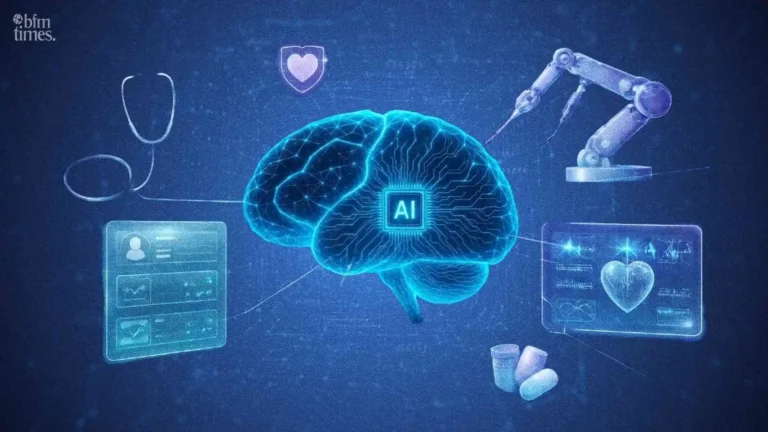
AI Applications in Healthcare are emerging as one of the most revolutionary technologies in all industries across the world, and the healthcare sector is not an exception. The quick growth of AI applications in healthcare is altering the process of disease diagnosis, treatment design, and hospital functioning. What started as models of experimental machine learning is becoming scaled-up versions of clinical systems used in hospitals or research laboratories the world over.
- Artificial Intelligence-based Diagnostics and Medical Imaging.
- Accuracy in medicine and genomics.
- Artificial Intelligence-Aided Drug Discovery and Development.
- Quickening Pharmaceutical R&D.
- Robotic-Assisted Surgery and Intraoperative AI.
- Better Surgical Application.
- Wearable Health Technology and Remote Patient Monitoring.
- Artificial Intelligence in Ongoing Health Checking.
- Documentation of Ambient Clinical Units.
- Artificial Intelligence in Hospital Finance.
- Ethical, Regulatory, and Security Challenges.
- The Challenge of Algorithmic Bias.
- The Future of Human-AI Cooperation in Medicine.
Healthcare AI is one of the industries that are viewed as being similar by technology followers and crypto-native investors who monitor the new trends in innovation closely; it is a foundational technology that transforms industries. The global study of digital health reveals that AI healthcare is likely to have a value of more than 300 billion dollars in the coming decade due to the development of data processing, predictive analytics, and machine learning-operated healthcare systems.
The next significant change that occurs nowadays is the automation of simple tasks to agentic AI systems. First AI applications had small tasks, like identifying abnormalities in medical imagery. The modern systems are becoming smart assistants that have the capability of aiding doctors in various aspects, such as diagnostics, planning of treatment, and operations in the hospital.
With the growing demands of patients and limited numbers of clinicians, AI healthcare solutions are becoming the necessary resources to increase efficiency and outcomes.
Related: The OpenClaw AI Agent Scandal
Artificial Intelligence-based Diagnostics and Medical Imaging.
Diagnostic imaging is one of the most popular AI applications in healthcare that has been followed by many. Medical imaging generates huge data volumes, which cannot be analyzed in a short period by human clinicians. Artificial intelligence is able to analyze such images in a few seconds and identify patterns that might be overlooked in the process of manual reviews.
Current machine learning healthcare systems break down several types of medical imaging:
- MRI scans
- CT scans
- X-rays
- Pathology slides
- Ultrasound imaging
Such AI systems are trained on millions of medical images and, hence, are well equipped to detect signs of the disease in an exceptional manner. Source.
Next Generation Radiology Systems.
One of the earliest adopters of AI applications in healthcare was the radiology departments. The radiologists are being helped by the AI models, which automatically point out any potential abnormality, like a tumor, a fracture, or internal bleeding.
Researchers indicate that the high accuracy of some medical image-based AI diagnostic systems (more than 90 percent) can assist clinics in diagnosing the disease earlier and achieving better treatment outcomes.
AI is not a replacement system for radiologists but a decision-support tool so that doctors can look at the results more quickly and minimize diagnostic mistakes.
Live Polyps Detection in Colonoscopy.
AI-assisted colonoscopy is one of the practical examples of how AI applications in healthcare are used. Computer vision-based systems like GI Genius are able to identify polyps in the colonoscopy process in real time.
These systems have been proposed to find the missed polyps up to 50 percent, which would help increase the accuracy of the colorectal cancer screening.
The latest generation of AI hospital technology is broadening the range of diagnostic functions to new fields such as
The latest generation of AI hospital technology is expanding its diagnostic capabilities to include skin lesion detection in dermatology and audio-visual heart imaging.
- Screening for diabetic retinopathy.
- Audio-visual heart imaging.
Continuous-learning diagnostic AI could also be approved by the authorities in the future, which means that the systems will expand alongside the new clinical informationbeing added. Source.
Accuracy in medicine and genomics.
The healthcare sector is moving towards generalized treatment to precision medicine, where treatment options are developed based on the genetic profile and medical history of the individual. Artificial intelligence has a significant role to play in this change.
Analyzing large volumes of data, genomic sequences, laboratory data, and lifestyle data, AI systems can find patterns to assist doctors in developing individual treatment plans.
This is one of the most promising AI applications in healthcare, particularly in the case of complex diseases like cancer.
Virtual Patients and Digital Twins.
Another recent technological development that is rapidly taking shape in the field of precision medicine is the idea of digital twins.
A digital twin is a simulation of a patient that is generated using medical imaging, physiological information, and AI simulations. These models enable doctors to establish the way the body of a patient might respond to certain treatments.
Indicatively, surgeons can practice heart surgery on a digital twin before conducting the actual operation. This will enable clinicians to assess the possible risks and streamline surgical plans.
The digital twin technology might one day facilitate treatment planning that is fully simulated, which will eliminate the uncertainty in risky processes.
Suggested: Role of Oracles in DeFi Ecosystem
Artificial Intelligence in Cancer and Individualized Medicine.
Another field where AI applications in healthcare are advancing is cancer treatment.
A machine learning system is able to examine the genetic makeup of tumors and determine the most probable drugs to be effective on this specific patient. Doctors will not have to rely on trial-and-error treatment options, but they can choose the therapies as per their predictions.
These AI systems analyze:
- Genetic mutations in tumors
- Patient’s medical history
- Clinical trial databases
- Global oncology research
With a combination of these datasets, AI applications in healthcare will be able to produce personalized treatment recommendations, which will lead to a higher survival rate and fewer unnecessary treatments. Source.
Artificial Intelligence-Aided Drug Discovery and Development.
The AI medical applications are also revolutionizing the pharmaceutical industry in a great way. The process of coming up with a new drug is considered to take over ten years of research and billions of dollars.
This is being expedited by artificial intelligence that assists scientists in the analysis of molecular structures and the prediction of drug behavior.
Machine learning healthcare systems can be used to support researchers by
- Target identification of drugs.
- The molecular interactions can be predicted.
- Optimizing compound design
- Modeling of early clinical trials.
Such capabilities save much time in bringing in new medications to the market.
Quickening Pharmaceutical R&D.
Already, AI has proved itself as valuable in pharmaceutical research. Machine learning models were also used during a global health crisis to analyze viral proteins quickly and discover possible routes of treatment.
Rather than having to test thousands of compounds by hand, AI systems can identify the most promising drug candidates within a fraction of the time.
The other novel innovation is the AI-assisted drug formulation. Some AI systems may forecast the interaction of drugs with inactive substances employed in the pharmaceutical production.
These predictive systems can assist pharmaceutical companies in saving money when a formulation failure occurs during production.
In the future, AI can be used to create personalized medicine production, whereby drug dosages are specific to the genetic information and medical history of each patient.
Robotic-Assisted Surgery and Intraoperative AI.
Robotic-assisted surgery is another field of AI applications in healthcare that is growing at a fast pace. Artificial intelligence has played a significant role in enhancing the performance of surgical robots, which have been in existence for years.
The current AI hospital technology helps surgeons by providing real-time analysis of surgical surroundings. These systems are a combination of machine learning, computer vision, and robotics that give precise instructions in complex medical procedures. Source.
The way AI -assisted Surgical Systems operate.
Surgical AI systems are live data analysis systems that help surgeons by:
- Anatomical real-time recognition.
- Stabilization of movement and accuracy.
- Alerts on the risk of sensitive tissues.
- Anticipatory directions on surgical routes.
The tools are used to enable surgeons to be more accurate, especially when performing minimally invasive procedures.
Instead of substituting surgeons, artificial intelligence is a smart co-pilot, providing analytical input to the operations.
Better Surgical Application.
It has been demonstrated that robots used in surgery with AI applications in healthcare can dramatically enhance those results. Research on the comparison of conventional surgeries and AI-assisted surgeries shows:
- 25% reduction in operative time
- A reduction in intraoperative complications by 30 percent.
- Shorter time to recover patients.
These not only help the patients but also decrease the hospital costs and the operating room workloads.
In several years, the field of intraoperative AI can further develop into systems that can assist in surgery somewhat autonomously, meaning that robots will carry out standard procedure steps, whereas surgeons will concentrate on critical decisions.
This change is one of the most promising AI applications in healthcare in the field of modern medicine. Source.
Wearable Health Technology and Remote Patient Monitoring.
Healthcare is gradually moving out of hospitals into life. Remote patient monitoring using connected medical devices with the power of artificial intelligence is one of the rapidly expanding applications of AI in healthcare.
This ecosystem is referred to as the Internet of Medical Things (IoMT): a wearable health sensor network and network of connected medical devices.
- LoMT devices are the following:
- Heart rhythm smartwatches.
- Glucose monitoring sensors
- Linked blood pressure gauges.
- Oxygen saturation trackers
These devices produce continuous health data, which is processed in the machine learning healthcare systems.
Artificial Intelligence in Ongoing Health Checking.
Wearable devices are used to monitor vital signs, and the AI applications in healthcare algorithms analyze them in real time to identify the first indicators of medical conditions.
As an illustration, AI-driven surveillance tools can detect trends that signal the following:
- Irregular heart rhythms
- Respiratory distress
- Sleep disorders
- Early signs of infection
This will enable the healthcare providers to intervene when the conditions are not severe.
Early detection is especially useful in high-risk patients, who have such chronic illnesses as heart failure, diabetes, or respiratory disorders.
Anticipatory Medicine and Preventive Treatment.
Predictive healthcare is one of the most promising AI applications in healthcare and wearable technology.
Rather than addressing sickness when the symptoms have been detected, AI systems access patient data to foresee any possible threats to health even before they arise.
To take one example, machine learning models are able to notice minute fluctuations in vital signs that could signal the possibility of early sepsis or cardiovascular issues.
Predictive healthcare can possibly transform medicine to be of a preventative nature; the diseases are treated before the individual is hospitalized.
In the eyes of technology investors and innovation-oriented readers, this change is representative of a trend in blockchain analytics and predictive financial systems when the size of datasets allows making smarter predictions and decisions. Source.
Hospital Efficiency and Administrative Automation.
Clinical complexity is not the only healthcare system challenge that is faced by administrative burdens. Doctors usually waste a major part of their time on documentation, billing, and typing in data.
This is where AI hospital technology is enhancing efficiency in operations.
Documentation of Ambient Clinical Units.
The use of AI-powered clinical documentation assistants, otherwise known as ambient AI scribes, is one of the fastest-growing AI medical applications in hospitals.
These are systems that can listen to the doctor-patient talk and generate medical notes automatically through the use of natural language processing.
The advantages of an AI documentation system are the following:
- Less administrative workload.
- Rapid electronic health record modifications.
- Improved clinical accuracy
- More to interact with the patients.
These tools have been found to save clinicians up to 2 hours per day in documentation, thereby helping to address physician burnout.
Artificial Intelligence in Hospital Finance.
Revenue cycle management (RCM) is another significant application of machine learning healthcare systems.
With the help of AI applications in healthcare, hospitals will be able to streamline their finances by automating:
- Medical billing and coding
- Checking of insurance claims.
- Fraud detection
- Reimbursement analysis
The systems minimize administrative mistakes and enhance financial transparency within healthcare organizations.
With the ongoing computerization of hospitals, AI-based administration systems can be as vital as electronic health records are.
Ethical, Regulatory, and Security Challenges.
Although AI applications have a positive impact on healthcare, the fast introduction of artificial intelligence raises significant ethical and regulatory issues.
Healthcare data is highly sensitive, and AI systems should be well-designed not to compromise patient privacy and give unfair results.
AI Regulation in Healthcare
Political entities and global bodies are initiating laws that regulate medical artificial intelligence systems.
The EU AI Act is one of the most striking regulatory frameworks that categorizes most healthcare AI tools as high-risk technologies.
Within these regulations, the AI healthcare systems should satisfy rigorous requirements such as
- Openness of the algorithm decision-making.
- Intensive clinical validation.
- Safety monitoring in the process.
- Before deployment, regulatory approval.
These guidelines have been set to make AI systems safe, reliable, and accountable.
The Challenge of Algorithmic Bias.
The other issue is the problem of algorithmic bias.
Artificial intelligence (AI) models can give inaccurate results about some groups of people based on incomplete or biased datasets.
To resolve this problem, healthcare regulators and developers are putting in place measures that include the following:
- Bias detection audits
- Diverse training datasets
- Explainable AI frameworks
To ensure the continued trust of people in digital healthcare systems, it is crucial to create ethical AI systems. Source.
Also Read: HeyGen AI Review: Is It the Best AI Video Generator in 2026?
The Future of Human-AI Cooperation in Medicine.
The accelerated use of AI applications in healthcare is an indicator of the fundamental change in the way medicine is administered.
AI is not going to supersede medical workers. Rather, it will become an effective decision support companion that enables clinicians to process complex data and make more informed decisions.
The future of AI healthcare systems is projected to be characterized by several trends:
- The predictive diagnostics using AI has become a regular practice.
- Genomic-based personalized treatment strategies.
- Robotic-assisted surgery is becoming the norm.
- Constant health surveillance with the help of wearable devices.
To technology adherents and the innovation-sensitive communities, AI applications in healthcare are one of the most important technological frontiers of the coming decade.
With hospitals, researchers, and tech companies creating more advanced AI applications in healthcare, the human-technology alliance approach will probably be the future of medicine in the upcoming generation.
Disclaimer: BFM Times acts as a source of information for knowledge purposes and does not claim to be a financial advisor. Kindly consult your financial advisor before investing.
Why are AI applications important for the future of healthcare?
AI improves diagnosis accuracy, speeds up drug discovery, and enables personalized treatment plans.
How does AI help doctors and medical professionals?
AI analyzes large medical datasets to assist doctors in making faster and more accurate clinical decisions.
What role will AI play in future medical treatments?
AI will power predictive healthcare, early disease detection, and highly personalized medicine.