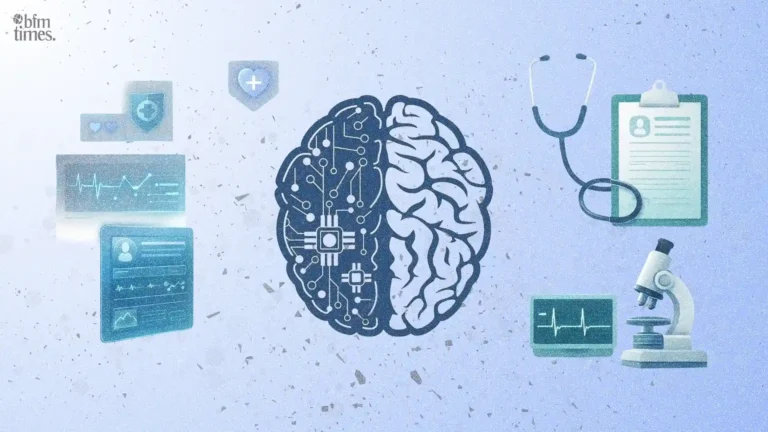
The discussion between AI vs traditional healthcare has gone way beyond the scholarly debate. AI is now being incorporated into hospitals, health systems, and research institutes across the globe in medical processes, diagnostics, and patient care systems.
- Status Report: 2026 AI is Moving Beyond Experiment to Core Healthcare Infrastructure.
- The Diagnostic Duel: AI Recognition vs. Human Clinical Diagnosis.
- AI-First Differential Diagnosis Systems: On the Rise.
- Operational Change: Old Systems vs AI-based Healthcare Processes.
- The Administrative Black Hole in Healthcare is Automated.
- The Financial Check: Reality AI vs Traditional Healthcare ROI.
- Transforming Healthcare Globally: AI-Expanding Access.
- AI vs Traditional Healthcare System: Trust, Governance, and Regulation.
- In conclusion: The Future of AI vs Traditional Healthcare.
Modern medicine has been driven by traditional healthcare technologies, including imaging, laboratory diagnostics, and electronic health records. Nevertheless, the emergence of AI versus traditional healthcare machinery is ushering in a new age in which healthcare technology can process large amounts of data, identify trends faster than humans, and automate clinical decision support.
The comparison of artificial intelligence in healthcare is not just about the replacement of tools. Rather, it has emphasized the roles of AI to enhance the existing systems to form a smarter, improved healthcare infrastructure. The coming decade will potentially transform the way medicine is practiced, delivered, and scaled as AI healthcare innovation gains momentum in the world.
Related: Why AI Applications in Healthcare Will Define the Future of Medicine
Status Report: 2026 AI is Moving Beyond Experiment to Core Healthcare Infrastructure.
Artificial intelligence in healthcare was viewed as an experimental technology in previous years. AI vs traditional healthcare models were experimented with in research laboratories, clinical trials, and pilot programs in hospitals.
By 2026, the latter stage will have mostly died.
Medical AI systems are increasingly being employed by healthcare providers to aid in real-world clinical activities.
Some of the changes elucidating this change include the following:
- The quick increase in machine learning algorithms.
- Access to big healthcare data.
- Rising pressure on the cost of healthcare.
- In most of the countries, there is a shortage of physicians.
- Increased demand oforthe patient to be diagnosed and treated faster.
The AI healthcare market, according to industry forecasts of Grand View Research, will expand at a fast rate over the next 10 years as hospitals find more effective data analysis and automation solutions.
Compared to conventional healthcare technology, which is primarily used to store and present data, AI systems can analyze medical data in real time and provide actionable insights.
This feature transforms uncooked medical data into clinical intelligence. Source.
The Diagnostic Duel: AI Recognition vs. Human Clinical Diagnosis.
The most noticeable point of the AI vs traditional healthcare controversy is the diagnostics.
Decades of medical diagnosis have been based on:
- Physician expertise
- Technologies in medical imaging.
- Laboratory testing
- Patient history analysis
The conventional healthcare technology generates diagnostic data, which is subject to interpretation by highly trained professionals.
AI proposes a completely new practice.
Diagnostic Performance of Machine Learning.
The latest machine learning healthcare applications are trained on millions of healthcare images and patient data. Such systems have the capacity to detect trends related to an illness sooner than traditional means.
A systematic review of the JMIR Medical Informatics article compared AI diagnostic tools to clinicians in various specialties.
The study discovered that AI vs traditional healthcare systems have achieved expert-level accuracy in a number of fields in medicine.
Radiology
The diagnostic accuracy of the AI systems using medical imaging data was found to be 98.88% in the case of multi-class disease classification.
The results are still validated by radiologists, but AI significantly shortens the time of image interpretation.
Ophthalmology
AI screening systems for diabetic retinopathy obtained:
- 87% sensitivity
- 90% specificity
Such accuracy enables the AI tools to conduct efficient eye disease screening in large clinical practices.
Oncology
AI-based radiotherapy planning systems have the potential to shorten the treatment planning time by up to 90% and accelerate the process of cancer treatment considerably.
Such findings underscore the increased power of AI healthcare innovation in diagnostics.
Nevertheless, AI vs traditional healthcare also depends on the supervision of the physicians. Doctors offer contextual knowledge, clinical expertise, and ethical control that machines cannot offer.
So, in the future, diagnostics will probably be a collaboration between humans and AI instead of replacing them. Source.
AI-First Differential Diagnosis Systems: On the Rise.
Traditional medicine has doctors create a differential diagnosis, or a list of possible diseases that might be the cause of the symptoms of a patient.
It is a process that relies on training, experience, and clinical intuition.
The AI vs traditional healthcare systems bring about a new model: AI-assisted differential diagnosis.
These platforms can examine numerous sources of data at once, such as
- Patient’s medical history
- Imaging results
- Genetic information
- Wearable device data
- Population health datasets
In a few seconds, AI models produce a list of potential conditions ranked by their likelihood of occurrence.
This feature can assist physicians in thinking about some rare diseases or complicated conditions that might be ignored.
Artificial intelligence triage systems are already being employed in emergency rooms to detect high-risk patients earlier.
These systems are utilized to examine the vital signs, symptoms, and stream of patient data to indicate the possibility of serious cases.
Instead of substituting clinicians, AI is a layer of clinical intelligence over conventional healthcare technology. Source.
Suggested: Global AI Show Announces Milestone Edition: AI:2031 – Accelerating Intelligent Futures
Operational Change: Old Systems vs AI-based Healthcare Processes.
In addition to diagnostics, the largest disparity between conventional healthcare technology and AI vs traditional healthcare medical systems is the efficiency of the workflow.
Electronic Health Records (EHRs) are important to healthcare organizations today to ensure that patient information is managed.
But there has been a significant issue with these systems, and that is documentation overload.
Research indicates that physicians take up almost 40 percent of their labor hours to carry out administrative documentation.
This is commonly referred to as click fatigue.
Physicians often take more time typing than communicating with the patients.
Ambient AI Clinical Systems
The ambient clinical intelligence is meant to address this issue by using new machine learning healthcare tools.
These systems are voice-activated natural language processing computers that automatically transcribe clinical dialogues.
The AI vs traditional healthcare system can respond to the patient in the consultation with:
- Write up medical conversations.
- Create standardized medical records.
- Suggest diagnostic codes
- Electronic health records update.
According to healthcare automation companies, ambient AI systems have the ability to decrease clinical documentation by over 50 percent.
This change enables doctors to spend more time attending to the patient instead of doing administrative work.
With the ongoing development of AI vs traditional healthcare innovation, workflow automation can be one of the most useful AI advantages in medicine. Source.
The Administrative Black Hole in Healthcare is Automated.
Administrative complexity can be considered a significant weakness of the traditional healthcare technology. The workloads faced by hospitals across the world comprise huge operations such as billing, insurance checks, medical coding, scheduling, and documentation of compliance.
The legacy software with manual supervision is usually used to handle such processes. The administrative burden has been on the rise as healthcare systems become larger.
This is the place where an AI medical system that is agentic artificial intelligence is starting to change the hospital processes.
The agentic AI is defined as autonomous AI systems that can execute tasks and make working decisions that do not involve human supervision at all.
These systems in the medical setting can:
- Auto-create medical billing codes.
- Check the patient’s insurance status.
- Identify insurance claim anomalies.
- Determine probable fraud in billing systems.
Maximize the scheduling of appointments and the capacity of a hospital.
Based on findings of SS&C Blue Prism, smart automation systems are assisting hospitals in lowering their operational expenses as well as enhancing accuracy in their administrative tasks.
In contrast to the conventional systems, where each step needs human involvement, AI-based automation can handle redundant tasks at all times.
Such a change is a major distinction between the AI vs traditional healthcare comparison. The primary purpose of traditional systems is to store and arrange data, whereas AI systems analyze data and carry out working functions.
In the long run, this change would help minimize one of the largest inefficiencies in healthcare, administrative overhead. Source.
The Financial Check: Reality AI vs Traditional Healthcare ROI.
Cost is one of the most widely discussed issues of AI vs traditional healthcare innovation. The application of AI infrastructure is a costly operation.
The healthcare organizations will need resources on:
- AI software platforms
- Computing infrastructure
- Healthcare data consolidation.
- Human resource development and system improvement.
These charges are usually perceived to be expensive compared to conventional healthcare technology.
Nevertheless, economic literature indicates that the use of AI has the possibility of generating quick profits.
Grand View Research reported that healthcare institutions using AI tools generally recover the costs of the tools in 14 months.
According to many organizations, the value returned on the AI systems is about 3.20 for every dollar invested.
These returns are attributed to various efficiency advances.
Administrative automation
AI minimizes the use of manual processing in billing, coding, and documentation.
Diagnostic accuracy
Early detection of the disease saves the treatment cost duringthe late stages.
Fraud detection
The AI algorithms have the ability to detect suspicious claims and billing patterns more quickly than traditional auditing systems.
Resource optimization
Predictive AI models can be used in hospitals to control staffing, bed availability, and supply chains.
Other forecasts state that AI-based automation may save the healthcare system of the United States up to 150 billion dollars annually in the near future.
Such monetary incentives are driving the world to adopt machine learning in healthcare. Source.
Transforming Healthcare Globally: AI-Expanding Access.
The possibility to increase the availability of medical services on a global scale is also among the most important opportunities of AI healthcare innovation.
Conventional healthcare infrastructures are very much dependent on physical facilities like hospitals, laboratories, and specialized doctors. Such infrastructure is restricted in most developing areas.
New solutions are offered by AI technologies.
Telemedicine platforms and AI diagnostic tools are more effective in reaching remote populations by combining them with an effective approach to healthcare provision.
Examples include:
- Medical Imaging: Smartphone-based medical imaging.
- AI-powered triage chatbots
- Prospective healthcare monitoring systems.
- Machine learning remote patient diagnostics.
These applications will enable medical workers to screen patients remotely and distinguish those who need immediate treatment.
AI systems are much more scalable compared to traditional healthcare technology.
After creating AI diagnostic models, they can be implemented across all countries on the basis of digital processes and contribute to the absence of medical specialists worldwide.
Also Read: Generative AI vs Traditional AI: What’s the Difference?
AI vs Traditional Healthcare System: Trust, Governance, and Regulation.
Although the pace of AI adoption is high, there are regulatory issues associated with it.
Medical device rules and software safety are traditional medical healthcare technologies.
Along with other issues, AI systems also bring about:
- Algorithmic bias
- Absence of decision-making transparency.
- Patient data privacy
- Responsibility in AI-assisted decision-making.
The new regulatory frameworks are being formulated by governments all over the world.
One of the most ambitious attempts is the European Union AI Act, which proposes stringent demands on high-risk AI use, such as in healthcare.
These rules require:
- Algorithm transparency
- Continuous performance evaluation.
- Bias detection
- Clinical decision-making under human oversight.
According to the research published by the Harvard Gazette, ethical governance and constant monitoring are the only ways to be sure that AI deployment is responsible. Source.
In conclusion: The Future of AI vs Traditional Healthcare.
The argument against AI vs traditional healthcare does not concern the substitution of the current medical systems.
The conventional healthcare technology is necessary in imaging, diagnosis, patient records, and the delivery of treatment.
Artificial intelligence is an alternative to introducing a strong analytical layer.
The integration of AI medical systems and traditional healthcare technology will help medical institutions to achieve greater levels of diagnostics, automate workflows, and increase access to care.
Over the next ten years, healthcare systems are expected to become a hybrid system in which traditional technologies produce medical data and AI processes clinical decisions.
Such a change would enhance efficiency, accuracy, and access to global healthcare.
Viewing the development of AI vs traditional healthcare as such, it can be said that it is one of the most notable technological transformations that will define the future of the medical profession.
Disclaimer: BFM Times acts as a source of information for knowledge purposes and does not claim to be a financial advisor. Kindly consult your financial advisor before investing.
How is AI different from traditional healthcare methods?
AI uses advanced data analysis and automation, while traditional healthcare relies mainly on manual diagnosis and experience.
How is AI changing medical technology and patient care?
AI improves diagnostic accuracy, speeds up treatment decisions, and enables personalized healthcare solutions.
Will AI replace doctors in the healthcare industry?
No, AI is designed to assist doctors by enhancing decision-making and efficiency, not replacing them.