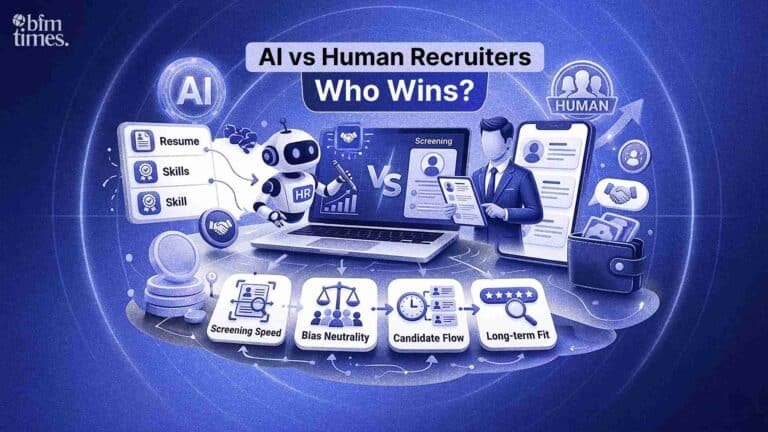
The hiring world is changing faster than ever before. Every company wants the best talent. The big question today is simple. The debate of AI vs human recruiters is reshaping how businesses find & hire people. It is no longer a future topic. It is happening right now in offices around the world.
- AI vs Human Recruiters: What Is the Big Shift All About?
- What Does AI Recruitment Do Better Than Humans?
- Speed & Efficiency: AI Takes the Lead
- Consistency & Accuracy in Screening
- Cost Savings That Are Hard to Ignore
- What Do Human Recruiters Still Do Better Than AI?
- Emotional Intelligence & Human Connection
- Building Trust With Candidates
- Judging Soft Skills & Unique Talent
- Is Bias a Real Problem in AI Recruitment?
- What Does the Future of Recruiters Look Like?
- How Should Companies Use AI in Recruitment Today?
- What Do the Numbers Say About AI Recruitment vs Human?
- Conclusion
- Frequently Asked Questions
In this article, readers will gain insights into the AI vs Human Recruiters: Who Wins in Hiring? featured on BFM Times.
AI vs Human Recruiters: What Is the Big Shift All About?
The way companies hire has changed completely. Around 87% of companies now use AI in their recruitment process. That number alone tells us a lot. The AI adoption in recruiting nearly doubled year over year, rising from 26% to 43%. This growth is not slowing down at all.
The shift is driven by one core problem. Google received over 3 million applications in a single year & McKinsey got more than 1 million. The volume is simply too large for human recruiters to handle alone. This is where the AI hiring comparison becomes very important for every business leader & HR team.
What Does AI Recruitment Do Better Than Humans?
Speed & Efficiency: AI Takes the Lead
Speed is the biggest strength of AI in recruitment. The AI in recruitment advantage can reduce hiring costs by 30% per hire. It works fast without stopping. These tools reduce time to hire by an average of 50%. It does not take breaks. It does not sleep. It can screen thousands of resumes in minutes.
The AI assessment tools process evaluations 15 times faster than human reviewers while maintaining 94% consistency in scoring. This level of speed is simply impossible for any human recruiter to match. The AI in recruitment advantage in speed is clear & undeniable.
Consistency & Accuracy in Screening
Human recruiters make mistakes. They get tired & lose focus. AI stays consistent every single time. The predictive hiring models reduce bad hires by 75% & improve employee retention by 34%.
These findings show that 74% of hiring managers say AI can assist in assessing the compatibility of an applicant’s skills with the position they applied to. This makes the screening process much sharper. The AI recruitment vs human difference in accuracy is becoming a key factor for businesses everywhere.
Cost Savings That Are Hard to Ignore
The teams using AI report 20 to 40% lower cost per hire & up to 40% faster shortlisting. These are real savings that matter for most of the organization. It is also noted that using AI recruitment not only cuts costs but it can also increase the revenue per employee by an average of 4%. The financial case for AI in hiring is very strong.
What Do Human Recruiters Still Do Better Than AI?
Emotional Intelligence & Human Connection
AI is fast. It is accurate. It processes the data well. It does not feel any emotions, though. Human recruiters understand these feelings. They read body language. They sense the cultural fit in a way no machine can match. This is a major area where human vs AI hiring shows a clear gap.
Candidates want to feel heard & be respected. They want to speak with a real person. The research shows that over half of candidates say AI first round interviews feel downright insulting & inhumane. This reaction tells us that human touch still matters deeply in the hiring process.
Building Trust With Candidates
Trust is a serious problem with any of the AI hiring today. The data shows that only 8% of job seekers believe AI algorithms that screen initial applications make hiring much fairer. That is a very low number. These findings also show that almost half of all job seekers say their trust in hiring has decreased over the past year, & 42% blame it directly on AI.
It is also noted that only 26% of applicants trust AI to evaluate them fairly. Human recruiters build real relationships. They inspire confidence. They explain the decisions better. This is one area where human recruiters win clearly in the AI hiring comparison.
Judging Soft Skills & Unique Talent
The concern is real, as 35% of recruiters fear AI may overlook their unique talent. Soft skills like creativity & adaptability are hard to measure. AI struggles here. Human recruiters spot any of the hidden potential. They pick up on passion & the drive in ways AI cannot replicate today.
How Do AI vs Human Recruiters Compare Side by Side?
The table below shows a clear comparison between the two in key areas of recruitment.
| Factor | AI Recruiters | Human Recruiters |
| Resume Screening Speed | Very Fast | Slow at High Volume |
| Cost Efficiency | 30% Lower Cost Per Hire | Higher Operational Cost |
| Bias Risk | Algorithmic Bias Possible | Human Bias Possible |
| Emotional Intelligence | Very Low | Very High |
| Availability | 24/7 | Limited to Work Hours |
| Soft Skill Assessment | Weak | Strong |
| Candidate Trust | Low (Only 26%) | Higher |
| Consistency in Scoring | 94% Consistent | Variable |
| Candidate Experience | Feels Impersonal | More Personal |
| Cultural Fit Detection | Limited | Strong |
This table makes the AI vs human recruiters debate very clear. Each side has its own real strengths & real weaknesses.
Is Bias a Real Problem in AI Recruitment?
Bias is a serious concern in AI hiring. The research shows 67% of companies acknowledge AI hiring tools could introduce bias & age bias is the most commonly identified type, which is followed by socioeconomic & also the gender bias.
It is also found that only 29% of companies maintain full human oversight on all AI rejection decisions. This is a big risk. AI learns from any of the past data. It can repeat old patterns of discrimination without anyone noticing it in time. The future of recruiters must include strong human oversight to prevent this problem.
The candidates broadly accept AI screening as long as a human makes the final call, & 79% want transparency on how AI is used in the hiring process. This shows that people are open to AI, but they want fairness & the clarity in return.
What Does the Future of Recruiters Look Like?
The real question is not who wins. The real answer is that both work better together. The big takeaway is that AI enhances the hiring process by streamlining tasks & by providing valuable insights & it is the expertise of the human recruiters that ensures that the technology is used most effectively.
It is also found that 93% of recruiters plan to increase the AI usage in 2026. The future of recruiters is not replacement. It is a partnership. AI handles the heavy repetitive tasks. At the same time, Human recruiters focus on building relationships & making the final call.
The AI now sources, screens, schedules, & they predicts fit at scale, which frees recruiters to coach, calibrate & close the deals. This is a powerful combination. It makes the entire hiring process faster, fairer & even more effective when it’s done right.
How Should Companies Use AI in Recruitment Today?
There are smart ways to use AI in hiring. These tips help any of the businesses to get the best results from both sides.
- Start with AI for screening: It handles the large volumes quickly & filters out unqualified candidates early.
- Keep humans in final decisions: AI should support the choices, not make them alone.
- Audit AI tools regularly: Check for any of the bias in screening results every few months.
- Be transparent with candidates: Tell applicants when AI is used in the process.
- Use AI for scheduling & communication: It saves time & it also improves response rates for candidates.
- Train recruiters to work with AI: They need to understand the tools they use every day.
The candidates who underwent AI-led interviews succeeded in any of the subsequent human interviews at a significantly higher rate of 53%. This shows that AI used well can improve the overall quality of hires for any company.
What Do the Numbers Say About AI Recruitment vs Human?
The data paints a very interesting picture. It is projected that by 2030, 94% of recruitment processes will incorporate AI in their Hiring Process. The growth is unstoppable. The global AI recruitment market is projected to reach $1.12 billion by 2030.
The AI hiring tools improve any of the workforce diversity by 35%. It also brings new risks. The key is balance. The AI recruitment vs human debate should not be about choosing one over the other. It should be about using each for what they do best.
Conclusion
The verdict in the AI vs human recruiters debate is not a simple win for either side. They are both powerful in their own ways. AI brings speed, consistency, & the cost savings to the table. Human recruiters bring empathy, trust & their judgment that AI simply cannot replace today. The companies that will succeed in hiring are those that combine both smartly.
The future of recruiters is one where AI handles the data & the humans handle the decisions. Together they create a hiring process that is faster, fairer, & be more effective. The AI vs human recruiters conversation is no longer about replacement. It is about the right partnership for better hiring outcomes. Smart companies are already making that shift today. The rest will follow soon.
Frequently Asked Questions
Can AI Fully Replace Human Recruiters?
The AI vs human recruiters debate is clear. AI handles speed & screening well. It cannot replace human empathy & judgment. They both work best together.
What Are the Biggest Benefits of AI in Recruitment?
The AI in recruitment reduces hiring costs by 30% & cuts time to hire by 50%. It also screens thousands of resumes in minutes consistently.
Do Candidates Trust AI in Hiring?
The trust is very low. Only 26% of applicants trust AI to evaluate them fairly. Companies must always keep humans in the final hiring decision.
Disclaimer: BFM Times acts as a source of information for knowledge purposes and does not claim to be a financial advisor. Kindly consult your financial advisor before investing.