

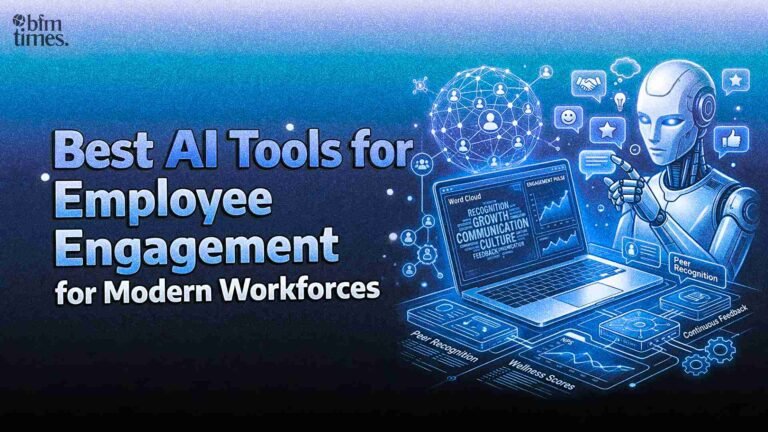
The way companies engage with their employees has completely changed. It is no longer about sending the annual surveys. It is about listening to them in real time. It is about taking action before the problems grow bigger and harder to solve. This is exactly where AI tools for employee engagement step in.
- What Are AI Tools for Employee Engagement?
- What Are the Key Benefits of Using AI for Employee Engagement?
- What Are the Best AI Tools for Employee Engagement in 2026?
- How to Choose the Right AI Tool for Employee Engagement?
- What Are the AI & Employee Engagement Trends Shaping 2026?
- Conclusion
- Frequently Asked Questions (FAQs)
In 2026, businesses face a tough challenge. Keeping all the employees motivated, connected & satisfied is not easy. Remote work, hybrid teams & the distributed workforces make it harder. The good news is that smart AI platforms now solve this problem pretty effectively. They analyze feedback, detect early warning signs & help the managers act faster.
In this article, readers will gain insights into the Best AI Tools for Employee Engagement in 2026 featured on BFM Times.
What Are AI Tools for Employee Engagement?
AI tools for employee engagement are software platforms that use machine learning, natural language processing, & also the predictive analytics. They help HR teams in measuring employee sentiment, collecting feedback, & also identifying disengagement risks. These tools move HR from a reactive approach to a proactive strategy. They replace their old static surveys with continuous listening systems. They turn raw data into much clearer insights. They help leaders understand what employees feel & why they feel it that way. This makes decisions faster & way more accurate.
What Are the Key Benefits of Using AI for Employee Engagement?
Before exploring these tools, it is important to understand what AI brings to the table for everyone who is using them. The benefits are real & they are measurable.
- Real-time feedback collection keeps HR teams always informed.
- Sentiment analysis reveals all of the hidden emotions in employee responses.
- Predictive analytics spots burnout & the disengagement early.
- Personalized learning paths keep employees growing in their roles.
- Automated recognition ensures no contribution goes unnoticed.
- 24/7 AI chatbots resolve employee queries without any delays.
Just like AI marketing tools, these platforms use data to drive smarter decisions & better outcomes
AI tools can analyze the survey responses, internal communication trends & also the employee feedback to identify recurring themes such as workload pressure, lack of recognition, or trust concerns. This helps HR leaders move beyond scores & helps them to understand where action is most needed.
What Are the Best AI Tools for Employee Engagement in 2026?
| Tool | Best For | Key AI Feature | Ideal Team Size |
| Culture Amp | Mid to Enterprise Teams | Open text AI analysis | Medium to Large |
| Microsoft Viva | Microsoft 365 Users | Work pattern insights | Enterprise |
| Qualtrics EmployeeXM | Advanced Analytics | AI theme detection | Large Enterprise |
| Workday Peakon | Continuous Listening | Driver-based insights | Global Enterprise |
| Lattice | Performance & Engagement | AI feedback synthesis | Growing Teams |
| Kvistly | Remote & Hybrid Teams | AI quiz generator | Small to Mid |
| ThriveSparrow | Diverse Workforces | Sentiment analysis | Medium Teams |
| Deel Engage | Global Teams | AI career path generation | Distributed Teams |
Culture Amp
Culture Amp remains one of the most well-known employee engagement platforms because it is strong across the full cycle of listening, understanding & taking action. In 2026, its AI capabilities will feel more mature. It is especially strong at making sense of open text responses & then turning large amounts of feedback into clear themes leaders can act on. The platform pairs insights with action planning & the manager coaching tools. This means the journey from insight to action happens inside the same workflow. It works best for all of the mid-size to enterprise teams that want surveys, action plans, & the manager coaching in one system.
Visit Website:www.cultureamp.com
Microsoft Viva
Microsoft Viva is a major player in 2026 because it meets the employees where they already work. It covers all of the multiple engagement angles through Pulse feedback, engagement surveys & the work pattern insights that support wellbeing & manager effectiveness. The AI story here is about turning workplace signals into real guidance. It helps leaders understand collaboration patterns, meeting overload & the focus time challenges. For Microsoft-centric companies, adoption is smoother because it sits in the existing workflows.
Visit Website:www.microsoft.com/en-us/microsoft-viva
Qualtrics EmployeeXM
Qualtrics EmployeeXM is built for organizations that want deep employee experience measurement & the advanced analytics. In 2026, Qualtrics leans even more into AI-driven analysis & it helps HR teams summarize themes, detect patterns & then surface areas that need attention faster. It works best when engagement is treated like a business process. It supports all of the complex structures, multiple employee groups & then it provides detailed reporting needs. This tool is a strong match for large enterprises with strong HR analytics teams.
Visit Website:www.qualtrics.com/employee-experience
Workday Peakon
Workday Peakon Employee Voice delivers AI-powered insights from employee feedback. By uniquely connecting this voice data with the already present core HCM, it creates a complete feedback loop that turns all of the insights into action. Workday Peakon is built for continuous listening at scale. It is a strong fit in 2026 for global organizations that need depth, rigor & the repeatable insight over time. Its driver-based approach helps all teams to understand which specific factors are influencing engagement & how those shift over time.
Visit Website:www.workday.com/peakon
Lattice
Lattice sits at the intersection of performance management & the employee engagement. Its AI layer makes the combination very useful. The platform collects 360-degree feedback, runs all of the engagement surveys, tracks OKRs & then it uses AI to bring all of that data into performance insights & with clear recommendations for managers & HR professionals. It is best suited for teams that want to connect engagement data directly to the performance outcomes.
Visit Website:www.lattice.com
Kvistly
Kvistly is an AI-powered engagement platform that turns these boring surveys & lso the training session into fun experiences people actually enjoy. The AI quiz generator is the star feature here. It analyzes all the responses in real time & then it provides insights into team sentiment, knowledge gaps & the engagement levels. It is perfect for onboarding with the new hires, running training sessions & also keeping remote & hybrid teams connected. It also offers a generous free plan, making it easy for all of the smaller teams to get started.
Visit Website:www.kvistly.com
ThriveSparrow
ThriveSparrow uses AI to turn engagement tracking into some meaningful actions that drive team success. With tools like Employee Net Promoter Score & the pulse surveys, the platform collects all of this real-time feedback & then applies AI insights to uncover sentiment patterns. Features include OKR tracking, automated employee rewards systems, & AI powered sentiment analysis. It also offers many of the multilingual surveys to support a diverse workforce.
Visit Website:www.thrivesparrow.com
Deel Engage
Deel Engage is an AI-driven employee engagement tool that helps you keep & then develop your people through performance management, feedback & growth opportunities. The AI helps you build career paths, then generate detailed training courses & even suggest development plans, all in minutes. It is ideal for many of the global teams that need engagement & with the performance management in one unified system.
Visit Website:www.deel.com/engage
How to Choose the Right AI Tool for Employee Engagement?
Choosing the right platform from the many of the AI tools for employee engagement available can feel like a big task. It helps to follow a clear process.
Start with your biggest pain point. If feedback collection is broken, focus on listening tools first. If recognition is the issue, look for the reward-driven platforms. It is better to solve one problem well than to buy a complex system you will never fully use or might not even understand.
The best AI tools for business always start by solving one clear problem first.
Consider your team size & structure. A small startup needs something simple & also affordable. A global enterprise needs something scalable & they are deeply connected with existing tools. Small businesses often do better with all-in-one platforms, while larger teams benefit from the specialized tools in each area.
Check integration capabilities. The best AI tools for employee engagement connect smoothly with all of the existing HRIS, payroll, & the communication systems. This saves time & also avoids any of the duplication of data.
Evaluate ease of use. A tool is only useful if employees & the managers actually use it. Look for clean interfaces & there are low survey fatigue options.
Think about the budget. There are good free plans available for many of the small teams. Platforms like Kvistly offer strong free-tier features. Larger organizations may need enterprise pricing with custom options.
What Are the AI & Employee Engagement Trends Shaping 2026?
The space of AI tools for employee engagement keeps growing. Several trends are now shaping how companies approach this area.
Predictive Retention Tools are becoming standard. Employee retention is one of the strongest use cases of AI in employee engagement. AI now identifies employees at flight risk weeks before they resign. This gives HR enough time to step in with meaningful support.
Personalized Learning & Development is rising fast. AI can suggest specific courses or certifications that align with an employee’s role or goals. Personalized learning not only boosts engagement but also improves retention as employees feel their professional growth is a priority.
AI Chatbots for Employee Support are now everywhere. AI-powered chatbots are available 24/7 to answer questions, assist with HR tasks & provide support. Employees can quickly resolve issues ranging from payroll queries to leave requests without waiting for human help.
Wellbeing & Mental Health Focus is growing stronger. AI tools now track stress indicators, meeting overload & declining intent to stay. This allows HR to support employees before burnout hits.
Reskilling for the AI Era is also a priority. Research shows 61% of CHROs expect 5% to 25% of roles to change because of AI within three years. This means employee engagement strategies must focus more on adaptability, confidence & reskilling.
What Are the Common Mistakes to Avoid When Using AI for Engagement?
Even the best AI tools for employee engagement can fail if they are used in the wrong way. Here are the most common mistakes that should be avoided.
Using AI only for monitoring. Employees lose trust when they feel they are being watched. AI should be used to listen & to support, not to track every move of the person.
Ignoring action planning. Collecting feedback without acting on it damages the morale of the people. Always pair insights with clear follow-up steps.
Overloading employees with surveys. Too many check-ins create survey fatigue. Use smart AI platforms that provide feedback in a balanced way.
Skipping change management. New tools need proper rollout. Train managers & also share the benefits clearly with all the employees.
Relying on AI alone. The organizations that succeed will not be those with the most AI tools. They will be the ones that help the employees feel prepared, included & supported through these changes.
Conclusion
AI tools for employee engagement are no longer optional. They are essential for any type of organization that wants to build a motivated & much productive workforce in 2026. The best platforms do more than just collect data. They help leaders listen better, act faster & also build stronger cultures. AI tools for employee engagement now cover everything from real-time feedback to predictive retention & with personalized learning. These platforms give HR teams the power to take action before the problems grow big.
The companies that win in 2026 will be the ones that use AI tools for employee engagement to make work more human, not less. They will build trust, invest in growth, & to create workplaces where people feel heard every single day. That is where the real advantage lies for everyone.
Frequently Asked Questions (FAQs)
What are the best AI tools for employee engagement in 2026?
The best AI tools for employee engagement in 2026 include Culture Amp, Microsoft Viva, Workday Peakon, Qualtrics EmployeeXM, Lattice, Kvistly, ThriveSparrow & Deel Engage. These platforms use machine learning, sentiment analysis, & also the predictive analytics to help HR teams collect real-time feedback. They also reduce turnover & help in building stronger workplace cultures.
How do AI tools improve employee engagement?
AI tools improve employee engagement by replacing the outdated annual surveys with continuous listening systems. They analyze the employee feedback & also detect early signs of burnout. They also suggest clear steps for the managers to take action. These tools personalize learning paths, automate recognition & provide 24/7 chatbot support so employees always feel heard & feel supported.
Which AI tool for employee engagement is best for small businesses?
Kvistly is one of the best AI tools for employee engagement for small businesses. It offers a generous free plan & it uses an AI quiz generator to create fun surveys & with the training sessions. It is simple to use & it requires no complex setup. It works well for remote & as well as hybrid teams looking to boost engagement without a big budget.
Disclaimer: BFM Times acts as a source of information for knowledge purposes and does not claim to be a financial advisor. Kindly consult your financial advisor before investing.