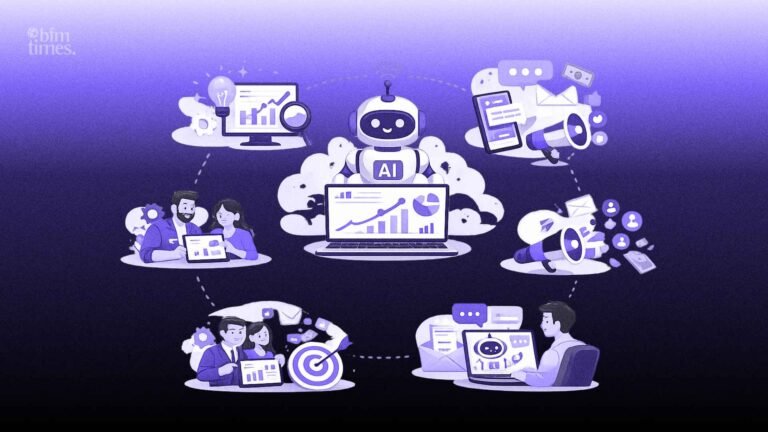
Not only is the use of AI Automation Tools for Marketing no longer optional, it is the very basis on which marketing and sales teams operate in 2026. Rather than manually running marketing campaigns, pursuing leads, and producing copious amounts of content, businesses are now in the process of building automated growth machines with the help of AI. From producing high-converting content to nurturing leads and closing them with precision, these tools are changing the entire marketing and sales funnel into a well-oiled machine. It is no longer about efficiency; it is about scaling, converting, and making informed decisions throughout the entire marketing and sales funnel
- Where AI Actually Fits in the Marketing & Sales Funnel
- What Separates Good AI Automation Tools for Marketing from Overhyped Ones
- Top AI Automation Tools Powering Marketing & Sales in 2026
- HubSpot AI: The All-in-One Growth Engine
- Salesforce Einstein: Enterprise-Level Predictive Intelligence
- ActiveCampaign: Automation That Actually Converts
- Marketo: High-Performance B2B Automation
- Apollo AI: Smarter Prospecting & Outreach
- Zoho CRM AI: Affordable Intelligence for Growing Businesses
- Drift / Intercom AI: Conversational Sales Automation
- Copy.ai: Content Automation for Growth Teams
- Jasper AI: Brand-Focused Content at Scale
- Zapier AI: The Automation Glue
- Best AI Automation Tools for Marketing & Sales
- How Modern Teams Combine Multiple AI Tools
- Automation Alone Doesn’t Drive Growth
- Choosing the Right AI Tool Based on Your Business Stage
- Common Mistakes Businesses Make with AI Automation
- The Future of AI Automation Tools for Marketing
- The Best AI Tool Is the One That Fits Your System
- Frequently Asked Questions
What used to take multiple teams, copywriters, SDRs, and CRM experts can now be distilled into smart workflows. AI can write emails, segment audiences, infer intent, and take actions in real-time. Salespeople won’t waste time on leads anymore. They’ll only act on those that have shown very high intent.
The change is obvious: we’ve gone from manual marketing and sales to automated pipelines. And the companies that are growing the fastest? They’re not necessarily hiring more people. They’re building more sophisticated levels of automation. AI is no longer a support function. It’s the engine behind the new growth systems.
Where AI Actually Fits in the Marketing & Sales Funnel
AI Automation Tools for Marketing is no longer just one piece of technology within your technology stack; it is pervasive throughout the entire funnel. It is creating content, optimizing ads, and finding high-intent audiences at the top. It is nurturing those leads with hyper-personalized email sequences and messages in the middle. It is assisting the sales organization with closing those deals with predictive analytics and CRM intelligence at the bottom.
What’s different is not only the technology itself but also the way it connects everything. Rather than siloed technology, businesses now have interconnected technology where data can flow freely between marketing and sales.
AI impact areas:
- Content automation (blogs, ads, landing pages)
- Lead scoring and qualification
- Email and outreach sequences
- CRM intelligence and forecasting
What Separates Good AI Automation Tools for Marketing from Overhyped Ones
Not all AI Automation Tools for Marketing are worth your time. The real distinction is not about the name; the real distinction is about execution. The best tools don’t just create results; they make decisions. They initiate actions, learn from information, and adapt over time. This is real automation. If the tool still requires extensive manual work, then it is not really helping you solve your problem.
Another way to distinguish the best tools from the rest is through integration. The best AI Automation Tools for Marketing seamlessly integrate with your existing infrastructure, such as your CRM, email, ads, and analytics. The overhyped tools work in silos, creating more complexity rather than reducing it.
Lastly, there is ROI. Some tools are flashy but do not really contribute to your bottom line. The tools that matter drive your top line by impacting revenue growth, reducing customer acquisition cost, or shortening sales cycles.
Top AI Automation Tools Powering Marketing & Sales in 2026
HubSpot AI: The All-in-One Growth Engine
HubSpot AI has become a full-fledged automation platform for marketers and salespeople. It no longer simply manages contacts but predicts their behaviors, automates interactions, and personalizes their experiences. Companies use it to power their entire marketing and sales funnel without ever having to leave their platform.
What sets HubSpot apart is how everything works together in perfect balance. Your email campaigns, CRM, and automation are housed in one place, making it perfect for those who want simplicity without sacrificing power.
Where it works best:
- Full-funnel automation for startups and scaling teams
- Strong integration and ease of use
- Limitation: Can get expensive as you scale
Salesforce Einstein: Enterprise-Level Predictive Intelligence
Salesforce Einstein is not really about automation; rather, it is more about intelligence. It uses massive data analysis to predict which leads will convert, when deals will close, and what actions salespeople should take next.
Large businesses use Salesforce Einstein to remove guesswork from decision-making processes. They do not simply react; rather, they act proactively.
Where it works best:
- Enterprise sales environments
- Deep predictive analytics
- Limitation: Requires setup and expertise
ActiveCampaign: Automation That Actually Converts
ActiveCampaign is where email marketing meets intelligent automation. It’s not just sending a sequence; it’s sending a message at the right time to the right people based on behavior.
Businesses use ActiveCampaign to create complex workflows to nurture leads, turn them into paying customers, and more, all on autopilot; no follow-ups are necessary.
Where it works best:
- Email-driven funnels
- Advanced automation workflows
- Limitation: Learning curve for beginners
Marketo: High-Performance B2B Automation
Marketo is still a force to be reckoned with in the B2B marketing automation space. It is best suited for companies with long sales cycles.
It is popular among companies using account-based marketing, which requires detailed control.
Where it works best:
- B2B lead nurturing
- Complex customer journeys
- Limitation: Not beginner-friendly
Apollo AI: Smarter Prospecting & Outreach
Apollo AI is transforming the way outbound sales are done. No longer is it necessary to search for prospects. It finds high-quality prospects and even enhances the data.
Sales teams can leverage this to scale up their prospecting efforts without compromising personalization. It’s like having an AI-powered SDR working 24/7.
Where it works best:
- Lead generation and cold outreach
- Data enrichment and targeting
- Limitation: Data accuracy can vary
Zoho CRM AI: Affordable Intelligence for Growing Businesses
Zoho CRM’s AI solution, Zia, offers predictive capabilities and automation to businesses that want to avoid enterprise-level complexity.
It is a great solution for small to mid-sized businesses that want to scale their business in a more efficient manner.
Where it works best:
- Budget-friendly CRM automation
- Easy implementation
- Limitation: Limited advanced features
Drift / Intercom AI: Conversational Sales Automation
Drift and Intercom have made it possible for chat to be used as a revenue stream. Their AI agents can qualify leads, answer questions, and even schedule meetings in real-time.
This removes the delay factor, engaging the potential customer in an instant.
Where it works best:
- Website conversion optimization
- Real-time lead qualification
- Limitation: Can feel robotic if not configured well
Copy.ai: Content Automation for Growth Teams
Importantly, Copy.ai has shifted its focus from text generation to full-fledged marketing automation. It assists businesses in developing marketing campaigns, writing emails, and designing go-to-market strategies.
It helps businesses in generating content quickly without compromising quality, making it a vital tool in contemporary marketing processes.
Where it works best:
- Content and campaign generation
- Fast execution for marketing teams
- Limitation: Needs human refinement
Jasper AI: Brand-Focused Content at Scale
Jasper AI is designed for teams that care about brand voice. The tool is able to produce high-quality content while ensuring that the tone and style are consistent across different platforms.
Jasper is commonly used by companies that produce a high volume of content but also want it to be human-like.
Where it works best:
- Brand-driven content marketing
- Long-form and campaign content
- Limitation: Expensive for small teams
Zapier AI: The Automation Glue
Zapier is a tool in AI technology that connects everything. It doesn’t replace your tools; rather, it makes them work together. It acts as a backbone in a system of automation.
Most systems of automation would fall apart without tools like Zapier.
Where it works best:
- Workflow automation across tools
- No-code integrations
- Limitation: Complex workflows can get messy
Best AI Automation Tools for Marketing & Sales
| Tool | Best For | Strength | Limitation |
| HubSpot AI | All-in-one automation | Easy integration | Expensive at scale |
| Salesforce Einstein | Enterprise analytics | Predictive insights | Complex setup |
| ActiveCampaign | Email automation | Advanced workflows | Learning curve |
| Marketo | B2B marketing | Deep customization | Not beginner-friendly |
| Apollo AI | Sales outreach | Lead generation | Data accuracy issues |
| Zoho CRM AI | SMB CRM | Affordable | Limited features |
| Drift / Intercom AI | Conversational sales | Real-time engagement | Can feel robotic |
| Copy.ai | Content automation | Fast execution | Needs editing |
| Jasper AI | Brand content | Consistency | High cost |
| Zapier AI | Workflow automation | Integrations | Can get complex |
How Modern Teams Combine Multiple AI Tools
You can’t have a serious operation relying on only one tool anymore. The growth in 2026 will be about strategically stacking these tools, each one taking care of one aspect of the funnel and then moving the data to the next one.
For instance, the process might start with Copy.ai creating content for campaigns. The content then drives traffic to a HubSpot CRM system, which then tracks and scores leads. The leads might then be taken care of by an Apollo AI outbound system, and Zapier might be used to string them all together.
This isn’t about tools; it’s about systems thinking. It’s about understanding that each tool plays a role in the grand machine.
Typical stack flow:
- Lead generation → Copy.ai / ads
- Nurturing → ActiveCampaign / HubSpot
- Conversion → Apollo/sales team
- Retention → CRM automation
Automation Alone Doesn’t Drive Growth
But here’s the point where most businesses get it wrong. They assume that with automation, growth happens. It doesn’t. It merely amplifies what already is.
If your message is weak, your AI will amplify your weak message. If your funnel is broken, your automation will break it even faster. But the magic happens when you pair it with strategy.
Human creativity is still important, and it’s needed now more than ever.
Choosing the Right AI Tool Based on Your Business Stage
The right AI Automation Tools for Marketing will not be determined based on its features but on where you are in your business. A startup doesn’t need enterprise-level complexity, and an enterprise doesn’t need a startup tool.
Start small, then scale your stack as you mature as a system. The point isn’t to use more tools; it’s to use the right tools at the right time.
By stage:
- Startups → Simple tools like HubSpot or Zoho
- Scaling businesses → Layered automation stacks
- Enterprises → Advanced CRM + predictive AI systems
Common Mistakes Businesses Make with AI Automation
Most failures aren’t the tools’ faults; they’re the way the tools are being used. Businesses over-automate, losing the human element, which is the actual conversion driver.
Another mistake is tool overload. Using more tools doesn’t equal success; it equals chaos.
Mistakes:
- Over-automation without strategy
- Ignoring personalization
- Using too many disconnected tools
The Future of AI Automation Tools for Marketing
Autonomy is the future. We’re moving towards the point where entire funnels will be handled by AI agents with little to no human intervention.
Accuracy will increase with predictive systems, allowing businesses to predict customer behavior even before it occurs. Marketing will no longer feel like broadcasting.
What’s changing the most is the fact that teams won’t be running campaigns anymore. They’ll be running the AI systems running the campaigns.
The Best AI Tool Is the One That Fits Your System
It’s not about what the best AI Automation Tools for Marketing is. The real benefit is about the fit within your system.
It’s not about the best stack; it’s about the best alignment. The companies winning in 2026 are not the ones with the most tools; they’re the ones with the best tools. Tools don’t create growth; systems do.
Frequently Asked Questions
What are AI automation tools for marketing?
AI automation tools for marketing are platforms that use artificial intelligence to automate tasks like content creation, lead generation, email campaigns, and audience targeting, reducing manual effort while improving performance.
Which AI tool is best for sales automation?
It depends on your needs. Apollo AI is great for outreach, while Salesforce Einstein is better for enterprise-level predictive sales insights.
Are AI marketing tools suitable for small businesses?
Yes, tools like HubSpot AI and Zoho CRM AI are specifically designed to be accessible and scalable for smaller teams.
Can AI completely replace marketing and sales teams?
No. AI enhances execution and efficiency, but strategy, creativity, and relationship-building still require human input.
How do I choose the right AI automation tool?
Focus on your current business stage, workflow needs, and integration requirements. The best tool is the one that fits seamlessly into your system and delivers measurable ROI.