



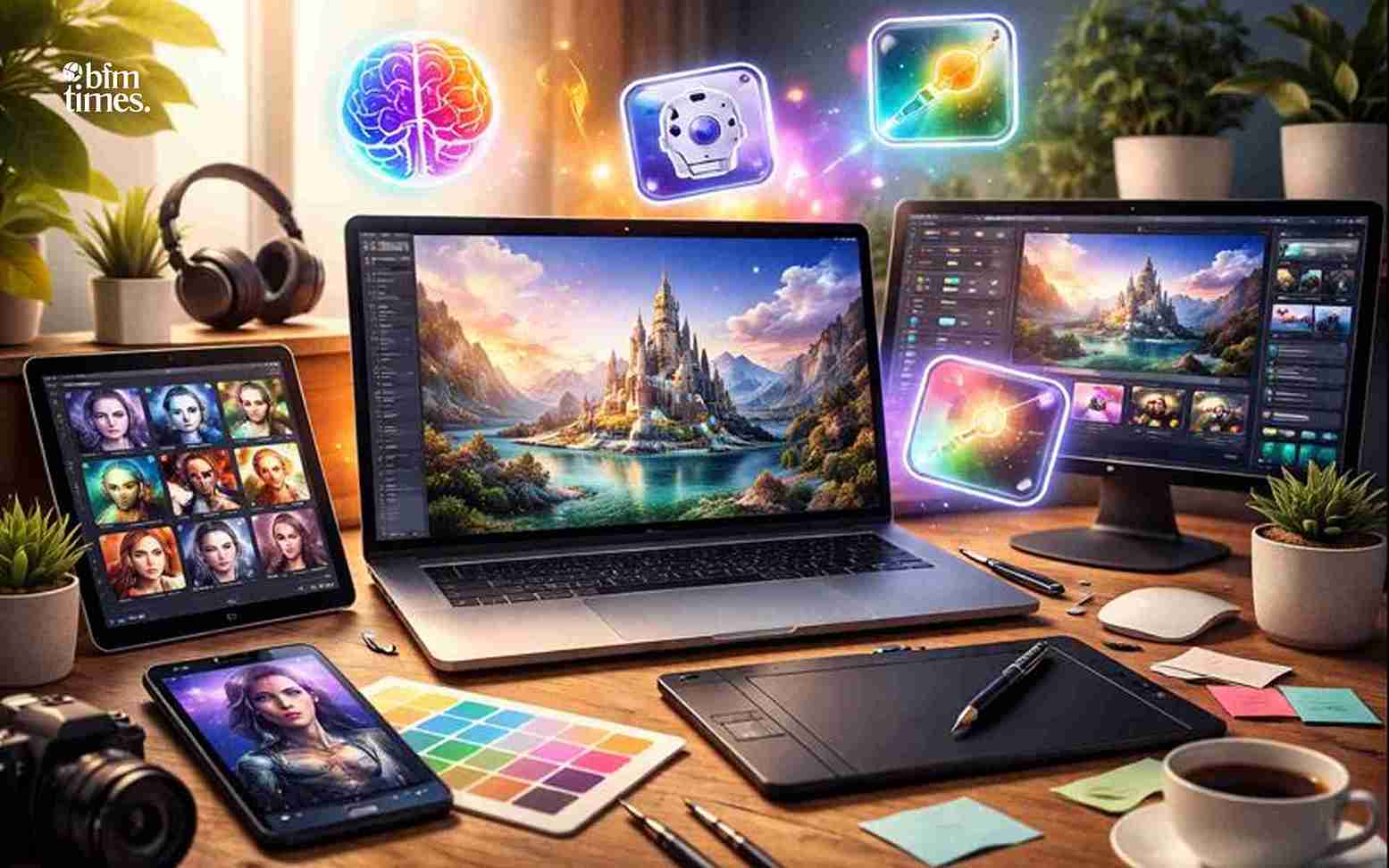
The visual content has taken center stage in brand communication on the web. The need to use high-quality images has been driven by social media graphics and blog visuals, as well as the creators of ads and product pictures. Meanwhile, shorter turnaround times and reduced budgets have forced creators to seek more intelligent solutions. This is why AI Tools for Image Creation have become: an effective alternative to the conventional design processes.
Artificial intelligence has evolved in the past couple of years to more than just photo filters and editing applications. The current generation of AI image-making tools has the ability to generate original images based on textual input, refine roughly conceived images into refined artwork, and assist designers during the design process. These tools are not recreating human creativity, but they are transforming the production of images on a large scale.
The guide discusses the concept behind the AI Tools for Image Creation, their functionality, the reasons why the image generation tools are being adopted by creators and businesses, and what platforms are already dominating the market. It additionally discusses ethical implications, restrictions, and ideal practices to be able to utilize AI-generated images responsibly and proficiently.
- What Are AI Tools for Image Creation?
- Why Creators and Businesses Use AI Image Tools
- Speed and Efficiency
- Cost Reduction
- Scalability
- Creative Experimentation
- Accessibility for Non-Designers
- Key Features to Look for in AI Image Creation Tools
- Image Quality and Resolution
- Style Control and Prompts
- Customization Options
- Editing and Upscaling
- Commercial Usage Rights
- Integration with Design Tools
- Best AI Tools for Image Creation
- 1. Midjourney
- 2. DALL·E
- 3. Stable Diffusion
- 3. Adobe Firefly
- 4. Canva AI
- 5. Leonardo AI
- 6. Runway ML
- 7. Playground AI
- 8. Ideogram
- Use Cases of AI-Generated Images
- AI Image Creation for Designers vs Non-Designers
- Ethical, Legal, and Copyright Considerations
- Limitations of AI Image Creation Tools
- Best Practices for Using AI Tools for Image Creation
- AI Image Tools for Businesses and Agencies
- Future of AI Image Creation
What Are AI Tools for Image Creation?
Definition and Purpose
AI Tools for Image Creation are computer platforms that generate images based on input provided by users through models of machine learning, which are usually trained on large collections of images. This input may be in text prompts, reference images, styles, or design parameters.
AI Tools for Image Creation software is not aimed at automation but rather at support. These tools help users:
- Produce novel pictures in real time.
- Discover innovative ideas through images.
- Lessen manual design load.
- Create visual content on a large scale.
How AI Image Generators Work
The majority of AI image generation models are based on diffusion models or transformer models. In simple terms:
- The AI learns visual patterns from large image datasets.
- A user provides a prompt, such as a description, style, or concept.
- The model interprets that input and generates an image pixel by pixel.
- Users refine the output through prompt changes or editing features.
Although it may seem that the process itself occurs instantly, it is a by-product of sophisticated probability and pattern recognition, not human knowledge.
AI-Assisted Design vs Fully AI-Generated Images
Two approaches should be differentiated:
| Approach | Description |
| AI-assisted design | AI supports activities such as removing backgrounds, improving, or varying as human beings manage the ultimate appearance. |
| Fully AI-generated images | The AI does all the visual creation prompted by prompts with little human intervention. |
The majority of professionals apply a hybrid workflow, which is a combination of AI image creation tools and conventional design software.
Why Creators and Businesses Use AI Image Tools
Speed and Efficiency
Image-generating AI devices will create pictures within minutes rather than hours and days. The speed is particularly useful in:
- Social media campaigns
- A/B testing creatives
- Rapid prototyping
Cost Reduction
It can be costly to hire designers or even buy stock pictures regularly. The image-creation software based on AI lowers the costs by:
- Reducing demand on the library of stocks.
- Minimizing revisions
- Supporting in-house teams
Scalability
In a case where the brand generates content on a daily basis, AI image generation software facilitates the scaling of content without loss of consistency.
Creative Experimentation
AI-based arts assist an artist in experimenting with a variety of styles, moods, and concepts faster than it would have been possible by hand.
Accessibility for Non-Designers
Any marketer, founder, or content manager who is not a designer can generate usable visuals with the least amount of training.
Key Features to Look for in AI Image Creation Tools
In the analysis of AI tools to create images, pay attention to the following key characteristics:
Image Quality and Resolution
- High-resolution output suitable for commercial use
- Clean details and minimal artifacts
Style Control and Prompts
- Ability to define artistic styles
- Prompt guidance or templates
Customization Options
- Variations and refinements
- Reference image support
Editing and Upscaling
- Built-in editing tools
- AI upscaling for print or web
Commercial Usage Rights
- Clear licensing terms
- Policies on the safe usage of business.
Integration with Design Tools
- Possibility to be compatible with Photoshop, Canva, or video tools.
- Advanced workflow API access.
Best AI Tools for Image Creation
1. Midjourney
Overview
Midjourney is a company that produces very artistic and visually saturated images based on AI generation. It is based on Discord and focuses on creative aesthetics.
Best Use Cases
- Concept art
- Branding inspiration
- Imaginative visual storytelling.
Strengths
- Exceptional artistic quality
- Strong style interpretation
Limitations
- Limited editing controls
- Not ideal for precise layouts
Best For
- Designers and artists exploring creative concepts.
2. DALL·E
Overview
DALL·E specializes in realistic images and correct prompt interpretation, which makes it trendy when it comes to marketing and content images.
Best Use Cases
- Blog illustrations
- Ad creatives
- Concept visualization
Strengths
- Strong prompt accuracy
- User-friendly interface
Limitations
- Not as artistic as other AI art tools.
Best For
- Advertisers and information developers
3. Stable Diffusion
Overview
Stable Diffusion is an open-source AI image generator with a high level of customization and the possibility to run it locally.
Best Use Cases
- Technical workflows
- Custom model training
- Experimental projects
Strengths
- Full control
- Open ecosystem
Limitations
- Technical knowledge is required.
Best For
- Entrepreneurs and innovative architects.
3. Adobe Firefly
Overview
The Adobe Firefly includes AI image creation software directly into the Adobe Creative Cloud system.
Best Use Cases
- Commercial design projects
- Brand-safe visuals
Strengths
- Ethical training data
- Easy integration with Creative Cloud.
Limitations
- Less experimental styles
Best For
- Design firms and agencies
4. Canva AI
Overview
Canva AI simplifies AI image creation for non-designers within a familiar design platform.
Best Use Cases
- Social media graphics
- Marketing visuals
Strengths
- Easy to use
- Built-in templates
Limitations
- Little sophisticated customization
Best For
- Small marketers and businesses
5. Leonardo AI
Overview
Leonardo AI is a visual generation that is highly quality and has good style and asset management.
Best Use Cases
- Game assets
- Product mockups
Strengths
- Detailed outputs
- Fine-tuning options
Limitations
- Learning curve
Best For
- Artists who work on visual assets
6. Runway ML
Overview
Runway ML is an amalgamation of image-generation (AI) with video and motion technology.
Best Use Cases
- Creative campaigns
- Multimedia projects
Strengths
- Innovative production processes
Limitations
- Higher pricing levels
Best For
- Video teams and creative agencies
7. Playground AI
Overview
Playground AI provides available AI image generators to test.
Best Use Cases
- Idea testing
- Visual exploration
Strengths
- Beginner-friendly
Limitations
- Limited professional features
Best For
- Students and hobbyists
8. Ideogram
Overview
Ideogram is a text-based image generator that has superior typography.
Best Use Cases
- Posters
- Headlines and banners
Strengths
- Accurate text rendering
Limitations
- Narrow focus
Best For
- Brand marketers and designers
Use Cases of AI-Generated Images
The applications of AI-generated images are popular in industries:
- Social media content
- Creatives in marketing and advertising.
- Blog and website visuals
- Product mockups
- Branding and concept art
- E-commerce imagery
AI Image Creation for Designers vs Non-Designers
Designers
- Apply AI as an acceleration and ideation tool.
- Refine outputs manually
- Maintain creative control
Non-Designers
- Be a major creator of AI tools to create images.
- Trust templates and presets.
- Focus on speed and usability
Workflow Comparison
| Aspect | Designers | Non-Designers |
| Control | High | Medium |
| Speed | Medium-Fast | Very Fast |
| Customization | Deep | Limited |
Ethical, Legal, and Copyright Considerations
- Depending on the platform, policies of ownership differ.
- The transparency of training data is important.
- The rights of commercial use should be revised.
- The safety of a brand should be considered.
The focus of the businesses should be on the AI image creation software that has explicit licensing conditions.
Limitations of AI Image Creation Tools
No matter their advantages, AI-based image generation is limited:
- Lack of emotional context
- Much dependence on timely quality.
- Repetitive visual styles
- Requirement to be reviewed and refined by a human.
Strategic thinking or brand storytelling cannot be replaced with AI.
Best Practices for Using AI Tools for Image Creation
- Write clear and descriptive prompts.
- Combine AI outputs with manual editing
- Maintain brand guidelines
- Do not use too many or common images.
AI Image Tools for Businesses and Agencies
AI image generation tools help organizations:
The AI image generation systems assist companies:
- Scale visual production
- Launch campaigns faster
- Striking a balance between cost and creative control
- Collaborate across teams
The agencies frequently include AI image generation software into their current design pipelines.
Future of AI Image Creation
The future of AI tools in image creation may consist of:
- Better personalization
- Better quality of realism and consistency.
- Greater integration with design tools
- Better human-AI interaction
Human creativity will not be sidelined; AI will improve rather than kill it.
Conclusion
AI Tools for Image Creation have improved the production of visuals in any industry. They are fast, convenient, and imaginatively flexible and reduce the barriers to production. AI-generated images still require human judgment, ethical awareness, and creative direction.
With careful application, AI image generators will be a powerful creative assistants: they will assist designers, marketers, and businesses to realize ideas with more speed and efficiency without losing originality or intent.
Disclaimer: BFM Times acts as a source of information for knowledge purposes and does not claim to be a financial advisor. Kindly consult your financial advisor before investing.