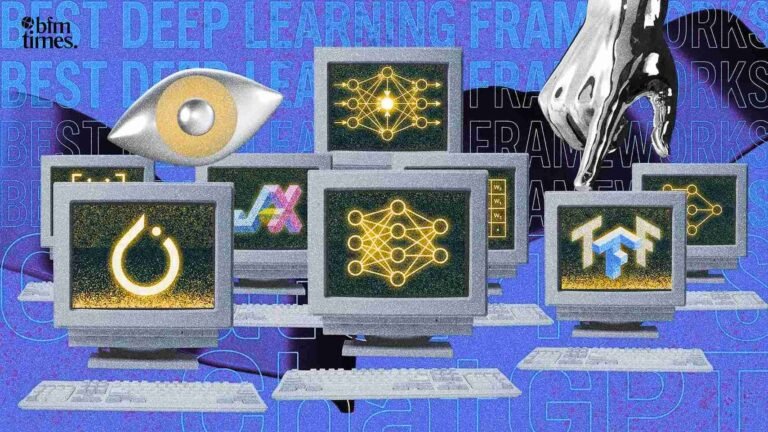
The world of artificial intelligence is growing rapidly. Developers need more smart tools to build more powerful AI systems. These tools are known as deep learning frameworks. They simplify the process of training neural networks. They handle the complex math operations automatically. They also support GPU acceleration for faster results. The global deep learning market is set to reach USD 1420 billion by 2034. This shows how critical these tools have become & choosing the right deep learning framework can make or break your AI project.
- How Do Deep Learning Frameworks Help Developers?
- Which Are the Top Deep Learning Frameworks You Should Know in 2026?
- TensorFlow – The Industry Standard
- PyTorch – The Researcher’s Favourite
- Keras – The Beginner-Friendly Choice
- JAX – The High-Performance Newcomer
- Microsoft DeepSpeed – The Large Model Specialist
- Caffe – The Speed Champion for Vision Tasks
- MXNet – The Scalable Cloud Training Powerhouse
- How Do You Choose the Right Deep Learning Framework?
- What Key Features Should You Look for in a Deep Learning Framework?
- What Trends Are Shaping Deep Learning Frameworks in 2026?
- Conclusion
- Frequently Asked Questions (FAQs)
In this article, readers will gain insights into the Best Deep Learning Frameworks for Developers in 2026 featured on BFM Times.
How Do Deep Learning Frameworks Help Developers?
Deep learning frameworks save a lot of development time. They offer pre-built modules for the most common AI functions. They reduce the coding errors during model building. They also allow faster testing & the experimentation. These tools provide much more scalability for large AI projects. They integrate easily with the cloud platforms. They also support the strong community resources. This makes problem-solving much faster for developers. Every serious AI developer needs a solid deep learning framework in their toolkit.
Which Are the Top Deep Learning Frameworks You Should Know in 2026?
| Framework | Developer | Best For | Ease of Use | GPU Support | Cost |
| TensorFlow | Production & scalability | Moderate | Yes (GPU/TPU) | Free | |
| PyTorch | Facebook/Meta | Research & prototyping | Easy | Yes (NVIDIA GPU) | Free |
| Keras | Google (via TF) | Beginners & fast builds | Very Easy | Yes | Free |
| JAX | High-performance research | Moderate | Yes (GPU/TPU) | Free | |
| DeepSpeed | Microsoft | Large model training | Moderate | Yes | Free |
| Caffe | UC Berkeley | Image classification | Moderate | Yes | Free |
| MXNet | Apache | Distributed cloud training | Moderate | Yes | Free |
TensorFlow – The Industry Standard
TensorFlow is developed by Google Brain. It is one of the most popular deep learning frameworks which is available today. It supports everything from research to enterprise production systems. The framework works with Python, C++ & JavaScript. It offers TensorFlow Lite for mobile & the edge devices. It also supports TensorFlow Serving for production deployments. The framework runs efficiently on GPUs & TPUs. It is a top choice for many of the scalable AI applications.
Best For: Large-scale production AI systems & enterprise deployments.
Visit Website: tensorflow.org
PyTorch – The Researcher’s Favourite
PyTorch is developed by Facebook’s AI Research Lab. It uses a dynamic computation graph. This makes model building flexible & make them more intuitive. The framework integrates well with Python libraries like NumPy & SciPy. It is widely used in academic research & industry projects. Tech giants like Meta, Tesla & Microsoft are actively using PyTorch. It also integrates well with the Hugging Face for large language models. It is a powerful deep learning framework for NLP & the computer vision.
Best For: Research, prototyping, & with the large language model development.
Visit Website: pytorch.org
Keras – The Beginner-Friendly Choice
Keras is a high-level neural network API. It is built on top of TensorFlow. The framework allows developers to build models using simple Python code. It is ideal for any of the rapid prototyping & the fast experimentation. Keras reduces the complexity of building neural networks. It is one of the most recommended deep learning frameworks for beginners. The framework also supports GPU acceleration for faster training.
Best For: Beginners, quick prototyping, & the easy model experimentation.
Visit Website: keras.io
JAX – The High-Performance Newcomer
JAX is developed by Google. It is quickly gaining popularity in the AI research community. The framework is designed for many of the high-performance computing tasks. It supports the automatic differentiation & GPU/TPU acceleration. JAX is ideal for complex mathematical computations in AI. It is becoming a go-to choice for many of the research-based AI projects. Developers looking for speed & the flexibility prefer JAX.
Best For: High-performance computing & the research-driven AI projects.
Visit Website: jax.readthedocs.io
Microsoft DeepSpeed – The Large Model Specialist
DeepSpeed is developed by Microsoft. It is built on top of PyTorch. The framework specialises in training very large AI models. It supports billions of parameters with lower hardware costs. DeepSpeed uses a Zero Redundancy Optimizer for much more memory efficiency. It powers large language models like BLOOM & GPT-NeoX. It is a leading deep learning framework for cloud-based AI training.
Best For: Training trillion-parameter models & enterprise cloud AI.
Visit Website: deepspeed.ai
Caffe – The Speed Champion for Vision Tasks
Caffe is developed by UC Berkeley. It is one of the fastest deep learning frameworks for image-based tasks. The framework is written in C++ for high performance. It can process more than 60 million images every single day. It supports both CPU & GPU processing with ease. Caffe works well with Python & MATLAB interfaces. It is widely used for image classification & the segmentation tasks. Developers who need speed in computer vision prefer Caffe.
Best For: Image classification, computer vision, & the fast model deployment.
Visit Website: caffe.berkeleyvision.org
MXNet – The Scalable Cloud Training Powerhouse
MXNet is an Apache Foundation project. It is one of the most scalable deep learning frameworks available today. The framework supports many of the multiple languages like Python, C++, R & Julia. It is designed for distributed computing across multiple GPUs & CPUs. Amazon Web Services actively supports & the promotes MXNet. It handles large-scale AI training with great efficiency. MXNet also supports both symbolic & imperative programming styles. It is a strong choice for many of the cloud-based AI projects.
Best For: Distributed cloud training, large-scale AI & multi-language projects.
Visit Website: mxnet.apache.org
How Do You Choose the Right Deep Learning Framework?
Choosing the best deep learning framework depends on your project needs. The skill level of your team matters a great deal. Beginners should start with Keras or PyTorch. These tools offer simple APIs & have large communities. Experienced developers may prefer TensorFlow or JAX. They offer more control & advanced features in their development process.
The type of AI task also plays a major role. Computer vision tasks work best with PyTorch or Caffe. Natural language processing tasks suit PyTorch or TensorFlow. Large-scale cloud training benefits most from DeepSpeed or MXNet.
The deployment environment is another key factor. Mobile & edge deployments need TensorFlow Lite. Cloud-based systems benefit from TensorFlow or DeepSpeed. Research environments work best with PyTorch or JAX.
What Key Features Should You Look for in a Deep Learning Framework?
- GPU & TPU Support: Faster model training with hardware acceleration.
- Community Support: Active forums, tutorials & open-source contributions.
- Scalability: The ability to scale from small tests to large AI systems with ease.
- Deployment Flexibility: Support for cloud, mobile & the edge environments.
- Ease of Use: Clear APIs with good documentation for faster learning.
- Pre-built Models: Ready-to-use components that speed up the development process.
What Trends Are Shaping Deep Learning Frameworks in 2026?
The AI landscape is evolving fast. New trends are directly shaping how the deep learning frameworks are built & are being used.
The rise of large language models is pushing frameworks to support billions of parameters. DeepSpeed & PyTorch are leading in this area. Edge AI deployment is growing rapidly. TensorFlow Lite is meeting this need effectively. Distributed training across multiple GPUs is now a standard requirement among these new models. MXNet & TensorFlow handle this with ease. The growing demand for ethical AI is also influencing the framework design. Developers now integrate bias mitigation tools directly into their pipelines for more ease.
Conclusion
The right deep learning framework can transform how you build AI systems. It saves time, reduces many of the errors & speeds up the deployment. TensorFlow remains the top choice for production-grade systems. PyTorch dominates research & the large model development. Keras is perfect for beginners entering the AI world. JAX, DeepSpeed & MXNet serve specialised, but they have powerful use cases.
The best deep learning framework for you depends on your project goals and needs. It depends on your team’s skills & your deployment environment. The AI market is growing fast & these tools are at the heart of it. Developers who master the right deep learning frameworks will stay ahead of the competition. Start exploring these tools today & then you can build smarter AI solutions for tomorrow.
Frequently Asked Questions (FAQs)
Which deep learning framework is best for beginners?
Keras is the best choice for many of the beginners. It offers a simple API & it is easy Python-based model building. PyTorch is also a great starting option for many of the beginners.
What is the difference between TensorFlow and PyTorch?
TensorFlow is best for production & the enterprise systems. PyTorch is preferred for research & for prototyping. They both support GPU acceleration & they have strong community support.
What features should a good deep learning framework have?
It should have GPU/TPU support, scalability & the easy-to-use APIs. It should also offer deployment flexibility & much stronger community resources.
Disclaimer: BFM Times acts as a source of information for knowledge purposes and does not claim to be a financial advisor. Kindly consult your financial advisor before investing.