Tracking the prices of crypto assets is a basic component for playing in the crypto market, from casual investors to active traders and those just jumping in to see what it is all about. Crypto markets trade 24/7, are highly volatile, and feature a wide range of tokens and assets. Also, without tools that report real-time pricing, historical trends, alerts, and your portfolio’s performance, it is easy to get in over your head.
Over the past few years, we have seen the introduction of a wide variety of tools ranging from basic price tickers to in-depth analysis dashboards, which have helped people stay current. In this article, we look at what we feel are the best crypto price tracking tools available at present. We also put them into categories by type, what they do best, and the audience they serve.
Why Crypto Price Tracking Matters?
Before jumping into the specific tools, we should cover why effective price tracking is important at all.
- 24/7 trading: Unlike traditional stock markets, which have set trading hours, crypto markets are open 24/7. Also, prices may change at any time.
- High volatility: Large price fluctuations are typical, especially for smaller tokens and early-stage projects.
- Fragmented market data: Across the world, there are a very large number of exchanges, and we see that their prices vary.
- Diverse assets: From Alt coins and cryptocurrencies in the digital asset space to watch out for, the spectrum is large.
A good price tracker that is at your service to aggregate live price data, present trends to you, and also issue alerts. Also, it may be put in portfolio management in the same package. The result improved access to info on your investments and the market.
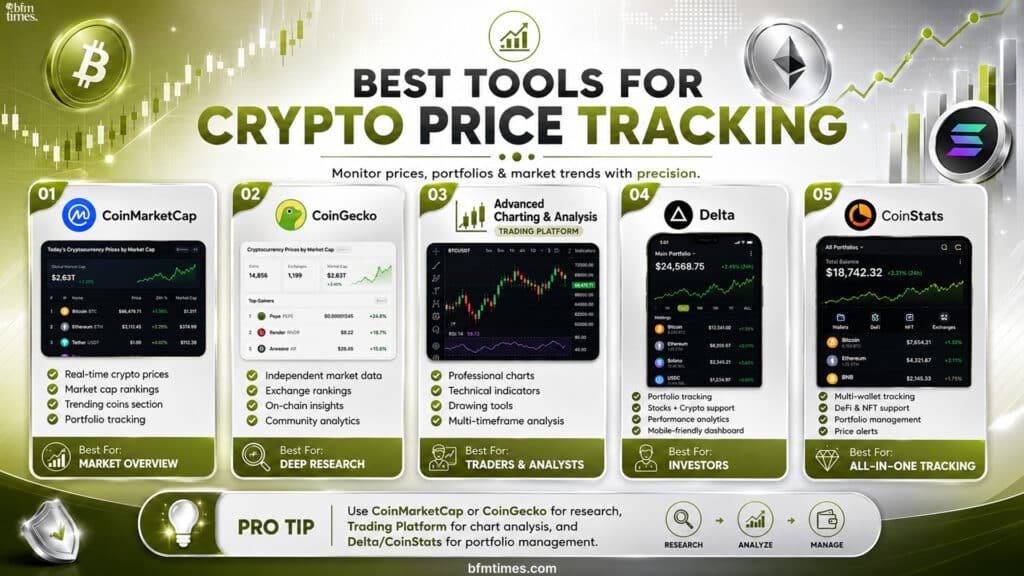
Broad Market Trackers: CoinMarketCap and CoinGecko.
1. CoinMarketCap
CoinMarketCap, a well-known name in crypto data, is what many go to first when they check prices. They aggregate pricing, volume, and market capitalization data from hundreds of exchanges and thousands of tokens, presenting it in a clean, search-friendly format.
Key features include:
- Live price data and past price charts.
- Market cap and volume statistics.
- Watchlists and customizable price alerts.
- Mobile app for on-the-go tracking.
- Educational content and news.
Who it’s for: For the new investor, the occasional trader, and any person who is interested in a trustworthy overview of the large crypto market.
Pros: Easy to use, reliable data sources, wide range of coins covered.
Cons: Does not provide in-depth analysis tools, which more specialized charting platforms do.
2. CoinGecko
CoinGecko is a major player in the crypto tracking field. It does what CoinMarketCap does, which is aggregate prices from many exchanges, but also includes additional metrics like developer activity, community growth, liquidity, and DeFi insights.
Highlights include:
- Prices for thousands of cryptocurrencies.
- Metrics which go beyond price — like social engagement and developer contributions.
- Portfolio tracking and price alerts.
- Clean, intuitive charts.
Who it’s for: Users looking for a little more in-depth information beyond the basic price lists, but at the same time value simplicity.
Pros: Great variety of data points for research.
Cons: Automatic portfolio sync may be limited in some cases compared to dedicated apps.
3. Advanced Charting & Analysis: Trading Platform.
For traders who use technical analysis or prefer to see price movements visually, TradingView is the standout platform. Although it does not focus solely on crypto, we at large see it as an invaluable tool for very active traders.
Key capabilities include:
- A wide range of chart tools, which include over 100 technical indicators.
- Personalized alerts for price levels and technical conditions.
- Community scripts and strategy backtesting.
- Multi-asset class tracking (crypto and stocks, foreign exchange, etc..
Who it’s for: Traders who use technical analysis and custom indicators for their crypto price tracking.
Pros: Industry pioneer in charting, a large community of users, and wide asset coverage.
Cons: For beginners, it may be too much, and we charge for many of the advanced features.
As the crypto space grows, we see that many are looking for more from the tools they are interested in, tracking their full portfolio across exchanges and wallets. Here are some of the best that do that:
4. Delta
Delta is a go-to portfolio tracking tool that reports real-time prices as well as performance analysis. We also see it to do auto sync with Exchange accounts (for some providers), custom price alerts, and in-depth performance reports.
Features include:
- Syncs with exchanges and wallets.
- In certain plans, we support a multi-asset portfolio that includes stocks and ETFs.
- Historical performance tracking and allocation views.
Who it’s for: Investors who have holdings on many platforms, which is a pain point.
Pros: Strong analytics and multi-exchange sync.
Cons: Some exclusive features are behind a paywall.
5. CoinStats
CoinStats is a one-stop shop for all your tracking and wallet needs. We connect to over 100 exchanges and wallets, which we then present to you on a single dashboard that includes your crypto values, price action, and DeFi positions.
Key points:
- Supports 300+ exchanges and wallets.
- Real-time price alerts and analytics.
- Some plans include tax reporting tools.
Who it’s for: Users who have a full picture of their whole crypto portfolio.
Pros: Extremely wide range of features, great UI.
Cons: The free version is limited.
Final Thoughts
The crypto space offers a wide variety of price-tracking tools that cater to all types of users. We have trusted players like CoinMarketCap and CoinGecko, in-depth analysis from sites like TradingView, and full-service portfolio platforms that do it all for you, like Delta and CoinStats. In terms of staying informed with what is going on in the market, we are very well covered.
What is important is choosing a tool that fits your goals and enhances your investment style. As you check prices before lunch or conduct in-depth research on multi-exchange portfolios at your desk, the right tool will improve your crypto experience, making it more efficient, informative, and, in the end, more profitable.
Frequently Asked Questions
Which tool is best for you?
With a wide range of choices, which is the best one for you depends on your goals. Here are some questions to guide your decision.
Are you a casual watchman or an active player?
Casual users go for sites like CoinMarketCap and CoinGecko, which present a simpler interface, and active traders prefer TradingView.
Do you prefer portfolio management or just prices?
If you are looking to see the full picture of your portfolio’s performance, then you will do better with tools like Delta or CoinStats, which outperform basic price trackers.
Do you need automatic syncing?
Some applications are able to access API keys, which in turn allows them to automatically pull balance and trade info. This is useful if you hold assets across many platforms.
How much analysis do you need?
For basic price alerts, simple trackers do the job. For in-depth insights and trend analysis, we recommend using advanced tools and charting platforms.
Disclaimer: BFM Times acts as a source of information for knowledge purposes and does not claim to be a financial advisor. Kindly consult your financial advisor before investing.