




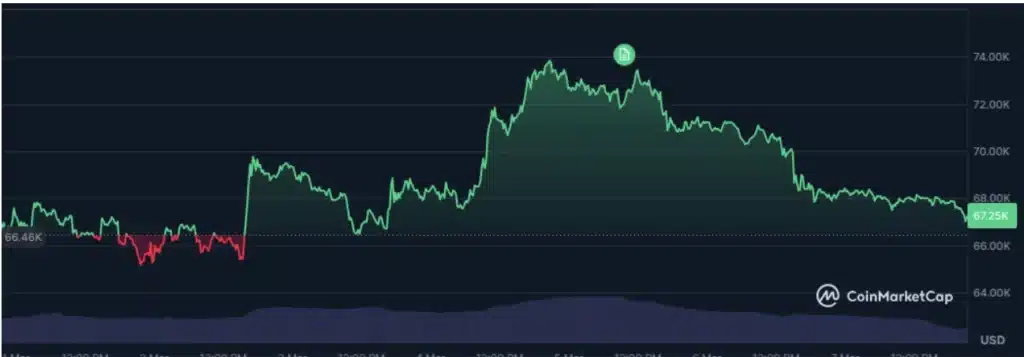
The cryptocurrency market was given a reality check this week as the recent bullish run was halted. The price of bitcoin, the largest cryptocurrency by market capitalization, fell below the psychological price of $68,000. This was after a price surge in the middle of the week saw the price of bitcoin touch the psychological price of $74,000, which many market analysts saw as a sign of a breakout to new all-time highs.
- Geopolitical Tensions and Risk-Off Sentiment
- The $228 Million ETF Exodus
- Technical Analysis: Resistance at $74,000
- Expert Insights and Social Media Reaction
- Why did Bitcoin’s rally slow down below $68,000?
- What does the $228 million outflow from spot Bitcoin ETFs indicate?
- How do ETF outflows affect Bitcoin’s price?
The recent price dip can be attributed to profit-taking by investors and a change of heart by institutions. Investors pulled a net of $228 million from spot bitcoin exchange-traded funds in the United States on Thursday, which was one of the largest outflows from these investment vehicles since their inception. This shows that institutions are losing confidence in the recent price run of bitcoin and that of other assets, due to geopolitical tensions that are rising by the day.
Related: Bitcoin Holds Above $72K as ETFs Attract $155M, Extending Two-Week $1.47B Inflow Streak
Geopolitical Tensions and Risk-Off Sentiment
The main contributor to the recent price dip of bitcoin and that of other assets in the cryptocurrency market was the geopolitical tensions that are rising by the day. There was a military escalation in the Middle East, which saw many of the main players in the region engage in a series of military confrontations. As a result of this, global markets are in a ‘risk-off’ mode. Investors are turning their attention to traditional safe-haven assets like gold and the US dollar, as opposed to assets like bitcoin, which are considered to be riskier. Market analysts pointed out that despite being considered ‘digital gold,’ the price of bitcoin does not react well during geopolitical tensions. Analysts pointed out that during geopolitical tensions, the price of bitcoin reacts like that of a high-tech stock. As a result of this, investors are turning their attention to gold, as evidenced by the recent price surge of the asset. Gold touched a new multi-month high as investors sought shelter from a possible disruption of supplies and higher energy costs.
The $228 Million ETF Exodus
The institutional narrative, which has been the backbone of Bitcoin’s growth throughout 2025 and into 2026, seemed to show signs of weakness this week. The $228 million outflows from spot ETFs are a disruption to what had been a promising run of inflows. SoSoValue and CoinGlass data show that these outflows are broad-based across several of these top funds. Fidelity’s FBTC and Bitwise’s BITB seem to have been particularly hard hit, with outflows of $48 million and $46 million, respectively. Even BlackRock’s IBIT, which has been the dominant player in the ETF space, suffered its first big loss in weeks, losing about $88 million. It appears that even institutions are not immune to the fear that’s currently gripping global markets.
Suggested: Bitcoin Rebounds 2% Amid Middle East Tensions & War Risks
Technical Analysis: Resistance at $74,000
From a technical perspective, the failure to hold support at the $74,000 level is bearish for BTC in the short term. One can also see this price rejection by looking at the BTC/USD price chart on TradingView. There’s a clear double top forming in the area between $73,500 and $74,000. This area of the price chart appears to be a place of heavy distribution, with long-term holders choosing to realize their gains.
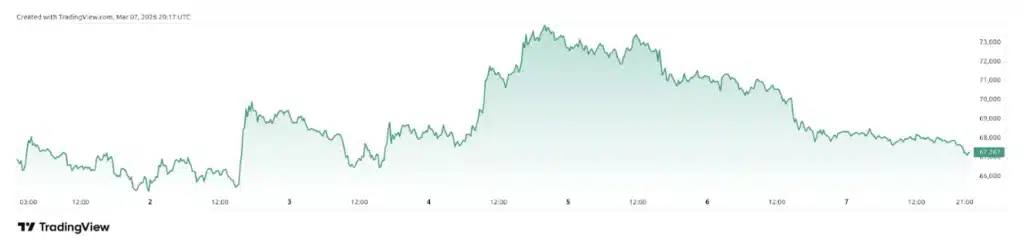
The current support levels are being put to the test as we speak. On CoinMarketCap’s historical data page, the $67,500 price point is highlighted as a major pivot point. If Bitcoin is unable to hold above this price point, there is a possibility that it could drop back down into the $63,000 or even $60,000 price points. This is where the new demand zones are. The Fear and Greed Index, which had previously been categorized as “Greed,” is now rapidly dropping into the “Neutral” category.
Expert Insights and Social Media Reaction
The crypto community on X (formerly Twitter) is very vocal about the current events. Many experts are saying that the current correction is a much-needed “flush out” of over-leveraged long positions.
“The market was getting ahead of itself with the $74k push,” said one prominent analyst. “Between the Middle East situation and the lack of fresh spot demand outside of the U.S., a pullback to retest the $68k breakout point was almost inevitable. The question is whether the ETF buyers will step back in at these lower prices or if they are waiting for more clarity on the global stage.”
Also Read: Massive Spot Bitcoin ETFs Inflows Reveal Powerful Institutional Shift Toward Bitcoin Recovery
Investors are also awaiting the release of macroeconomic data. The U.S. labor market continues to surprise to the upside, making the Fed’s path to potential rate cuts more difficult. High interest rates are a general headwind for Bitcoin, as the higher the interest rate, the higher the opportunity cost of holding a non-yielding asset such as Bitcoin.
The digital asset market will be closely watched over the next two weeks as the March FOMC meeting approaches. The Fed’s hawkish rhetoric could further weigh on the price of Bitcoin. However, if the geopolitical tensions ease or if the $68,000 price level holds over the weekend, we could see a fresh push towards the $70,000 price range.
For now, the mantra for many investors appears to be “caution.” The thesis for Bitcoin remains the same for the long term; however, the near-term environment is full of unknowns. We suggest investors keep an eye on the charts in real time on a site such as Coinbase to get the latest information about the price and volume changes for Bitcoin and other digital assets.
As the $228 million exit dust settles, the question remains: is this a mere blip on the radar for a larger bull run, or are we about to enter a protracted bearish run?
Disclaimer: BFM Times acts as a source of information for knowledge purposes and does not claim to be a financial advisor. Kindly consult your financial advisor before investing.
Why did Bitcoin’s rally slow down below $68,000?
Bitcoin’s rally stalled as investors took profits and market momentum weakened near the $68,000 resistance level.
What does the $228 million outflow from spot Bitcoin ETFs indicate?
It suggests short-term investor caution and reduced institutional buying pressure.
How do ETF outflows affect Bitcoin’s price?
Large ETF outflows can increase selling pressure and slow down upward price momentum.