








- Quick Price Prediction Summary
- Current Market Overview
- What Is Chainlink?
- Factors Affecting Chainlink’s Price
- Chainlink (LINK) Price Prediction by Timeframe
- Short-Term Price Prediction (Next 3-6 Months)
- Medium-Term Price Prediction (2026-2027)
- Long-Term Price Prediction (2030 & Beyond)
- Technical Analysis Overview
- Bullish vs Bearish Scenarios
- Is Chainlink (LINK) a Good Investment?
- FAQs
- Final Thoughts
Key Insights
- Chainlink is now the main partner for financial giants like Swift and J.P. Morgan when it comes to tokenising real-world assets.
- The expansion of Staking v0.3 and the “Universal Gas” model are creating strong demand for the tokens, which already have a limited supply.
- Analysts are predicting a long-term range of $100 to $400 by 2030, as the protocol becomes the global standard.
Chainlink has grown from being a simple data provider into being one of the pillars that hold the world’s finances up.
January of 2026 has only just begun, but analysts expect great things through te year and until 2030.
Here are some realistic targets for Chainlink, especially if institutional demand and new technological milestones push the value of LINK upwards.
Read More: Cardano (ADA) Price Prediction (2026-2030)
Quick Price Prediction Summary
| Period | Estimated Price Range | Market Outlook |
| Current Price (Jan 2026) | $11.50 – $13.50 | Consolidating / Neutral |
| Short-Term (Next 6 Months) | $10.00 – $24.00 | Bullish Reversal Potential |
| Mid-Term (2026-2027) | $35.00 – $85.00 | Expansionary / RWA Boom |
| Long-Term (2030+) | $100.00 – $400.00 | Global Standard Maturity |
Current Market Overview
As of late January, Chainlink is seeing some intense accumulation from investors.
The asset currently trades at approximately $12.27, and this valuation makes it one of the top 15 cryptocurrencies by market cap ($8.4 billion).
Investors are particularly interested in its limited supply of 708 million LINK tokens and how it affects the price.
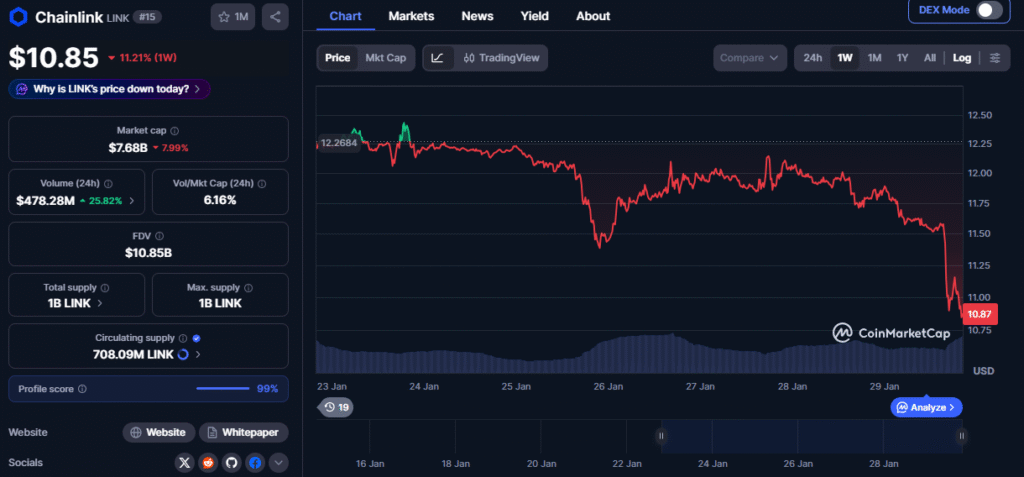
Chainlink is showing horizontal to bearish sentiment | source: CoinMarketCap
Charting platforms show that Chainlink has been relatively flat so far, and the $11.50 level now serves as a strong support floor.
For now, Chainlink is afloat with its Cross-Chain Interoperability Protocol (CCIP), which is now in full production.
In the future, its partnerships with firms like Mastercard and SBI Group could do much to expand the network’s reach. And while the price has not yet jumped with these partnerships, on-chain data shows that activity grew by nearly 2,000% last year alone.
As such, investors are likely watching for institutional capital to start moving through these new systems before jumping in.
What Is Chainlink?
Chainlink is the most popular decentralized oracle network in the world. Put simply, it allows smart contracts to interact with real-world data and services safely.
Because blockchains are isolated systems that cannot see outside information on their own, Chainlink comes in with a solution by acting as a bridge between both worlds.
Some of the biggest use cases for ChainLink include Node payments, where developers pay operators in LINK for retrieving and verifying data, and staking, where holders lock their tokens to secure the network.
Chainlink has become a major part of the DeFi space because it is the “source of truth” for almost all of DeFi. Without its price feeds, most protocols would stop working.
So to sum things up, Chainlink acts as the “Value Layer” that connects the real world to the blockchain.
Factors Affecting Chainlink’s Price
Chainlink’s price performance between now and 2030 could depend largely on how well it is used in the financial space.
So far, the adoption of tokenised Real-World Assets (RWAs) is showing the most promise.
Banks are now using Chainlink to verify bonds and real estate and if this market reaches the expected $16 trillion market cap by 2030, the demand for LINK will be massive.
Staking updates are also important because future versions of staking could lock up a larger portion of the supply. If this happens, it could reduce the number of tokens available on the open market.
Furthermore, the CCIP protocol creates a “Universal Gas” effect. For context, under CCIP, users can pay for services in any asset, but the backend settlement still uses LINK.
All of this combines to create a steady (and sometimes invisible) demand for the token.
Global rules and ETFs are also factors in this movement. Spot LINK ETFs launched late last year, and this allowed traditional funds to hold LINK as an infrastructure asset.
Chainlink (LINK) Price Prediction by Timeframe
Short-Term Price Prediction (Next 3-6 Months)
So far, Link is copying the rest of the market and is trading horizontally. Analysts expect a range between $10.00 and $24.00, and a break above the $14.85 level could lead to a major rally.
This move depends on whether Bitcoin can hold itself stable, and traders are still looking for signs that the post-halving market is ready for an altcoin season.
Medium-Term Price Prediction (2026-2027)
By late 2027, the trend from pilot projects to real production will be the main story. Moreover, as CCIP becomes the standard bridge for institutional subnets, analysts are calling for a price range of $35.00 to $85.00.
By then, Chainlink would have become an “Infrastructure Giant,” and during this stage, the market will treat LINK more like a software token than just another asset to trade on an exchange.
Long-Term Price Prediction (2030 & Beyond)
By 2030, Chainlink could become the standard for cross-chain settlement for both private and public banks.
If Chainlink is used to power CBDCs around the world and other financial applications, the price could hit $100.00 to $400.00 easily.
However, this assumes that the network keeps its massive market share. Eventually, the market cap would rival major payment firms like Visa or Mastercard.
Technical Analysis Overview
Chainlink is showing signs of a bullish accumulation pattern on the weekly chart.
Despite recent small dips, the price is currently above the 200-day Moving Average, which appears to be flattening near $16.24.
Its support is strong at $10.00, and investors should be aware of a deeper floor near $8.15 if the bears gain any more strength.
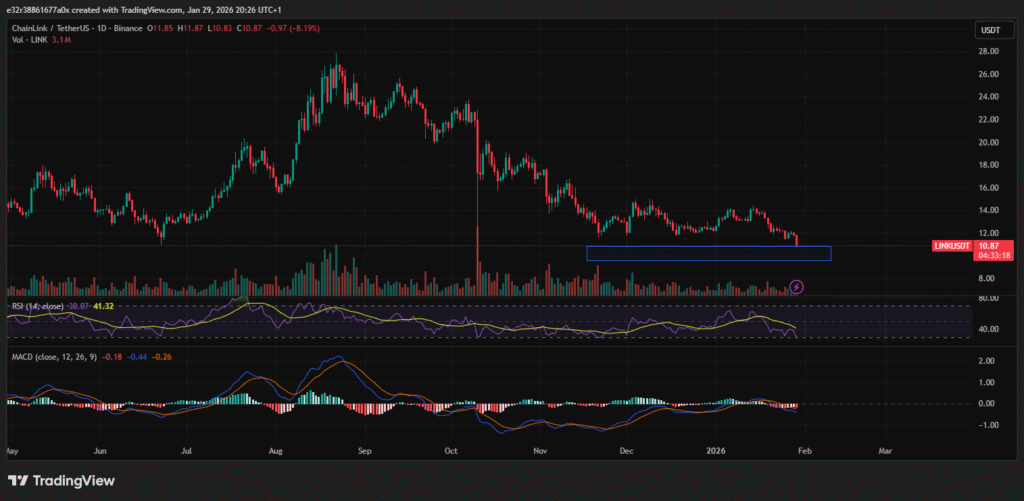
Chainlink is stabilising above support and could rebound if the bulls take charge | source: TradingView
The asset’s resistance levels are set at $14.50 and $18.00, which means that the major barrier for the next year is $28.70.
According to the charts, the Relative Strength Index (RSI) is currently at 40, which means that the asset is getting close to “oversold” territory.
In all, CoinMarketCap data shows that roughly 45% of the supply is held by large wallets, which means that “smart money” is not selling during this quiet period.
Bullish vs Bearish Scenarios
Bullish Case
As mentioned earlier, it would be extremely bullish for Chainlink if the CCIP protocol becomes the global standard for the $150 trillion Swift transaction volume.
Chainlink could also benefit if staking programs expand to lock up 20% of the total token supply. Spot LINK ETFs could see massive inflows from retirement accounts as Chainlink allows more and more banks to use its infrastructure.
Bearish Case
On the other hand, Chainlink has some competition, and it would be bearish if specialised competitors like Pyth Network capture more of the trading market.
Regulators could also unexpectedly target node operators and slow down the network’s growth.
The final nail would be if a security flaw shows up in the CCIP bridge and shakes the trust of these big banks.
Is Chainlink (LINK) a Good Investment?
Chainlink is a “Blue Chip” infrastructure asset. It is a good choice for people who believe the global economy needs a secure data layer. It often stays stable even when “meme coins” are crashing. This makes it a helpful part of a diverse portfolio.
However, short-term traders might find it boring. The price often stays sideways for many months. It is a choice that requires a lot of patience. As with any crypto, there is no guarantee of success. Always research the competition and manage your own risks.
FAQs
Can Chainlink reach $1,000?
Yes. However, to reach $1,000, Chainlink would need a $1 trillion market cap. This is very high, and while it could happen if it replaces the entire banking backend, $1000 is not very likely between now and 2030.
Is Chainlink safe?
Chainlink is known as one of the most secure protocols. So far, it has handled tens of trillions in value without a major failure, and it is so decentralised that it is very hard to hack or manipulate.
Where can I buy LINK?
Anyone can buy LINK on platforms like OKX, Binance, MEXC, Coinbase and Kraken.
Chainlink also recently had a spot LINK ETF approved, so investors can buy it through brokerage accounts that offer spot ETFs.
What is the biggest threat to Chainlink?
Specialised rivals are the biggest threat to Chainlink, like the Pyth network. Some new networks offer faster data for specific niches like high-frequency trading.
This means that Chainlink must hold on to its leadership by offering the best security and cross-chain tools.
How does CCIP affect the price?
CCIP creates direct demand for the token, which means that users must make a payment every time data moves between chains.
At the end of the day, more activity in the cross-chain space leads to more LINK being used.
Final Thoughts
Chainlink’s journey so far, will mostly be tied to how well it can scale up.
It has already proven its technology and institutions are already hooked. However, it still needs to beat competitors or risk falling behind.
Investors should note that LINK is a cryptocurrency, and it can be very volatile. As such, do your own research and never invest money you cannot afford to lose.
Meta Description:
Here are some of the most accurate predictions for LINk between now and 2030, including updates from the CCIP rollout, institutional RWA adoption, staking and more.
Tags: Chainlink, LINK, Price Prediction, Blockchain, Oracle, Finance, CCIP
Disclaimer: BFM Times acts as a source of information for knowledge purposes and does not claim to be a financial advisor. Kindly consult your financial advisor before investing.