One of the strongest technologies in the current era of artificial intelligence is convolutional neural networks. These are specialized neural network models that are configured to process and analyze visual data, including images and videos. Convolutional neural networks allow machines to perceive visual information in the way that only humans could before, regardless of whether it is an image of your face or a self-driving vehicle.
- What Are Convolutional Neural Networks?
- CNN in Deep Learning
- Understanding CNN Architecture
- How Convolutional Neural Networks Work
- 1. Input Image Processing
- 2. Feature Extraction Through Convolution
- 3. Downsampling Through Pooling
- 4. Pattern Learning
- 5. Final Classification
- Applications of Convolutional Neural Networks
- Advantages of CNN Models
- Limitations and Challenges of CNNs
- Conclusion
CNN models are very important in the world of deep learning, which helps computers to identify patterns and objects and process complex visual images. They are deep learning algorithms that automatically learn meaningful features of the raw data, which have revolutionized areas of computer vision, medical imaging, and image recognition AI.
Related: Dogecoin Explained Price Use Cases & Future
What Are Convolutional Neural Networks?
Convolutional neural networks are a model of a deep neural network that is particularly created to process grid-based data like images. They are especially efficient regarding tasks that require computer vision since they have the capability of automatically recognizing patterns in visual data.
The classical neural network models accept input information as a very long sequence of numbers. Images, however, do have spatial information whereby the correlation between adjacent pixels matters. Convolutional neural networks address this issue by maintaining the spatial structure of the pictures when they analyze them.
CNNs are very useful in executing tasks like:
- Image classification
- Facial recognition
- Object detection
- Medical image analysis
- Video processing
CNNs are extensively utilized in image recognition AI systems since they are capable of identifying patterns, including edges, textures, and shapes.
CNN in Deep Learning
CNN in deep learning is imperative since these networks are able to automatically learn valuable features out of visual data without having to manually engineer features.
In most machine learning systems, features that the model should seek to identify would have been manually specified by engineers. This was a time-consuming and error-prone process. Convolutional neural networks transformed this mode, as machines can learn features out of data.
The CNNs are trained on large sets of labeled images using deep learning algorithms and learn to identify patterns over time. Considering the example of a CNN that has been trained to identify cats in images will learn to identify the following attributes:
- edges and contours
- fur texture
- ear shapes
- facial patterns
The model is enhanced with time to identify the following patterns and categorize the images correctly.
Due to this capacity, CNN models are currently regarded as one of the most significant neural network models applicable in contemporary artificial intelligence.
Understanding CNN Architecture
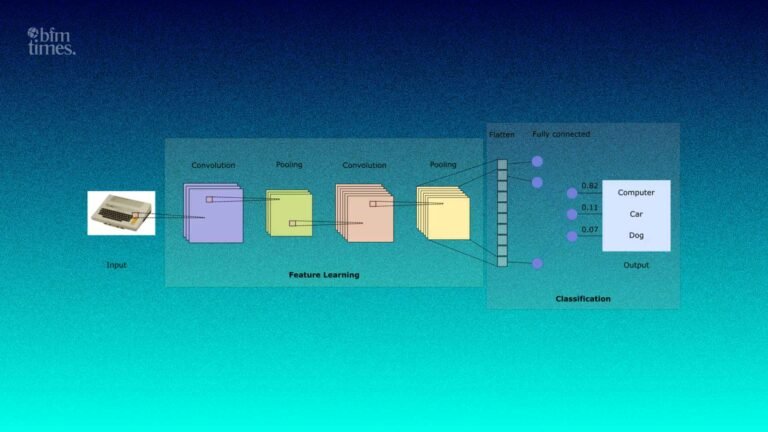
Convolutional neural networks are effective due to their layering property, also known as CNN architecture. This architecture permits processing of the images by the network step by step as more and more complex features are extracted.
A common CNN architecture has some layers of different types:
Input Layer
Image data are received in the input layer. Images are typically described by pixel values in a grid. As an example, a color picture might have three channels, i.e., red, green, and blue.
Convolutional Layers
The fundamental element of CNN architecture is the convolutional layers. These layers apply little filters (also known as kernels), which move around the image.
The image is scanned by each filter, and the specific features that it detects include:
- edges
- textures
- shapes
- patterns
The process is referred to as convolution and enables the model to capture significant visuals.
Activation Functions
Activation functions bring non-linearity to the network after convolution. One such activation is ReLU (Rectified Linear Unit), aiding the network to learn more complicated patterns.
Pooling Layers
The pooling layers are used to downsize the map of features created by convolutional layers. This will assist in easing the data and preserving the most significant dynamics.
Types of common pooling techniques are:
- max pooling
- average pooling
The efficiency and requirements on computing resources are enhanced by pooling.
Fully Connected Layers
The last layers in the CNN architecture are fully connected layers. These layers synthesize all the features extracted and predict on the input image.
An example is an image that is defined by the model as:
- cat
- dog
- car
- human
How Convolutional Neural Networks Work
It is easier to learn the working of the convolutional neural networks by dividing the working process.
1. Input Image Processing
An image in the form of pixel values of numbers is fed into the model initially. Such values are given to the network.
2. Feature Extraction Through Convolution
The convolutional layers scan the image with filters that identify patterns in the image, like edges or textures. All filters create some feature map indicating where some patterns are.
3. Downsampling Through Pooling
The pooling layers make feature maps smaller and preserve the most essential information. This allows for making the model quicker and more effective.
4. Pattern Learning
The network is able to learn more and more complex features as the data passes through the various layers.
For example:
- early layers detect edges
- middle layers detect shapes
- Objective layers that are deeper observe objects.
5. Final Classification
All the extracted features are analyzed during the fully connected layers, which classify the data as probabilities to the various categories. The most probable category is predicted by the model.
This is a process that can give CNNs the ability to identify intricate patterns of visual information.
Suggested: Telegram Gaming Ecosystem Explained
Applications of Convolutional Neural Networks
Convolutional neural networks have transformed most of the industries, whereby machines are able to perceive images and videos.
Some applications of these include:
Facial Recognition
A lot of smartphones and security systems involve CNN-based image recognition AI to recognize people.
Self-Driving Cars
The autonomous vehicles use CNN models to identify:
- pedestrians
- road signs
- traffic lights
- other vehicles
Medical Imaging
Medical scans like X-rays, MRIs, and CT scans are analyzed using CNNs. Such systems have the ability to help physicians to detect diseases at an earlier stage.
Security Systems
Neural network models can be used to power surveillance cameras that are used to identify suspicious behaviors and identify faces in busy locations.
Image Search Engines
Search engine applications can identify objects in a picture using CNN-based algorithms of deep learning to get related search results.
Advantages of CNN Models
Convolutional neural networks have multiple benefits, which render them very effective for analyzing visual data.
Key benefits include:
- Automatic feature extraction without manual engineering.
- Great precision in image recognition.
- Effective management of big data.
- Minimized preprocessing needs.
- AI complex applications with scalability.
Due to all these advantages, CNN models are extensively applied in contemporary deep learning algorithms and computer-based vision systems.
Also Read: ICO vs IDO: Presale Differences Explained
Limitations and Challenges of CNNs
Convolutional Neural Networks have disadvantages, although they have strong points.
High Computational Requirements
CNN models can be hard to train with basic hardware like GPUs.
Large Data Requirements
CNNs are most effective when trained using big data. Insufficient information may minimize precision.
Overfitting Risk
In the event that a model becomes too well-versed with the training data, it might have difficulties generalizing to novel images.
Complex Training Process
Deep neural network models are time-consuming and technically difficult to design and train.
Researchers are still coming up with better ways of overcoming this.
Conclusion
Convolutional Neural Networks are one of the essential technologies of contemporary artificial intelligence and computer vision. These machine neural network models enable machines to analyze images by automatically learning patterns, including edges, textures, and objects.
These systems are based on a layered CNN architecture to extract features sequentially and classify visual data with extraordinary accuracy. Convolutional neural networks have revolutionized machine perceptions of the visual world, both in terms of facial recognition and medical imaging, and in autonomous vehicles. CNN technology will be one of the main sources of innovations in image recognition AI and other applications, as deep learning algorithms keep evolving and developing.
Disclaimer: BFM Times acts as a source of information for knowledge purposes and does not claim to be a financial advisor. Kindly consult your financial advisor before investing.
What is a Convolutional Neural Network CNN?
A Convolutional Neural Network CNN is a deep learning model designed to analyze and recognize patterns in images and visual data.
How do Convolutional Neural Networks work?
CNNs use layers that automatically detect features like edges, shapes, and textures from images.
Where are Convolutional Neural Networks commonly used?
CNNs are widely used in image recognition, facial detection, medical imaging, and autonomous vehicles.