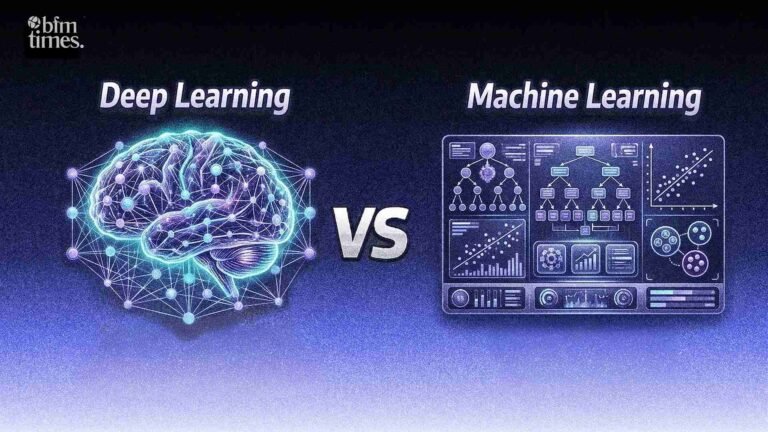
Artificial Intelligence is changing the world at a rapid pace. Two terms you hear often are deep learning vs machine learning in the field of A. Many people use these terms as if they mean the same thing. Whereas they do not. Both are part of AI. Both learn from the data, but they work very differently. Understanding these differences will help you make smarter tech decisions. It also helps you in understanding how AI tools work around you every day.
- What Is Machine Learning?
- What Is Deep Learning?
- What is the core concept behind deep learning vs. machine learning?
- What Are the Key Differences Between Deep Learning and Machine Learning?
- How Does Machine Learning Work in the Real World?
- How Does Deep Learning Power Modern AI?
- What Are the Data Requirements for Deep Learning vs Machine Learning?
- How Does Computing Power Differ Between the Two?
- Which Technology Needs More Human Intervention?
- When Should You Use Machine Learning vs Deep Learning?
- What Are the Real-World Applications of Deep Learning vs Machine Learning?
- What Does the Future Hold for Deep Learning vs Machine Learning?
- Conclusion
- Frequently Asked Questions (FAQs)
In this article, readers will gain insights into the Deep Learning vs Machine Learning: Key Differences You Must Know featured on BFM Times.
What Is Machine Learning?
Machine learning is a branch of AI. It teaches the computers to learn from data. The computer does not need step-by-step instructions. It finds the patterns on its own. It then improves its performance over time.
ML uses structured data. It relies on algorithms like decision trees & linear regression. The human expert selects the important features. The model then uses these features to make predictions. Examples of machine learning in daily life include spam filters, product recommendations, & the fraud detection systems.
Machine learning is AI that can automatically adapt with minimal human interference. It powers tools like Google Maps, Netflix suggestions & the bank fraud alerts. ML works well with small to medium-sized datasets. It does not need a supercomputer to run these things.
What Is Deep Learning?
Deep learning is a more advanced form of machine learning. It is a specialized subfield of machine learning that utilizes various neural networks with many layers to learn patterns directly from raw data. These layers are inspired by how the human brain works in processing things.
Deep learning excels in tasks that require high levels of abstraction, such as speech recognition, image recognition & natural language processing. It processes images, videos, audio, & the text with great accuracy. The word “deep” refers to the many layers that are present in the neural network.
These neural networks consist of multiple layers that extract increasingly complex features from the data, making deep learning particularly good at handling unstructured data like images, videos, & the audio. ChatGPT is an example of deep learning AI.
What is the core concept behind deep learning vs. machine learning?
The debate around deep learning vs machine learning comes down to one thing. It is about how each system learns from the data that is provided to it. ML needs human help to select the features, and then it works. Deep learning does this automatically on its own.
The primary difference between machine learning & deep learning is how each algorithm learns & how much data each type of algorithm uses to give you the result. Deep learning automates much of the feature extraction process, eliminating some of the manual human intervention required.
This is a major advantage of deep learning. It can handle the raw data without any preparation. It saves time & it also reduces human effort. The tradeoff is that it needs far more data & computing power to work well.
What Are the Key Differences Between Deep Learning and Machine Learning?
| Feature | Machine Learning | Deep Learning |
| Data Type | Structured data | Unstructured data |
| Data Requirement | Small to medium datasets | Large datasets (millions of records) |
| Feature Engineering | Manual by humans | Automatic by the model |
| Computing Power | Standard CPU | High-end GPU or TPU |
| Interpretability | Easy to explain | Hard to interpret |
| Training Time | Fast | Slow |
| Human Intervention | High | Low |
| Best Use Cases | Fraud detection, forecasting | Image recognition, NLP, speech |
| Model Complexity | Low to medium | Very high |
| Cost | Low | High |
How Does Machine Learning Work in the Real World?
Machine learning is being used everywhere today. It is practical & they are cost-effective compared to deep learning. It works well for many businesses of all different sizes.
Machine learning has become an essential tool in many of the sectors of today’s. It automatically filters unwanted emails by analyzing their content & then structures them. It suggests movies, music, or products tailored to the user’s preferences on platforms like Netflix, Spotify & Amazon.
It also predicts the weather patterns & the market demand. Banks use it to spot any of the suspicious transactions to catch in real time. Businesses use it for customer sentiment analysis. These are all tasks that work perfectly with the structured data & with the clear labels.
How Does Deep Learning Power Modern AI?
Deep learning is behind the most advanced AI tools today. It powers the voice assistants like Siri & Alexa. It drives self-driving car technology. It enables the facial recognition systems.
Deep learning excels at analyzing medical images like X-rays or MRIs, which are tasks that traditional machine learning struggles with. It reads the medical scans with high accuracy. Doctors use it as a second opinion tool.
The deep learning market in the Asia Pacific region is expected to grow at a rate of over 31.8% annually from 2025 to 2030. This rapid growth is fueled by advancements in big data analytics & computing power. Industries across the world are adopting the use of deep learning at a fast pace.
What Are the Data Requirements for Deep Learning vs Machine Learning?
One of the biggest differences is in the data size. Machine learning works with smaller datasets. Deep learning needs massive amounts of data to perform well and give accurate results.
ML performs well with hundreds to thousands of labeled examples. Deep learning requires large-scale labeled datasets, often millions, to generalize it effectively, especially in supervised settings.
This matters a lot for many of the small businesses. They may not have millions of data points. Machine learning is a better fit for them. Large tech companies that deal with huge data stores benefit more from deep learning. The key is to match the technology to your data size.
How Does Computing Power Differ Between the Two?
The hardware requirements for these two technologies are very different. This affects the cost and accessibility.
Machine learning can run on any of the moderate computing resources, such as standard CPUs. Deep learning requires high-performance GPUs or TPUs to handle such large amounts of data involved & the complex multilayered neural network architecture.
This makes deep learning expensive. It requires special infrastructure. It consumes a lot of energy. Small teams may find it difficult to afford and make use of it. Machine learning remains the more practical choice for teams with limited budgets.
Which Technology Needs More Human Intervention?
Machine learning requires more human involvement. Experts must choose which data features matter most to them. They must clean the data & then prepare it carefully. The model then learns from these prepared features.
Machine learning models require human intervention when they get something wrong. Deep learning models can learn from their own mistakes. This is a key behavioral difference between these two approaches.
Deep learning is more self-sufficient. It discovers the patterns on its own. It adjusts its approach based on errors. This makes it powerful & it is also harder to control & explain. It operates more like a black box.
When Should You Use Machine Learning vs Deep Learning?
Choosing between the two depends on your project needs. There is no single right answer. The best choice depends on context and your usage.
The right approach is to use machine learning when data is structured, explainability matters & the resources are limited. The right approach is to use deep learning when working with unstructured data, complex representations, or cutting-edge applications.
Use machine learning for tasks like sales forecasting & the credit scoring. These tasks need clear explanations. Use deep learning when you are dealing with image analysis, language translation & voice recognition. These tasks involve complex unstructured data. The right tool depends on the problem at hand that you are trying to solve.
What Are the Real-World Applications of Deep Learning vs Machine Learning?
Both technologies are being used across many industries. They solve different kinds of problems.
Machine learning applications include email spam detection, stock market predictions, & the customer churn analysis. It powers recommendation engines on all of the e-commerce platforms. It helps HR teams to screen resumes faster and much more efficiently.
Deep learning applications include autonomous vehicles & the language translation apps. It powers tools like Google Translate & facial recognition in today’s smartphones. It helps doctors detect cancer from the imaging scans. It also powers generative AI tools like text-to-image systems.
From fully autonomous AI agents & self-driving cars to curated user feeds & the personalized Netflix recommendations, ML & DL are everywhere.
What Does the Future Hold for Deep Learning vs Machine Learning?
Both technologies are growing very fast. The job market for AI professionals is also booming.
The World Economic Forum projects that AI & machine learning specialist jobs will grow by over 80 percent from 2025 to 2030. This shows us how important these skills are becoming. Companies are investing heavily in AI talent.
Deep learning will continue to grow as hardware becomes cheaper. Machine learning will remain relevant for many of the businesses that need quick & the interpretable solutions. The two technologies are not competitors. They work together. The future of AI depends on both of them working in harmony.
Conclusion
The comparison of deep learning vs machine learning comes down to the complexity, data & the resources. Machine learning is fast, affordable, & they are easy to interpret. It works well for structured data & for everyday business tasks. Deep learning is powerful & it is self-learning. It handles images, voice & language with great accuracy. Both are essential parts of modern AI. Understanding deep learning vs machine learning will help you choose the right tool for your project. The right choice leads to better results & with smarter decisions. As AI continues to grow, knowing the difference between these two technologies will become even more valuable for professionals & the businesses alike.
Frequently Asked Questions (FAQs)
What is the main difference between deep learning and machine learning?
The main difference is in how they learn. Machine learning needs humans to select important data features. Deep learning learns these features automatically from the raw data using neural networks. Deep learning also requires much more data & the computing power than machine learning.
Which is better for small businesses: machine learning vs deep learning?
Machine learning is generally better for many of the small businesses. It works with smaller datasets & runs on standard hardware. It is also easier to explain & manage. Deep learning requires large amounts of data & the expensive GPU infrastructure, which may not be practical for smaller teams.
Can machine learning & deep learning work together?
Yes, they can & often do. Many modern AI systems combine both approaches. Machine learning handles structured data tasks, & the deep learning manages complex unstructured data tasks. This combination creates more powerful & the flexible AI solutions for real-world problems.
Disclaimer: BFM Times acts as a source of information for knowledge purposes and does not claim to be a financial advisor. Kindly consult your financial advisor before investing.