


Stop loss in trading is the most critical tool which any investor or trader can use for protecting his money. Stop loss in trading provides you the safety net which automatically closes the trade if the prices have moved against you up to a certain limit. Stop loss in trading allows you to control your risks, eliminate emotions from your decisions & maintain discipline in the most turbulent markets. In 2026, as the cryptocurrency and stock market is experiencing high volatility in both directions, it becomes highly essential for an investor to understand the concept of stop loss in trading. This blog will help you understand the definition, significance & examples of stop loss in trading.
What is Stop Loss in Trading?
The stop loss in trading is an order placed with a broker or exchange to automatically sell an asset when its price falls to a specific level. It is designed to limit the maximum loss an investor is willing to accept on a trade. The stop loss removes the need to manually watch a position every minute of the day.
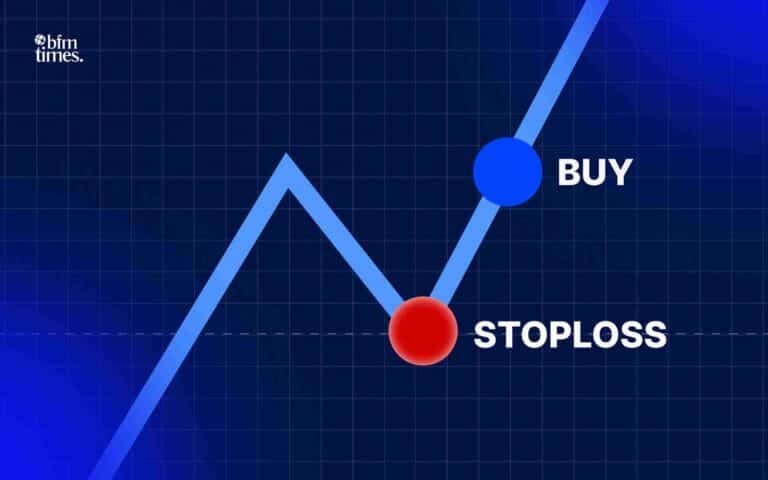
This type of order operates in a fairly straightforward manner. First, the order is placed at a price lower than the prevailing market price in case of a long position & at a higher price in the case of a short position. Once the price hits that point, the order will be activated & the position will be closed.
Why is Stop Loss in Trading So Important?
The stop loss in trading is important because it gives every trader a defined exit plan before entering a position. Without a stop loss, a trader is exposed to unlimited downside risk. The market can move very quickly in one direction & without a pre-set exit, emotions take over & lead to even bigger losses.
These are the key reasons why every trader must use stop loss in trading:
- Capital Protection: The stop-loss in the trade is used to reduce the amount of risk in case you lose the trade. In effect, the stop-loss prevents a bad position from affecting all the profit made by your entire portfolio in months.
- Emotion Control: The stop-loss takes away fear & greed from the decision making process. The stop loss acts automatically without the need to monitor the price change.
- 24/7 Market Protection: In crypto markets that trade 24 hours a day & 7 days a week, the stop loss protects your position even while you sleep. It is an essential tool for any crypto trader in 2026.
How to Calculate the Right Stop Loss Level?
The stop loss in trading should be placed at a logical price level, not just a random number. These are the most widely used methods to calculate the right stop loss:
Percentage Method
The percentage method sets the stop loss at a fixed percentage below the entry price. It is simple & easy to use for the beginners. A common rule is to not risk more than 1 to 2 percent of total trading capital on any single trade. For example, if you buy Bitcoin at $65,000 & set a 5 percent stop loss, the exit price would be $61,750.
Support Level Method
The support level approach involves placing the stop-loss order slightly below a significant level of support in the chart. This is based on technical analysis, & the logic behind it is that when the price drops below this support level, it means that the initial trading thesis is incorrect.
ATR Method (Volatility Based)
The Average True Range (ATR) indicator measures the average price movement of an asset over a set period. The stop loss is placed at a multiple of the ATR below the entry price. This method is very effective for volatile assets like Bitcoin & altcoins where a fixed percentage stop loss may be triggered too easily by normal market swings.
What is The Real World Example for Stop Loss in Trading?
The best way to understand stop loss in trading is through a real & practical example. The following example shows exactly how it works in a live trade scenario.
Consider the case when a trader purchases Ethereum at $2,500 in the middle of 2026 based on the discovery of a solid support at $2,350. He puts a stop-loss at $2,300 that is just under the support area. Also, he places a take-profit order at $2,900. Here, the risk per Ethereum will be $200 (difference between entry price and stop-loss price), & the reward will be $400 (difference between take-profit price and entry price). Thus, the risk to reward ratio is 1:2.
A few days later, the entire market goes down, & the price of Ethereum falls to $2,295, triggering the automatic stop loss set at $2,300 & leading to the closing of the position. The trader incurs losses of $200 for every ETH traded. The trade is closed without any emotions from the trader.
Let us now contrast this with a trader that did not use a stop-loss order. He saw the prices drop to $2,295 & opted to hold the position in hopes of a rebound. Prices however dropped further to $2,000. The trader who used the stop loss incurred losses of $200 while the one without incurred a loss of $500.
What are the Common Mistakes to Avoid When Using Stop Loss?
The stop loss in trading is a great instrument, which is extremely dangerous if used improperly. Below is the list of the most frequent errors that all traders should avoid:
- Setting Stop Loss Too Tight: Placing the stop loss too close to the opening price forces exiting the position due to market noise. The stop loss should be set up on a significant technical level, not a couple of ticks from the opening.
- Moving the Stop Loss Wider After Entry: The biggest emotional mistake in trading is widening the stop loss when the price moves against you. It defeats the entire purpose of risk management & leads to much larger losses.
- Using the Same Stop Loss for Every Trade: Various investments & time periods will require a different stop-loss approach. A 2% stop-loss for Bitcoin might be too tight, whereas 2% stop-loss on a low volatility stock might be too loose.
- Placing Stop Loss at Obvious Round Numbers: Stop loss orders placed at round numbers like $60,000 or $2,000 get targeted by large players who know many retail traders cluster their orders there.
Conclusion
Stop-loss in trading is not merely a part of the trading software but the backbone of every trader’s strategy. Stop-loss in trading is what protects your capital from losing money, takes away emotions & creates discipline necessary for trading success in the long run. In 2026, while markets will continue to be volatile for cryptos, stocks & forex, every trader will need to see the stop-loss in trading as an obligatory element of trading rather than a supplementary one. Properly implemented stop-loss in trading, combined with position sizing & accurate technical analysis, provides every trader with an opportunity to survive in the market & win profits. The first & foremost action to undertake is the implementation of the stop-loss in all trades.