The world of decentralized finance (DeFi) and Web3 has grown exponentially, and choosing the right gateway to this ecosystem is one of the most important decisions a crypto investor can make. Two names dominate: MetaMask and Trust Wallet. This MetaMask vs Trust Wallet guide provides a comprehensive DeFi wallet comparison and non-custodial wallet comparison. While both serve as bridges to the decentralized world, they offer significantly different experiences tailored to different types of users.
- Understanding the Basics: Non-Custodial Wallet Comparison in MetaMask vs Trust Wallet
- Trust Wallet vs MetaMask: Supported Blockchains and Assets
- Best Mobile Crypto Wallet: User Experience and Interface
- DeFi Wallet Comparison: Trading and Staking
- Ethereum Wallet Comparison: Smart Contract Interactions
- Security Features: How Safe Are They?
- NFT Support and Management
- Pros and Cons Recap
- Frequently Asked Questions
- Which is better for beginners – MetaMask or Trust Wallet?
- Can I use MetaMask and Trust Wallet together?
- Is MetaMask safer than Trust Wallet?
- The Verdict: Which One Should You Use?
In this MetaMask vs Trust Wallet comparison and Trust Wallet vs MetaMask analysis, we examine features, security, and networks. Whether seeking the best mobile crypto wallet or conducting an Ethereum wallet comparison, this guide provides clarity.
Also Read: Best Hardware Wallets for 2026: Top Cold Storage Crypto Wallets Compared
Understanding the Basics: Non-Custodial Wallet Comparison in MetaMask vs Trust Wallet
Before looking at specific features, it is essential to understand that both MetaMask and Trust Wallet are non-custodial wallets. This means that you, and only you, have control over your private keys and recovery phrases. Unlike a centralized exchange where the platform holds your funds, these wallets give you full sovereignty. However, this also means you are solely responsible for your security. If you lose your recovery phrase, neither MetaMask nor Trust Wallet can help you recover your assets.
What is MetaMask?
Launched in 2016 by ConsenSys, MetaMask was originally designed as a browser extension for the Ethereum network. It revolutionized how users interacted with decentralized applications (dApps) by allowing them to sign transactions directly from their web browsers. Over time, it expanded into a mobile app and began supporting other Ethereum Virtual Machine (EVM) compatible chains like Polygon and BNB Chain. It remains the industry standard for DeFi developers and power users.
What is Trust Wallet?
Trust Wallet was launched in 2017 and was later acquired by Binance in 2018. It was built from the ground up as a mobile-first application. Unlike the early versions of MetaMask, Trust Wallet was designed to be multi-chain from day one. It supports a massive array of blockchains beyond the Ethereum ecosystem, including Bitcoin, Solana, and Cosmos. It is often cited as the go-to choice for beginners who want a simple, all-in-one mobile experience.
Trust Wallet vs MetaMask: Supported Blockchains and Assets
One of the primary differences in the Trust Wallet vs MetaMask debate is the range of supported networks.
MetaMask: The EVM King
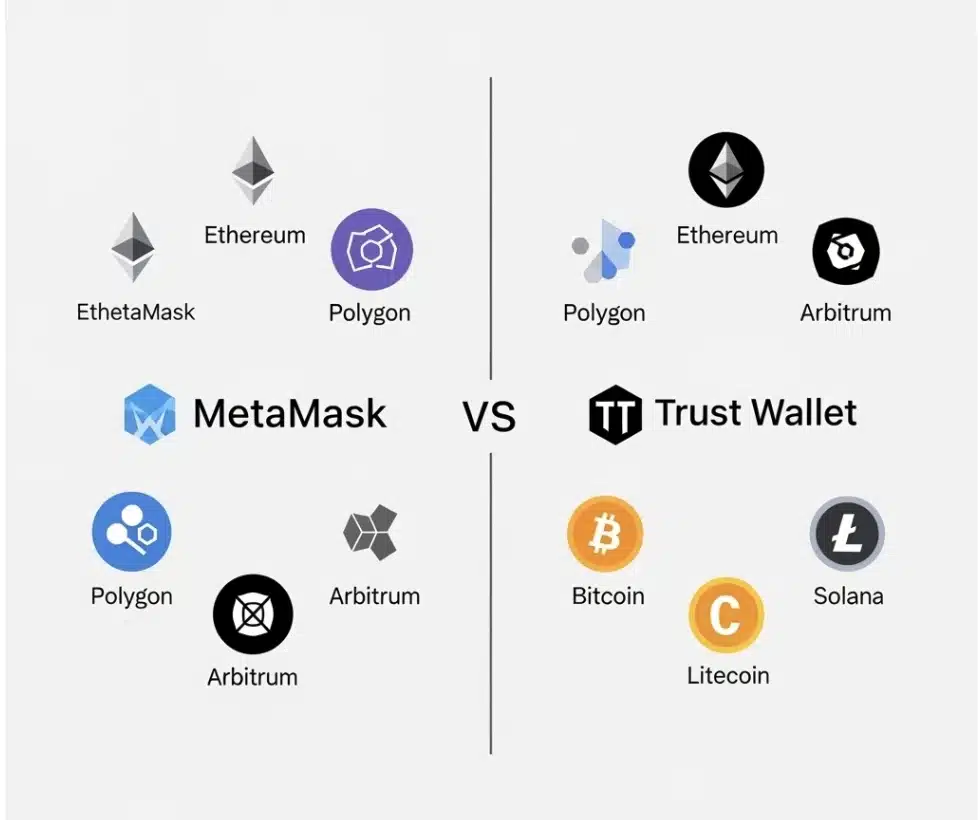
MetaMask is primarily an Ethereum-focused wallet. While it supports any chain that uses the Ethereum Virtual Machine (EVM), it does not natively support non-EVM chains like Bitcoin or Ripple. To use networks like Avalanche or Polygon, users often have to manually add the network settings (RPC URLs and Chain IDs), although modern updates have made this process much more automated.
Trust Wallet: The Multi-Chain Giant
Trust Wallet shines when it comes to diversity. It supports over 100 different blockchains and millions of individual tokens right out of the box. You do not need to manually configure networks to see your Bitcoin, Solana, or BNB Chain assets. This “zero-configuration” approach makes it incredibly convenient for investors who hold a diverse portfolio of assets across various protocols.
Best Mobile Crypto Wallet: User Experience and Interface
When searching for the best mobile crypto wallet, the user interface (UI) plays a massive role in the daily experience.
Mobile Experience
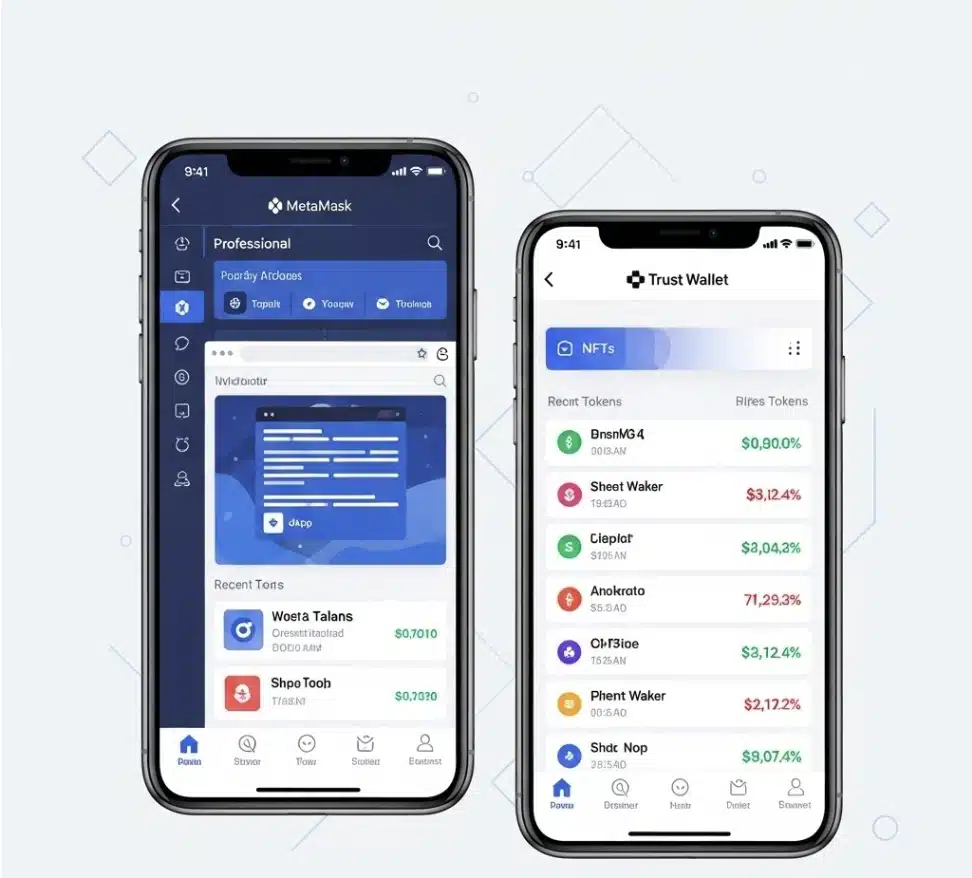
Trust Wallet has a slight edge in terms of pure mobile design. Its interface is clean and intuitive, with dedicated tabs for tokens, NFTs, and a built-in dApp browser. The app feels lightweight and responsive. MetaMask also has a robust mobile app, but because it started as a browser extension, some of the mobile workflows feel a bit more like a “companion” app rather than a standalone powerhouse. That said, MetaMask’s mobile browser is highly functional and syncs seamlessly with the desktop extension.
Desktop Experience
This is where MetaMask takes the lead. Most DeFi protocols are designed with the MetaMask browser extension as the primary connection method. If you spend most of your time on a laptop using platforms like Uniswap, Aave, or OpenSea, MetaMask provides a smoother, more integrated experience. Trust Wallet did launch a browser extension in 2023, but it is still catching up to the years of optimization MetaMask has put into its desktop software.
DeFi Wallet Comparison: Trading and Staking
For many users, a wallet is not just a place to store funds; it is a place to grow them.
Token Swaps
Both wallets offer built-in token swap features that aggregate liquidity from various decentralized exchanges to find you the best price. However, there is a notable difference in cost. MetaMask charges a service fee of 0.875% on every swap performed through its interface. This fee helps fund the development of the wallet. Trust Wallet, on the other hand, typically does not add its own service fee to swaps, meaning you only pay the underlying provider and network gas fees. For high-volume traders, this can make a significant difference over time.
Staking and Passive Income
Trust Wallet offers a much more accessible native staking experience. Within the app, you can stake assets like BNB, Cosmos (ATOM), and Tezos (XTZ) with just a few taps. It provides a clear dashboard showing your estimated annual yield and accumulated rewards.
MetaMask has recently introduced “MetaMask Staking,” but it is more focused on the Ethereum ecosystem. It allows users to stake ETH through providers like Lido and Rocket Pool directly from the wallet. While powerful for Ethereum enthusiasts, it lacks the multi-asset staking variety found in Trust Wallet.
Ethereum Wallet Comparison: Smart Contract Interactions
MetaMask remains the gold standard for anyone deeply involved in the Ethereum ecosystem. Because of its long history, nearly every dApp on Ethereum is optimized for MetaMask.
MetaMask provides more detailed information when you are signing a transaction. It offers advanced settings for gas limits and priority fees, which are essential when the Ethereum network is congested. For developers or advanced traders who need to fine-tune their transactions, MetaMask offers a level of control that Trust Wallet’s simplified interface sometimes obscures.
In an Ethereum wallet comparison, MetaMask is the “pro” tool, while Trust Wallet is the “consumer” tool. Trust Wallet is great for sending and receiving ETH, but MetaMask is superior for managing complex DeFi positions and interacting with experimental protocols.
Security Features: How Safe Are They?
Security is the top priority for any crypto user. Since both are non-custodial, the hardware of your device and your personal habits are the most important factors.
Encryption and Biometrics
Both wallets use industry-standard encryption and allow you to secure the app with biometrics (FaceID or Fingerprint) and PIN codes.
Hardware Wallet Integration
This is a critical area where MetaMask excels. MetaMask allows you to connect a hardware wallet like Ledger or Trezor to the browser extension. This means your private keys never leave the hardware device, but you can still use the MetaMask interface to interact with dApps. Trust Wallet supports Ledger, but the integration is generally considered less robust and more limited than MetaMask’s comprehensive hardware support.
Privacy
MetaMask is owned by ConsenSys, which has faced some scrutiny regarding the data it collects through its default RPC provider, Infura (such as IP addresses). Users can opt out of this by using a different RPC, but it requires technical knowledge. Trust Wallet claims to collect no personal data or IP addresses, making it a popular choice for privacy-conscious users who want a “plug and play” solution.
NFT Support and Management
The NFT craze has made wallet visuals more important than ever.
Trust Wallet provides a very clean “NFTs” tab that automatically detects and displays collectibles from multiple chains like Ethereum, Solana, and BNB Chain. It organizes them neatly into collections, making it easy to browse your digital art on the go.
MetaMask also supports NFTs, but the experience is more varied. On the mobile app, you can view your NFTs easily. On the desktop extension, however, the visual support for NFTs is still somewhat basic compared to the mobile experience. If you are an avid NFT collector who wants to show off your pieces on your phone, Trust Wallet currently offers a more aesthetically pleasing gallery.
Pros and Cons Recap
To help you finalize your decision, let us summarize the strengths and weaknesses of each.
MetaMask Pros:
- Best-in-class integration with Ethereum and EVM chains.
- Advanced transaction controls and gas settings.
- Superior desktop browser extension.
- Strongest hardware wallet support (Trezor and Ledger).
- The primary choice for developers and DeFi power users.
MetaMask Cons:
- High service fee (0.875%) on internal swaps.
- No native support for non-EVM chains like Bitcoin or Solana.
- Steeper learning curve for beginners.
Trust Wallet Pros:
- Native support for 100+ blockchains out of the box.
- Excellent, beginner-friendly mobile interface.
- Built-in staking for multiple assets.
- Zero additional service fees on token swaps.
- Superior NFT gallery across multiple chains.
Trust Wallet Cons:
- No native desktop app (only a browser extension).
- Limited hardware wallet support compared to MetaMask.
- Less advanced control over transaction parameters.
Frequently Asked Questions
Which is better for beginners – MetaMask or Trust Wallet?
Trust Wallet is generally easier for beginners because of its mobile-friendly interface and multi-chain support.
Can I use MetaMask and Trust Wallet together?
Yes, you can hold funds in both and connect MetaMask to dApps while using Trust Wallet for broader asset storage.
Is MetaMask safer than Trust Wallet?
Both offer similar non-custodial security, and safety mainly depends on how well you protect your seed phrase and device.
The Verdict: Which One Should You Use?
Choosing between MetaMask and Trust Wallet often comes down to your device of choice and the assets you hold.
If you are a DeFi enthusiast who uses a laptop to interact with Ethereum, Layer 2s like Arbitrum, or the BNB Chain, MetaMask is the essential tool. Its deep integration with the Web3 ecosystem and its power-user features make it indispensable for serious on-chain activity.
If you are a mobile-first user who wants to hold a bit of everything—Bitcoin, Ethereum, Solana, and some NFTs—without dealing with manual configurations, Trust Wallet is the winner. It is the best mobile crypto wallet for those who value simplicity and multi-chain variety.
Many experienced users actually choose not to decide at all. It is very common to use both wallets. You might keep your complex DeFi positions in MetaMask for desktop use and use Trust Wallet as your daily mobile driver for tracking your portfolio and staking various coins. Because they are both non-custodial, you can even import the same recovery phrase into both apps, though most security experts recommend keeping separate wallets for different purposes to minimize risk.
In the end, the MetaMask vs Trust Wallet debate highlights how far the industry has come. We now have two incredibly polished, secure, and functional gateways to the future of finance. Whichever you choose, remember that your security starts with you. Keep your recovery phrase offline, stay away from suspicious links, and enjoy the world of decentralized finance.
Disclaimer: BFM Times acts as a source of information for knowledge purposes and does not claim to be a financial advisor. Kindly consult your financial advisor before investing.