


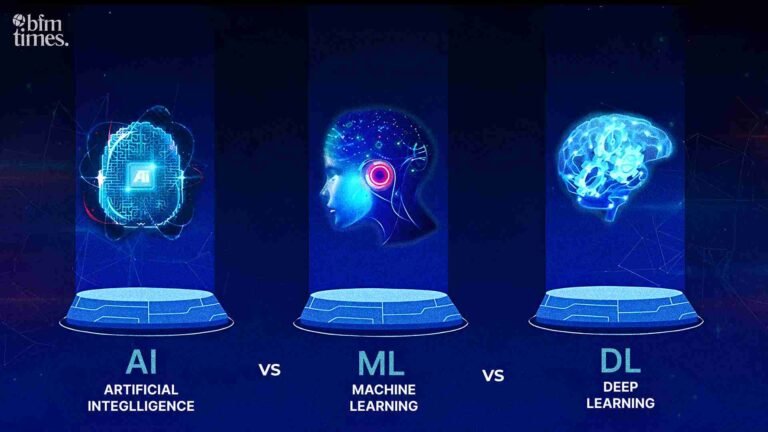
The world of technology is growing faster than ever. The terms ML vs AI vs deep learning are everywhere. They appear in news headlines & product descriptions & job postings. It is easy to get confused by these words. They sound similar, but they are not the same thing. Understanding ML vs AI vs deep learning helps you make better tech decisions. It also helps you understand the digital world around you.
- What Is Artificial Intelligence?
- What Is Machine Learning?
- What Is Deep Learning?
- What Is the Core Relationship Between ML, AI, and Deep Learning?
- What Are the Key Differences Between ML, AI, and Deep Learning at a Glance?
- What Are the Real-World Applications of AI, ML & Deep Learning?
- Conclusion
- Frequently Asked Questions (FAQs)
In this article, readers will gain insights into the ML vs AI vs Deep Learning: Key Differences Explained featured on BFM Times.
What Is Artificial Intelligence?
Artificial Intelligence is the broadest concept of the three. It refers to any machine that performs tasks like a human. These tasks include reasoning & problem solving & learning. The goal of AI is to simulate human intelligence in machines. It does not always mean the machine learns on its own. Some AI systems simply follow pre-written rules.
The “if this then that” rule is a basic form of AI. It does not require any data learning at all. AI covers everything from a simple chess program to a complex chatbot. The key point is that AI is the big umbrella under which everything else fits. Machine learning & deep learning both fall under this umbrella.
What Are the Types of AI Systems?
The AI field includes many different types of systems. Rule-based AI follows fixed instructions written by humans. It works well for simple & predictable tasks. Reactive machines respond to input without storing memory. Limited memory AI learns from past data to make future decisions. Theory of mind AI tries to understand human emotions & thoughts. This type is still in development today. General AI aims to think like a full human brain. We have not achieved this level yet. The AI systems we use every day are narrow. They are designed to do one specific task very well.
What Is Machine Learning?
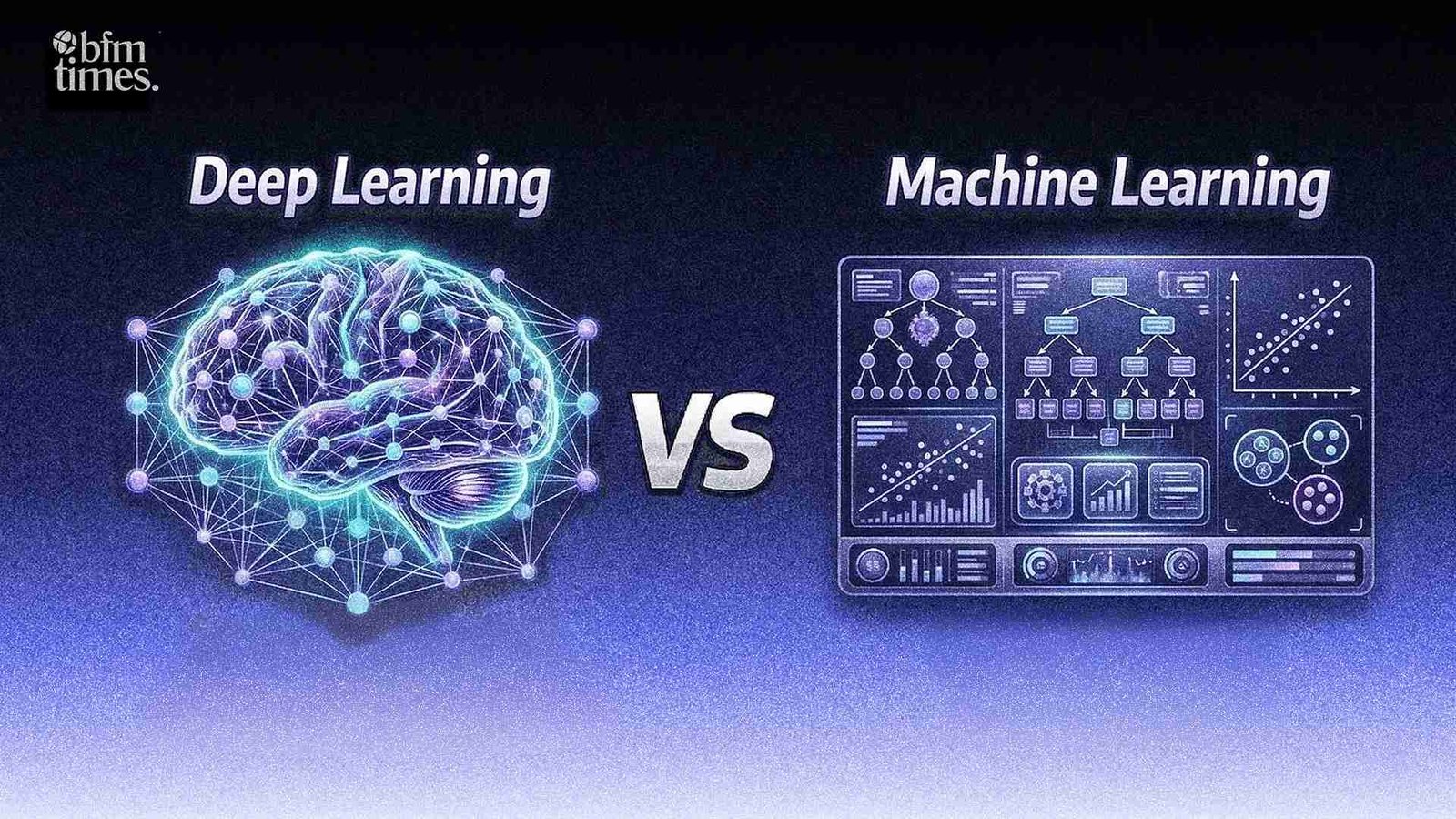
In comparison of ML vs AI vs deep learning, Machine learning is a subset of AI. It focuses on teaching machines to learn from data. Instead of writing rules for every situation, a human feeds examples to the system. The system then finds patterns in those examples. It uses those patterns to make decisions & predictions. ML improves over time as it reads more data.
Email spam filters are one of the great examples of machine learning. They learn which emails are spam by studying thousands of such examples. Recommendation systems on all of the streaming platforms also use machine learning. They study your watch history to suggest new content. The key thing about ML is that it needs human involvement to prepare & also to label the data.
What Are the Types of Machine Learning?
There are four main types of machine learning that are used today.
- Supervised learning uses labeled data to train the model. That means the model learns from examples that already have correct answers for things.
- Unsupervised learning works with unlabeled data. That means the model finds hidden patterns on its own; there are no correct answers to it.
- Semi-supervised learning uses a mix of both the labeled & unlabeled data. It is useful when labeling data is expensive or they are time-consuming.
- Reinforcement learning trains a model using rewards & also the penalties. The model learns the best action by the trial-and-error method.
What Is Deep Learning?
In comparison of ML vs AI vs deep learning, Deep learning is a subset of machine learning. It uses artificial neural networks with many layers. The word “deep” refers to the number of layers in the network. Each layer learns a different level of pattern from the data. The first layer may learn edges in an image. The next layer may learn shapes.
The final layer may recognize full objects like faces or cars. Deep learning does not need humans to tell it what features to look for. It discovers those features automatically from raw data. This makes it very powerful for complex tasks. Voice assistants like Siri & Alexa use deep learning to understand speech. Medical imaging tools use it to detect diseases in scans.
How Do Deep Learning Neural Networks Work?
The neural network in deep learning is inspired by the human brain. It contains many of the connected nodes called neurons. These neurons pass information from layer to layer. Each layer transforms the data into something more abstract. The more layers a network has, the more complex patterns it can learn. Training a deep learning model requires a huge amount of data. It also requires significant computing power, like GPUs.
The training process takes much longer than any of the traditional ML methods. The result is a model that can perform tasks with very high accuracy. This is why deep learning powers the self-driving cars & also language translation & image recognition today.
What Is the Core Relationship Between ML, AI, and Deep Learning?
The relationship between these three, ML vs AI vs deep learning, is like a nested circle. AI is the biggest circle. ML sits inside the AI circle. Deep learning sits inside the ML circle. This means all of the deep learning is machine learning. All machine learning is AI. The reverse is not true at all. Not all AI is machine learning, but not all machine learning is deep learning. Think of it like this. AI is the destination.
ML is one road to get there. Deep learning is a powerful vehicle that travels on that road to take you there quickly. They work together in these modern technology systems. The best AI products combine all of these three approaches based on the task at hand.
What Are the Key Differences Between ML, AI, and Deep Learning at a Glance?
| Feature | Artificial Intelligence | Machine Learning | Deep Learning |
| Definition | Machines mimicking human intelligence | Machine learning from data | Neural networks learning from raw data |
| Scope | Broadest concept | Subset of AI | Subset of ML |
| Data Needed | Low to High | Moderate to High | Very Large Datasets |
| Human Involvement | High for rule-based systems | Moderate | Low |
| Feature Engineering | Manual or none | Required | Automatic |
| Computing Power | Low to Moderate | Moderate | Very High |
| Interpretability | High for simple models | Moderate | Low |
| Real-World Examples | Chess engines, expert systems | Spam filters, recommendation engines | Image recognition, voice assistants |
| Accuracy | Varies by approach | Good for structured data | Very high for complex data |
What Are the Real-World Applications of AI, ML & Deep Learning?
These technologies power many of the products we are using every day. Understanding their applications helps us to connect the theory to real-life implementation. It also shows why understanding ML vs AI vs deep learning is so important for everyone.
AI in Everyday Life
The AI we interact with daily includes virtual assistants & the smart search engines. Google Search uses AI to rank the pages & it also understands all the queries. Navigation apps like Google Maps use AI for traffic prediction. To prevent fraud, banks use AI to flag all of the suspicious activity. Customer service chatbots handle most of the basic questions using rule-based AI. These systems may or may not use machine learning under the hood.
Machine Learning in Business
Businesses use machine learning to gain data-driven insights. E-commerce platforms use ML to predict what customers will buy next. Banks use ML models to assess loans and prevent default risk. Marketing teams use ML to predict customer churn. Healthcare companies use ML to analyze patient records & to predict the outcomes. The power of ML lies in its ability to improve with more data available.
What Is the Future of ML vs AI vs Deep Learning?
The lines between these, ML vs AI vs deep learning technologies, are disappearing fast. AI is becoming more powerful with every year. Machine learning models are getting more and more efficient with less data needed to be trained. Deep learning is pushing into new fields like drug discovery & the climate modeling. Hybrid systems that combine both ML & deep learning are now very common and are being used on a large scale.
The rise of generative AI has brought deep learning to the mainstream. Tools like image generators & the code assistants use deep learning at their core. The demand for professionals who understand ML vs AI vs deep learning is growing rapidly. Companies across every industry are hiring AI talent. The future belongs to those who understand these technologies deeply.
Conclusion
The differences between these, ML vs AI vs deep learning, are very clear once you break them down. AI is the broadest field that covers all of the intelligent machine behavior. Machine learning is a powerful subset of AI that lets machines learn from the set of data. Deep learning takes it even further with multi-layered neural networks. Each technology has its own strengths & their own use cases.
The best solutions often use all three of these together. Understanding ML vs AI vs deep learning gives you an edge in the modern tech world. It helps you to choose the right tool for the right problem. It also helps you understand the AI-powered products shaping our lives. The journey into artificial intelligence starts with getting these basics right. The more you explore ML vs AI vs deep learning, the better equipped you become for the future to survive.
Frequently Asked Questions (FAQs)
What is the main difference between AI & ML & deep learning?
AI is the broad concept of machines acting like humans. ML is a subset of AI where machines learn from data. Deep learning is a subset of ML that uses these multi-layered neural networks. They follow a nested relationship where each one builds on the previous.
Is deep learning better than machine learning?
Deep learning is not always better than machine learning. It excels with the large & unstructured data like images & speech. Machine learning works better with smaller & structured datasets & when interpretability matters. The best choice depends on the specific task, availability of the data & the resources.
Do I need to learn ML before deep learning?
It is strongly recommended to learn ML before diving into deep learning. ML provides the foundational understanding of the algorithms & how the data is handled. Deep learning builds on those concepts using neural networks. Starting with ML makes it much easier to understand the core deep learning models.
Disclaimer: BFM Times acts as a source of information for knowledge purposes and does not claim to be a financial advisor. Kindly consult your financial advisor before investing.