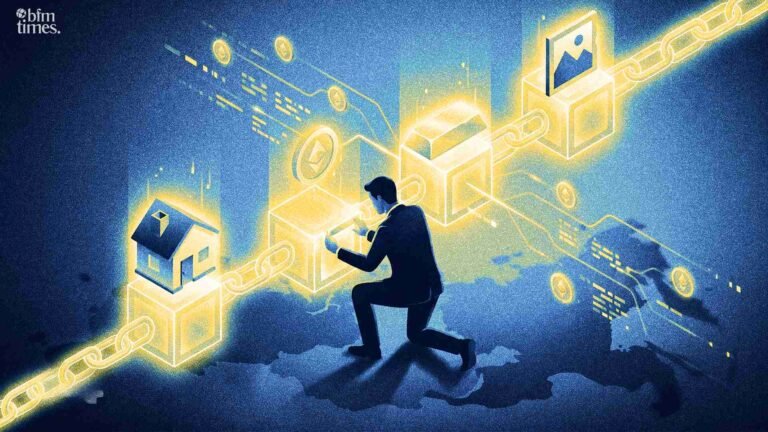
Real-World Assets (RWAs) are physical assets converted into blockchain tokens. This is done to enable quick and easy transfer, fractional ownership, and facilitate cross-border exchanges, giving them the power of blockchain technology for improved efficiency.
- What is a Real World Asset in Crypto?
- How Does RWA Tokenization Work in Blockchains?
- What are the Different Types of Real World Assets that can be Tokenized?
- Why is Real World Asset Tokenization Growing So Fast?
- What Role Does Crypto Play in All This?
- What Are the Key Benefits of Tokenized Assets?
- What Does the Future Look Like for Real World Assets?
- Conclusion
- Frequently Asked Questions (FAQs)
Assets such as tokenized ETFs, tokenized money market funds, phygital NFTs, land tokenization, etc., come under real-world assets. The process of converting these assets into blockchain tokens is called Asset Tokenization.
What is a Real World Asset in Crypto?
Real-world asset tokenization is the process of transferring ownership of an asset to a token on a blockchain platform. As a result, whoever owns the token is entitled to ownership of the asset.
For example, the most common type of real-world asset we use in our daily lives is money market funds. Previously, these funds were held in liquid fund ETFs, but now they are also tokenized by platforms such as BlackRock and are available worldwide.
Each RWA can be converted into one or even thousands of tokens. Each token represents a fraction of an asset stored in a blockchain. A blockchain is a highly secure, immutable, and decentralized ledger used to record asset transactions and transfers, which enables trustless trading and exchange of such assets.
How Does RWA Tokenization Work in Blockchains?
The tokenization process consists of five key steps:
- Step 1 – Asset Selection: Select an asset to tokenize. This can include real estate property, gold bars, bonds, private credit, artwork, etc.
- Step 2 – Legal Structuring: The asset is properly legalized and structured in accordance with relevant laws. For example, the tokenized markets in the USA require separate laws, whereas in the UK, the already present equity laws rule them.
- Step 3 – Asset Evaluation: The selected asset undergoes professional assessment and valuation. The outcome will determine the price of a token.
- Step 4 – Token Implementation: Token implementation involves deploying a smart contract that generates and controls token issuance and use, i.e., allows trading, selling, or storing tokens.
- Step 5 – Issuance and Trading: The asset becomes tradable after tokenization. Tokens will be available for sale, buying, and storage on approved trading platforms.
What are the Different Types of Real World Assets that can be Tokenized?
The list of assets suitable for tokenization is constantly growing. The examples of various assets are presented in the table below:
| Asset Type | Examples |
| Private Credit | Business loans, short-term lending |
| U.S. Treasuries | Government bonds |
| Real Estate | Commercial real estate, residential real estate portfolios |
| Commodities | Gold, silver, iron ore, energy |
| Alternative Funds | Money market funds, hedge funds |
| Artwork & Collectibles | Fine art, rare collectibles |
Why is Real World Asset Tokenization Growing So Fast?
Below are several reasons behind the explosive growth of real-world asset tokenization.
- Greater Accessibility: Prior to tokenization, only institutional investors could invest in expensive assets, such as prime real estate and private credit funds. However, thanks to tokenization, anyone can now invest in them even with a small amount of money.
- Faster Transactions: Compared to traditional asset transfers, blockchain transactions are executed much faster due to automation and decentralization provided by smart contracts.
- Transaction Transparency: Transactions that take place within a blockchain cannot be interfered with. Hence, anyone can trace the history of ownership of any token.
- Round-the-Clock Global Markets: There are no limitations on trading times. Blockchain-based assets can be traded at any time of day, seven days a week, worldwide.
- Trust: Some of the largest investment companies in the world, including BlackRock, Franklin Templeton, Goldman Sachs, and Fidelity, actively create and issue blockchain assets.
Increasing credibility in this industry is also supported by government regulations in this sphere. More details about crypto regulations worldwide can be found here
What Role Does Crypto Play in All This?
The term “RWA crypto” describes utilizing cryptocurrency networks or blockchain technology for trading real-world assets.
It is essential to realize that RWA tokens are not the same as traditional cryptocurrency tokens. While Bitcoin or Ethereum gain their value from the market and the underlying technology, asset-backed tokens depend on a specific physical or financial asset. This increases their stability, transparency, and credibility.
RWA crypto serves as a connection between traditional finance (TradFi) and decentralized finance (DeFi). RWA crypto bridges the gap between old-school financial instruments and new technologies. For a beginner-friendly breakdown of how this decentralized side works, check out this guide on how DeFi works in crypto.
What Are the Key Benefits of Tokenized Assets?
Below is a quick comparative chart outlining key benefits of tokenized assets compared to traditionally held assets.
| Feature | Traditional Assets | Tokenized Assets |
| Minimum Investment | Often $100,000+ | Can start with $100–$1,000 |
| Settlement Time | 2–5 business days | Near real-time |
| Market Hours | Limited (market hours) | 24/7 |
| Transparency | Limited | Full blockchain visibility |
| Geographic Reach | Local or regional | Global |
| Intermediary Costs | High (5–8% issuance fees) | Low (1–3% issuance fees) |
| Fractional Ownership | Rare | Built-in |
What Does the Future Look Like for Real World Assets?
The future of real-world assets is immense. Below are some key projections:
- McKinsey forecasts a tokenized asset market worth $2 trillion dollars by 2030
- Even more optimistic forecasts predict a market of $30 trillion dollars in tokenized assets by 2030
- According to Standard Chartered forecasts, this market may reach $30 trillion dollars by 2034
- The global tokenization market will be worth $5,254 billion dollars in 2029 at a compound annual growth rate (CAGR) of 43.36%
The on-chain RWA industry has already seen some diversification. By early 2026, each of at least six different asset categories will have independently surpassed the $1 billion mark in on-chain value. Such an ecosystem with six pillars is much stronger than one based on just one pillar.
With maturing regulation, increased adoption, and rising awareness, real-world asset tokenization looks poised to become a core part of global finance. For those interested in how institutional players are approaching on-chain settlements specifically, this piece on institutional on-chain settlement is worth reading.
Conclusion
Real-world asset tokenization is a groundbreaking financial innovation of our age. It allows us to convert physical and financial assets, such as real estate, bonds, precious metals, and credit, into digital assets secured on blockchain networks.
This process is supported by numbers. Today, the size of the RWA market is $3.8 trillion, up 380% in just three years. BlackRock, Goldman Sachs, and Franklin Templeton have already made themselves fully committed to this industry, and there are even regulatory advances being made.
Frequently Asked Questions (FAQs)
What is the difference between RWA crypto and regular cryptocurrency?
Unlike regular cryptocurrencies such as Bitcoin or Ethereum, RWA crypto is backed by physical and financial assets, including real estate, commodities, precious metals, and government bonds. Because of that, RWA crypto tends to be less volatile.
Can beginners invest in tokenized assets?
Yes, one of the key advantages of tokenized assets is their accessibility. You do not need hundreds of thousands of dollars to invest, since some platforms allow minimum investments starting at $100 to $1,000. Please make sure you understand the platform requirements for KYC, etc.
Is real-world asset tokenization legal?
Yes, real-world assets are perfectly legal. Countries such as the United States of America, Singapore, Hong Kong, and the United Arab Emirates have adopted regulatory guidelines for tokenized assets. Moreover, most regulated platforms require identity verification of their users.
Disclaimer: BFM Times acts as a source of information for knowledge purposes and does not claim to be a financial advisor. Kindly consult your financial advisor before investing.