


Generative AI has gone from hype to infrastructure within record time. It is the code for writing-generating designs, automating content, and redefining decision-making in industries. However, behind this rapid adoption, there is an increasing list of concerns, no longer theoretical; they are already being acted out in real-life situations.
- Generative AI Is Powerful: But Not Without Serious Risks
- The Core Problem: Generative AI Doesn’t Actually “Understand”
- Accuracy Issues: When AI Sounds Right but Is Completely Wrong
- Data Privacy and Security Risks: What Happens to Your Data?
- Intellectual Property and Legal Risks
- The Hidden Risk: Overdependence on AI Systems
- Lack of Transparency: The Black Box Problem
- Security Threats: Deepfakes, Scams, and Misinformation
- Environmental and Cost Concerns
- The Bigger Risk: Societal and Economic Impact
- Why These Risks Are Increasing in 2026
- The Real Limitation: AI Cannot Think Like Humans
- Generative AI Is Not Dangerous: Misuse Is
- Frequently Asked Questions
Risks of generative AI are not merely technical flaws; these are more of systemic, ethical, and social issues that need to be taken seriously. The problems mentioned, be they misinformation, bias, or a leak of privacy, one can note that generative AI is not an ideal system of intelligence. In fact, understanding the risks of generative AI is now essential for anyone using or building with these tools.
Generative AI Is Powerful: But Not Without Serious Risks
Generative AI is proliferating at a greater rate compared to regulatory rates across industries. Entrepreneurs are investing in complete enterprises around it, companies are automating workflows with it, and people are using it as a daily productivity tool.
However, this fast growth is accompanied by untold AI risks and challenges that the majority of users are not well-informed about. Regulators and international entities have already begun marking generative AI limitations, in particular, misinformation, security, and misuse of its ethical capabilities.
The peculiarity of this technology is that it may both result in innovations and cause harm on a large scale. The technology that composes useful content can also create fake news, impersonate voices, or control the opinions of people. This bifurcationality is the basis of the risks of generative AI, which is simultaneously potent and even harmful.
The Core Problem: Generative AI Doesn’t Actually “Understand”
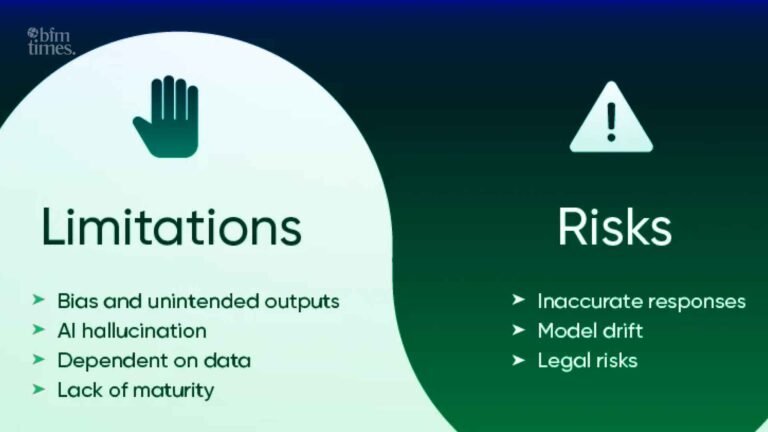
Generative AI does not understand the meaning, truth, and context as humans do. It makes predictions using very large amounts of data; it is a statistical prediction of what words or outputs are likely to be the case, not what is true in fact.
This results in one of the biggest common problems with AI: it has the ability to come up with extremely believable answers that are entirely incorrect.
These systems are devoid of reasoning, awareness, and grounding in the real world. What knowledge they do not have, they feign to know. As a result:
- They produce hallucinations (fabricated information)
- They generate confident but incorrect outputs
- They fail in unfamiliar or nuanced scenarios
This is the main constraint of the risks of generative AI, as users tend to confuse fluency and accuracy. People are inclined to trust AI when it is perceived as intelligent, even in cases when it is not.
Accuracy Issues: When AI Sounds Right but Is Completely Wrong
Among the most harmful disadvantages of AI, there is the possibility of creating false information that is based on credibility. Generative AI does not check facts but rather produces answers in accordance with the probability.
This results in hallucinations; the system makes new statistics, references, or explanations that do not exist. It may also give outdated or inaccurate information, particularly in the event of being trained using fixed datasets.
The effects are not insignificant. In high-stakes domains:
- Healthcare: Incorrect medical advice can harm patients
- Legal: Fabricated case laws can mislead legal professionals
- Finance: Inaccurate analysis can result in financial losses
This is not an edge case; this is a real-world example of how risks of generative AI can be. It is not only the question of inaccuracy but also the certainty with which AI delivers wrong data, which is more difficult to notice.
Data Privacy and Security Risks: What Happens to Your Data?
With generative AI, there is a risk involved with each prompt you provide to the system. Your data can be stored, analyzed, or even used to train models, depending on the platform.
This raises severe AI ethical concerns of data ownership and confidentiality. Users, in most cases, end up sharing sensitive information without even knowing that it is confidential information.
The reality is more complex:
- Logging and review of inputs can be done.
- Delicate company information may be released.
- Personal information could be unintentionally reused
This turns out to be a big security concern for businesses. Sensitive files, internal plans, or company data that is keyed into artificial intelligence systems may result in accidental spills.
The risks of generative AI in this context are not hypothetical, they directly affect compliance, trust, and data governance.
Intellectual Property and Legal Risks
The legal environment surrounding generative AI is still evolving, and that uncertainty itself is a risk.
Significant amounts of publicly available information are trained on AIs, and this content might consist of copyrighted content. When such systems create content, there are questions:
Who owns the output?
Is it original or based on the work?
This creates significant generative AI limitations in professional use cases, particularly for content creators, designers, and developers.
There is also the risk of unintentional plagiarism. The content created by AI can be close to existing, which can result in legal issues.
The risks of generative AI here are not just technical, but they also overlap with the intellectual property laws that are yet to be updated to the technology.
The Hidden Risk: Overdependence on AI Systems
This is where the deeper things start, and there is more concern.
With the increasing use of generative AI in everyday work processes, users start overusing it. In the long run, this decreases critical thinking, creativity, and problem-solving on their own.
Instead of checking the outputs, individuals begin to accept them. They begin prompting instead of thinking.
This overdependence is one of the most overlooked AI risks and challenges. It brings about a silent transition in the human knowledge and decision-making interaction.
The long-term effect?
- Decline in original thinking
- Reduced accountability
- Blind trust in automated systems
The threats of generative AI are not only concerned with the capabilities of the technology itself but also with the way that it transforms human behavior.
Lack of Transparency: The Black Box Problem
Most generative AI systems operate as black boxes. They produce outputs without clear explanations of how those outputs were generated.
This lack of transparency creates serious challenges:
- Difficult to audit decisions
- Hard to debug errors
- Limited accountability
This becomes a significant problem in sectors like healthcare and finance. It becomes challenging to trust or control an AI system if it makes a recommendation and no one knows why.
These limitations of generative AI reveal a basic disconnect between interpretability and performance.
Security Threats: Deepfakes, Scams, and Misinformation
The difficulty of producing phony content has been greatly reduced by generative AI. The sophistication of automated phishing messages, AI-generated voices, and deepfake videos is rising.
This is one of the most visible risks of generative AI today.
Cybercriminals are already using AI to:
- Impersonate individuals
- Create fake news at scale
- Launch targeted scams
Fraud detection is made more difficult by the speed and realism of AI-generated content. As a result, new digital threats emerge that are difficult for conventional security systems to manage.
Environmental and Cost Concerns
Large AI models need a lot of processing power to train and operate. Significant energy consumption and environmental effects result from this.
Large amounts of electricity are used by data centers that power AI systems, which increases carbon emissions. Data centers that run AI systems consume a lot of electricity, which raises carbon emissions. However, the cost of developing and maintaining these systems is very high.
These disadvantages of AI are crucial when assessing long-term sustainability, but they are frequently overlooked in popular discourse.
The Bigger Risk: Societal and Economic Impact
The risks of generative AI affect society as a whole, not just specific users or organizations.
We are already seeing the following:
- Job displacement in creative and technical roles
- Misinformation is spreading faster than ever
- A growing trust crisis in digital content
The basis of trust starts to deteriorate when people are unable to discern between information produced by AI and that which is genuine.
This is a social change rather than merely a technological problem. The way we engage with information, work, and even truth itself is being redefined by these AI risks and challenges.
Why These Risks Are Increasing in 2026
Adoption of AI has surpassed governance in speed. Businesses are implementing AI systems more quickly than they can create regulations about them
There are inconsistent ethical frameworks, little oversight, and no standard regulations.
As a result, the risks of generative AI are increasing, not because the technology is new, but because its usage is expanding without sufficient control.
The Real Limitation: AI Cannot Think Like Humans
Despite its capabilities, generative AI cannot replicate human thinking. It lacks intuition, emotional intelligence, and true creativity.
It does not generate ideas; it recombines existing patterns.
This is the ultimate generative AI limitation. No matter how advanced the model becomes, it remains dependent on data and probabilities.
Understanding this is key to mitigating the risks of generative AI, because it reminds us that AI is a tool, not a replacement for human intelligence.
Generative AI Is Not Dangerous: Misuse Is
Generative AI is one of the most powerful technologies of our time, but it is also deeply flawed. The risks of generative AI do not come from the technology alone but from how it is used, misunderstood, and over-relied upon.
Misuse, lack of awareness, and blind trust amplify these risks.
Learning how to use AI responsibly is the true challenge, not stopping it.
Because in the end, the biggest risk of generative AI is not the system itself, but the human decisions behind it.
Frequently Asked Questions
What are the main risks of generative AI?
The main risks of generative AI include hallucinations, bias, data privacy issues, misinformation, and a lack of transparency.
Why is generative AI sometimes inaccurate?
Because it predicts patterns rather than understanding facts, leading to incorrect or fabricated outputs.
Is generative AI safe to use?
It is safe when used carefully, but users must verify outputs and avoid sharing sensitive information.
What are the ethical concerns of AI?
Key AI ethical concerns include bias, discrimination, misinformation, and lack of accountability.
Can generative AI replace human thinking?
No, it lacks true reasoning and creativity and should be used as a support tool, not a replacement.
Disclaimer: BFM Times acts as a source of information for knowledge purposes and does not claim to be a financial advisor. Kindly consult your financial advisor before investing.