



Cryptocurrency has left behind the past, when it was dominated by buying and holding coins. Today, users quickly trade in and out of their currencies, make instant payments, interact with dApps, buy NFTs, and participate in DeFi platforms. For all these day-to-day crypto transactions, hot wallets are the go-to and most popular solution.
A hot wallet is one connected to the internet. They enable the instant sending, receiving, trading, and management of crypto assets. Hot wallets, which may be mobile apps, desktop software, or browser extensions, are what make these tools very accessible for day-to-day use.
Hot wallets are key in the crypto space, which we see as very fast and borderless. When you need to pay out, trade tokens, or interface with Web3 platforms, you want instant access to your funds. Hot wallets give you what makes them the choice for day-to-day transactions.
However, we see that hot wallets are online, which in turn means users have to follow better security practices. They do well for holding small to medium amounts of crypto for everyday use, but for long-term storage, it is better to use cold or hardware wallets.
In this guide, we will go over what hot wallets are, what they do, the pros and cons of using them, and which are the best hot wallets for day-to-day crypto transactions.
History of Digital Purses.
Hot wallets have been around since the start of crypto. At Bitcoin’s introduction in 2009, users stored their coins in online desktop wallets. While these early wallets were simple in design, they did allow for easy transfer in and out of Bitcoin.
As more people adopted crypto, mobile wallets developed as a platform, making crypto accessible to a larger audience. With the introduction of Ethereum and smart contracts, hot wallet growth surged. Also at this time, wallets like MetaMask enabled users to interface directly with decentralized apps, which in turn drove the growth of DeFi, NFTs, and Web3.
Over time, hot wallets have grown to support many blockchains and a wide variety of tokens, and they now include staking, token swaps, NFT storage, and in-app browsers. Today’s hot wallets strike a balance between convenience and security, with features such as encryption, biometric access, and hardware wallet integration.
Today we see that hot wallets are a main component in the crypto environment, and they are used by millions of people worldwide.
What are Hot Wallets and how do they function?
Hot wallets put users’ private keys in encrypted form on connected devices. Private keys’ role is that of which they sign transactions and prove ownership of crypto assets. Upon a user’s initiation of a transaction, the wallet digitally signs it and sends it to the blockchain network.
Internet connection speed.
Because hot wallets are always on, we see almost immediate transaction processing, which in turn makes them very useful for trading, payments, and interacting with decentralized apps. Speed and ease of use are the hot wallet’s greatest assets.
Transmitting and Receiving Crypto.
To get crypto into your account, users just give out their wallet address or QR code. To send out, crypto users enter the recipient’s address, select the amount to send, and confirm the transaction. Network fees are a go based on blockchain traffic, and confirmation times will vary by network.
Wallet security.
Hot wallets are for daily use, which is fine, but they pose a greater risk than cold wallets due to their internet connection. Most reliable wallets use strong encryption, passwords, PINs, and biometric authentication to protect private keys.
Security is also a major issue related to what the user does. Phishing, fake apps, and malicious links are the main risks. Hackers tend to go after users instead of the wallet software.
To reduce risk, users should deposit only what is spent into hot wallets and keep large sums in cold storage. Also, many hot wallets offer hardware wallet integration, which adds an extra layer of security.
Different kinds of Hot Wallets.
Hot wallets in various forms exist each for different use cases:.
- Mobile payment apps you download to your phone for easy payment and convenience.
- Desktop clients: software installed on your computer that gives you more control.
- Wallet extensions for your browser, which include MetaMask for Web3 and DeFi.
- Online wallets accessed through browsers are also typically custodial and exchange-linked.
- Each set has its own degree of convenience and security.
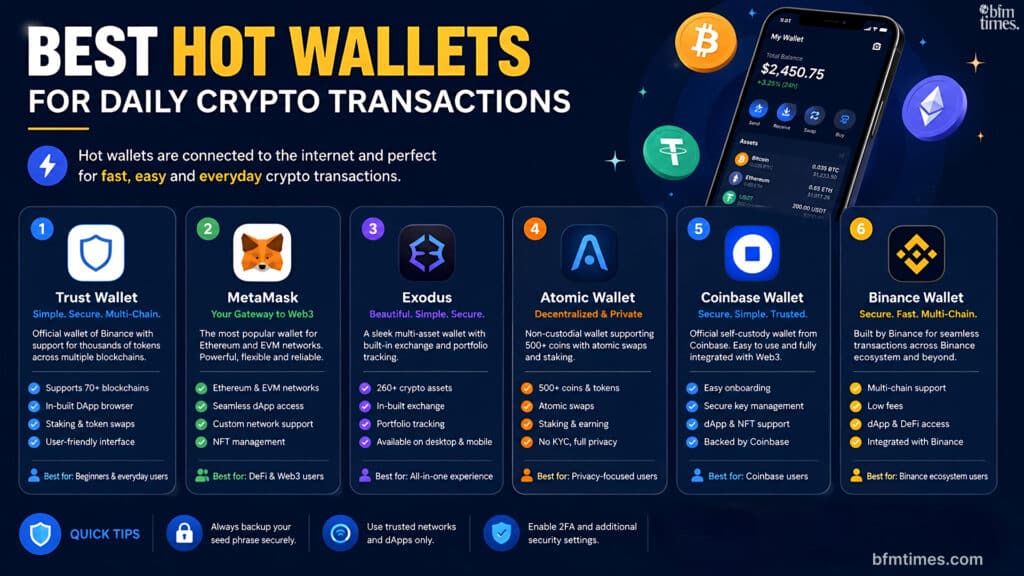
- Best crypto wallets for daily transactions.
Meta Wallet.
MetaMask is a widely used hot wallet that supports Ethereum and EVM-compatible blockchains. We have it as a browser extension and mobile app.
Best for: Decentralized Finance, NFTs, and Ethereum-based transactions.
Key features: Custom nets, token trades, and hardware wallet support.
MetaMask is best for users who engage with Web3.
2 Wallet Trust.
Trust Wallet is a mobile-oriented hot wallet that supports a wide range of cryptocurrencies across multiple blockchains.
Best for: New and multi-chain users.
Key features: Simple interface, support for staking, built-in dApp browser.
It is used every day for mobile payments.
Coinbase Account.
Coinbase Wallet, which we have developed, is a non-custodial wallet. We see it differently from exchange wallets in that you control your private keys.
Best for: Users who prefer convenience over security.
Key features: Web access 3, NFT storage, and hardware wallet integration.
For users leaving centralized exchanges.
Exodus Purse.
Exodus has a very clean and attractive design, which is also present in their desktop and mobile versions.
Best for: People who prefer simplicity.
Key features: Integrated exchange, multi-asset support, easy setup.
Exodus is great for beginners.
Phantom Wallet.
Phantom is the dominant wallet in the Solana ecosystem.
Best for: Solana community members.
Key features: Quick transactions, NFT support, staking.
It is designed for speed and low fees, which in turn makes it great for daily use.
Warm and Cold Wallets.
Hot wallets and their cold wallet counterparts have different uses. For frequent transactions, wallets are the way to go, but for long-term secure storage, cold wallets are your best option.
Wallets are fast, easy to use, and give access to Web3, but they also pose greater online security risks. Cold wallets, which remain offline, are best for large-scale secure storage.
Most heavy users of the system use wallets for their day-to-day activities and cold wallets for savings.
How to Protect a Hot Wallet.
To use a hot wallet safely is a common requirement.
- Use strong passwords and biometric locks
- Do not share your private keys or recovery phrases.
- Download from official websites and app stores only.
- Be on guard for phishing links and fake apps.
- Regularly update wallet software
- Good security habits significantly reduce risk.
Are hot wallets secure for beginners?
Yes, indeed, hot wallets are beginner-friendly when used properly and responsibly. Most modern wallets are designed with new users in mind, as evidenced by guided setup processes that walk you through each step in a simple, easy-to-understand way. From the creation of your wallet to the secure storage of a recovery phrase and your first transaction, the wallets provide clear instructions, which in turn reduces confusion and helps users to feel very confident from the start.
Conclusion
Hot wallets are a key tool for the daily crypto user. As the crypto space grows beyond basic buy-and-hold, we see an increasing need for fast, reliable access to digital assets outside the wallet. Hot wallets make it easy for users to go about everyday crypto activities like sending and receiving crypto, trading tokens, and engaging with decentralized apps (dApps) in the Web3 space.
Although hot wallets aren’t designed for long-term storage of large sums of crypto, they do a great job at what they are designed for: daily crypto use. They function almost like a digital spending wallet, with funds you use regularly rather than save.
Frequently Asked Questions
Are hot wallets free?
Yes, I see that, for the most part, wallets are free to download and use for users. What they do pay for are the blockchain network fees, which happen at the time of transaction and not for the wallet’s use.
Which is the best wallet for daily use?
Popular for everyday use are MetaMask, Trust Wallet, and Coinbase Wallet, which we note for their great user experience, strong security, and large crypto support.
Do hot wallets require KYC?
Most of what we see in non-custodial hot wallets is that they don’t require KYC. Users have full control over their private keys and funds, so they don’t have to submit any personal information.
Disclaimer: BFM Times acts as a source of information for knowledge purposes and does not claim to be a financial advisor. Kindly consult your financial advisor before investing.