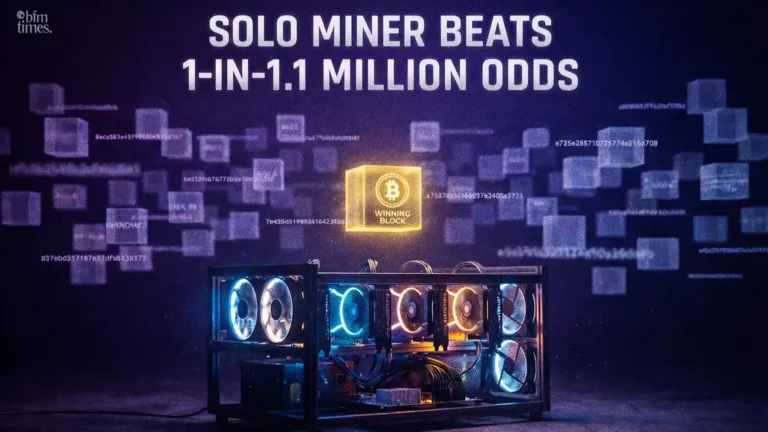
One of the most unlikely Bitcoin wins of 2026 happened when Solo Bitcoin Mining achieved a successful result in winning Bitcoin block 938092 with minimal expenditures on rented hash power estimated at about 75. The reward? The entire 3.125 BTC block subsidy and transaction fee are estimated to be about $200,000 at the time of validation.
This public verification of block confirmation data through blockchain explorers, e.g., Mempool.space, confirms the timestamp, block height, and reward structure.
It was not a payout of a mining pool. It was an entire block’s victory. At a time when the Bitcoin network hashrate was over 1.1 zettahashes per second and industrial mining farms were the rule, this turn of events brought back the question of whether individuals could still play in the game in 2026. Source.
Anatomy of the 1-in-1.1 Million Odds.
Clusters of Hash Power vs. Network Scale.
The probability of solo Bitcoin mining is given by an equal contribution of hashes.
In early 2026:
- Total network hashrate: ~1.1 ZH/s
- Miner’s rented power: 1 PH/s
- Share of network: ~0.00009%
This statistical imbalance forms the 1-in-1.1 million odds that had been mentioned in reports on the event. Probability trackers like SoloChance mine expected block discovery schedules on the basis of hashrate inputs.
At 1 PH/s, block discovery is expected to take more than 20 years at the current levels of Mining difficulty in 2026.
The Statistical Reality
Solo Bitcoin mining is a Poisson distribution. That means:
- The hash attempts are independent.
- It lacks the accumulation of probability.
- Previous failures do not augur more opportunities.
This is referred to as memoryless probability. Although a miner may not coincide in years, a subsequent hash attempt has the same probability as the initial attempt.
That is why solo Bitcoin mining in 2026 can be frequently compared to a lottery: the probabilities of this event are ridiculously low, and technically, it may occur at any particular moment. Source.
Hashpower Block Win: The Cloud Shortcut is Rented
How the Miner Accessed Hashrate
As an alternative to acquiring ASIC hardware, the hash power marketplace provided by Braiins was utilized by the miner. The users can rent computing power on this platform and target it to a personal mining system.
A structural change is seen in the rented hashpower block win:
- No warehouse
- No ASIC ownership
- None of the long-term capital expenditures.
Just a temporary hashrate allocation into a Solo Bitcoin Mining endpoint.
- The fee: about 119,000 satoshis (~$75).
- The payout: over 3.125 BTC.
Although the payoff was remarkable, repeated attempts under the present set of difficulties are still negative, which would have had a negative expectation. Source.
CKPool Solo Block Reward: Infrastructure Behind the Win.
The protocol layer was not completely mined alone by the miners. They also used Solo CKPool, which is specifically a service that was created to accommodate independent miners.
How CKPool Solo Mining Works
In comparison with the traditional mining pools, which divided the reward proportionately:
- Templates of blocks are built by CKPool.
- Offers stratum connectivity.
- If you find a block, you keep 100%.
The distribution of rewards is non-existent. The full CKPool solo block reward is attributed to the address that is set by the miner.
With this model, technological obstacles are diminished, and the essence of solo economics is maintained.
Validation and Network Contribution
The miner: when block 938092 had been solved, the miner:
- A valid block header was generated.
- Verified transactions
- Send to the network the block.
- Concurrence of reception.
Although the miners were renting hash power, they were providing network security at the time at full capacity. Source.
Economy 2026 and Open Landscape Mining Difficulty.
Rising Network Difficulty
The mining difficulty varies in bitcoin every 2016 blocks (approximately two weeks).
By 2026 the difficulty will be over 144 trillion and will indicate the following:
- Increasing institutional involvement.
- Increased ASIC efficiency
- International infrastructure profiling.
This is what renders solo Bitcoin Mining statistically harder as time goes by unless the hashrate is decreasing.
Industrial Pivot To AI Compute.
The reason being an emerging trend in 2026 which is that large mining firms are redistributing capacity to
- AI model training
- High-performance computing (HPC)
- Strategies of hybrid data centers.
According to some analysts, this presents a window of variances of block discovery distribution on a temporary basis. Although it has no effect on long-term probability math, it somewhat alters short-term competitive dynamics.
12-Month Solo Surge
Other independent trackers like fastbitcoin miner tracker, indicate that there have been over 20 wins of solo blocks in the last year.
Important clarification:
- These victories are outliers, which are of a normal form.
- They fail to herald better-anticipated profitability.
They are a kind of mirror of the network scale; the more participants, the less frequent the events.
The open participation design of Bitcoin is enhanced, however, by the visibility of these wins. Source.
Is Solo Mining of Bitcoins Worth It?
Probability-wise, the anticipated ROI of the Solo Bitcoin Mining is close to zero for small contributors of hash. The 1-in-1.1 million occurrence cannot be strategically repeated.
At this point, before going alone to mine Solo Bitcoin Mining 2026, take into account the following:
- Electricity expenses (in case you are not renting)
- Rental pricing volatility
- Bitcoin price exposure
- Rising mining difficulty
- Variance tolerance
Nevertheless, such infrequent block victories have a significant structural value. They demonstrate that the consensus system of Bitcoin does not limit the influence of only industrial players. Any valid hash (of any origin) can be used to generate a block.
The rented hashpower block win, which led to Bitcoin block 938092 was not a mere coincidence. It was a living example that decentralization will not be destroyed mathematically.
With the mining business still developing in 2026, Solo Bitcoin Mining is probably in the high-risk, low-probability, yet ultimately possible category.
Also Read:
Tokenomics Guide: Check Before Investing
Best Hardware Wallet vs Software Wallet: Key Differences & What to Choose
How to Transfer Crypto Between Wallets Safely
Disclaimer: BFM Times acts as a source of information for knowledge purposes and does not claim to be a financial advisor. Kindly consult your financial advisor before investing.