


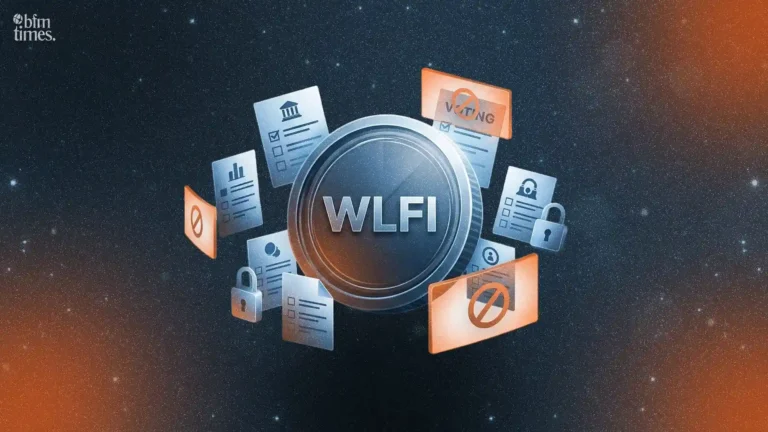
The WLFI Governance Proposal proposes implementing a 180-day stake in the investor who would be interested in voting in the DAO of World Liberty Financial. Although the change will protect governance against manipulation over the short term, critics have cautioned that it might consolidate power among whales and insiders.
- The Catalyst
- Market Reaction
- On-Chain Data
- Price and Sentiment Trends
- Staked-up lock-ups, which result in a lower circulating supply.
- Why Investors Are Concerned
- The Hierarchy of Nodes: Tiers of Governance Explained
- The “So What?” The importance of this to DeFi Governance.
- What to Watch Next for WLFI Governance Proposal
- Conclusion: WLFI Governance Proposal
The controversy is much bigger than one project. It brings a question to the crypto industry that is rising: how to strike a balance between decentralization and the long-term stability of governance.
Related: Best free Crypto Games With No Upfront Investment in 2026
The Catalyst
The controversy started when World Liberty Financial proposed a governance reform in March 2026 that dramatically altered the operation of WLFI staking and voting rights.
The WLFI Governance Proposal does not permit the token holders to vote by wallet but permits them to lock tokens for 180 days before obtaining the right to participate in governance.
Key elements of the proposal
- 180-day governance-voting token lock-up.
- The weight of the vote was dependent on the amount of staked tokens and the length of the lock period.
- Active voters are rewarded by the government.
- Another hierarchy of governance whereby a supernode and a Node are in place.
Proponents of the plan say that the staking model is immune to governance attacks in which short-term traders buy tokens in the short run to change votes.
Nevertheless, critics are of the opinion that the proposal can practically restrict the rights to vote of the investors, particularly the small ones who are unable to sustain long lock-ups.
The proposal immediately became the subject of discussion in DeFi governance communities since it involves a new form of governance where a long-term commitment takes precedence over liquidity. Source.
Market Reaction
The WLFI Governance Proposal is already impacting the way investors feel and the patterns of governance participation, even prior to a final decision.
On-Chain Data
According to governance analytics platforms that track the activity of the DAOs, the early governance participation data indicate that a significant proportion of voting tokens that back the proposal are of major holders.
Observers on-chain note that big tokenholders tend to be more active in the governance process, particularly when a proposal entails staking rewards.
This brings up a critical issue: whether or not governance needs long-term token lock-ups, in which case the whales will have an advantage since they can afford the capital stake.
An earlier report by blockchain study companies on the distribution of tokens indicated that token concentration is typical of those in early-stage crypto projects and that governance fairness is a recurrent discussion point across DeFi ecosystems.
Price and Sentiment Trends
Although the volatility of the WIFi token prices is moderate, there has been a governance uncertainty that has had an impact on investor sentiment.
Governance proposals can tend to affect the behavior of the token in crypto markets in various ways:
Staked-up lock-ups, which result in a lower circulating supply.
Greater investor demand for governance power.
Short-term price movements when making significant decisions by Dao.
These trends have been observed in various DeFi ecosystems where governance is connected to staking. Source.
Suggested: Prediction Markets Fake News: How Misinformation Is Distorting Modern Betting Platforms
Why Investors Are Concerned
The largest issue with the WLFI Governance Proposal is that there is a trade-off between liquidity and influence on governance.
Crypto markets move quickly. Investors often require flexibility to:
- Response to sporadic market volatility.
- Transfer Protocols between protocols.
- Hedge positions when the market is down.
- The 180-day lockout of tokens eliminates that.
In the case of smaller investors, the decision is tough:
- Stake tokens become eligible to vote.
- Liquidity tokens relinquish voting power in DAOs.
Opponents state that in a situation where the cost of governance participation is too high, protocol decisions will be made by only large investors.
This dynamic has already been seen in certain DeFi ecosystems in which governance power is slowly accumulated by the institutional players, venture funds, or early insiders.
The WLFI proposal thus starts another industry debate: is it possible to have truly decentralized governance with higher capital requirements?
The Hierarchy of Nodes: Tiers of Governance Explained
The next debatable aspect of the WLFI Governance Proposal is the proposal to implement a node-based governance model.
The system comes up with several levels of participation.
Node Level
Users who have around 10 million WLFI tokens are considered Nodes.
Potential benefits include the following:
- Availability of institutional liquidity partners.
- Ecosystem incentive programs.
- More opportunities to know how to do things.
Super Node Level
Members who bet 50 million WLFI tokens or higher are considered Super Nodes.
Other privileges might include:
- Preferential treatment of joint ventures.
- Personal contacts with project management.
- Greater visibility of governance.
Well-wishers argue that these tiers encourage intensive involvement within the ecosystem.
Critics do contend, though, that these types of structures can lead to plutocratic forms of governance, with power being the main determinant of the amount of wealth.
To offset such a hazard, the proposal proposes a square-root voting model, which tries to prevent domination by very large holders of tokens.
Nevertheless, the capital requirements that are necessary to reach superior governance levels are an issue of contention. Source.
The “So What?” The importance of this to DeFi Governance.
The WLFI Governance Proposal might look merely like the redesign of the DAO rule at first sight.
Factually, it is a larger experiment with a DeFi governance structure.
Several decentralized protocols are now investigating how to resolve several long-standing governance issues:
- Low voter participation
- Short-term traders attack governance.
Long-term commitments in the protocol are not needed by token holders who vote but do not have any long-term involvement in the protocol.
Stake-to-vote governance models strive to address these problems by matching the financial incentives to governance accountability.
However, they also come with their own risks:
- Less accessibility by smaller investors.
- Concentration of power of long-term capital owners.
- Stronger complexity of governance participation.
The WLFI proposal is thus in the middle of a far bigger discussion of the way that decentralized finance will develop under the maturity of the industry. Source.
Also Read: OCC Proposes GENIUS Act Stablecoin Rules: A Landmark Federal Framework for Digital Dollars (2026)
What to Watch Next for WLFI Governance Proposal
The ultimate result of the WLFI Governance Proposal may have an effect on the governance models of the new DeFi platforms.
There are a number of developments that will probably define its long-term effect.
Governance Vote Outcome
With the proposal being passed, it is possible that WLFI will turn into one of the larger projects with a mandatory system of staking and governance.
Participation Levels
The question that will be keenly monitored by the observers will be whether smaller investors will remain in the game of governance or withdraw slowly.
Token Liquidity Trends
The effect of lock-up requirements on the circulating supply might be a considerable decrease that will impact the dynamics of the WLFI prices and market dynamics.
DeFi Governance Trends
In case the model is successful, other protocols can follow the same framework of enhancing governance security. Source.
Conclusion: WLFI Governance Proposal
The WLFI Governance Proposal has emerged as a point of controversy in the discussion of DeFi governance, voter rights, and transparency in crypto.
World Liberty Financial wants to focus on the long-term dedication of its community by introducing 180-day governance participation staking. Nevertheless, there are other valid worries concerning accessibility and equity in governance in the proposal.
The success of the WLFI model to remain a guideline in future DeFi governance or be a case in point will be determined by its ability to remain trustworthy to communities and accessible to all in the coming months.
Disclaimer: BFM Times acts as a source of information for knowledge purposes and does not claim to be a financial advisor. Kindly consult your financial advisor before investing.
What is the WLFI governance proposal about?
The WLFI governance proposal focuses on how investor voting rights will influence key decisions within the platform.
Why has the WLFI governance proposal sparked debate?
The proposal has raised concerns about fairness and the level of control investors should have in governance decisions.
How could the WLFI governance proposal affect investors?
It could change how investors participate in voting and shape the future direction of the WLFI ecosystem.