Game testing has become one of the most intense stages of modern development, and, frankly speaking, it is understandable. Games now are not linear experiences; they are rich, living systems that can consist of physics engines, dynamically interacting systems, multiplayer layers, and continually updated systems. Because of the sensitivity of this environment, even a small change can cause the system to blow up and break something that would not have happened otherwise.
- Game Testing Is One of the Hardest Problems in Software Development
- What AI-Based Game Testing Actually Means
- How AI Detects Bugs in Games
- AI Game Testing Tools
- AI Game Testing Tools Transforming the Industry
- Automated Game Testing: How AI Replaces Manual QA Work
- Real-World Use Cases: How Game Studios Use AI
- The Rise of AI QA Testing in the Gaming Industry
- What Makes AI Debugging Tools So Powerful
- Limitations of AI-Based Game Testing
- AI Agents Testing Entire Games Autonomously
- Conclusion
- Frequently Asked Questions
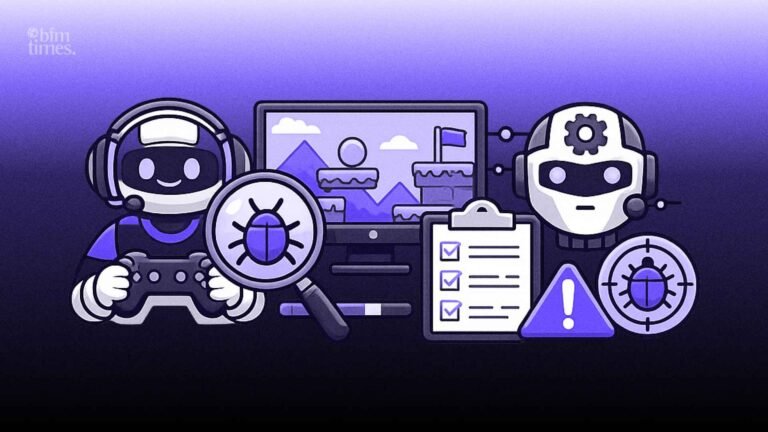
This is where AI-based game testing is changing how studios approach quality. Instead of trying to manually cover infinite possibilities, developers are now using AI to explore, analyze, and stress-test games at a scale that simply wasn’t possible before. It is not that QA teams have to be replaced; it is just that they should be provided with the type of support that would reflect the complexity of contemporary games.
Game Testing Is One of the Hardest Problems in Software Development
If you compare games to traditional software, the difference is massive. There are established routes and known results of a given application. Games don’t. Players do not take orders; they do things, they stretch limits, and occasionally they break things in a manner that was never envisaged by a developer.
That unpredictability creates a serious challenge. One mechanic of the game can act in different ways based on the time, environment, or system conditions. Scaled to a full open world or a multiplayer system, it has millions of potential states.
Manual testing, no matter how skilled the team is, has limitations. These possibilities can only be studied by testers, and the rest are left to chance. This is why even the most anger-inducing bugs are not shown till the launch, when thousands of actual players begin to interact with the game.
AI doesn’t remove this complexity. Instead, it leans into it and explores it faster.
What AI-Based Game Testing Actually Means
Another myth about AI-based game testing is that it is simply automation with a new trendy name. In reality, modern AI QA testing gaming systems behave very differently from traditional scripts.
AI systems are not reactive to preset steps, but behave more organically with the game world.
They mimic the actions of the players, change situations, and can even learn through what has been done in the past. This causes them to be much more effective in revealing the problems that strict automation would not have shown.
AI-based game testing integrates various capabilities into a single workflow at a deeper level. It can analyze gameplay data in real time, create test scenarios dynamically, and use patterns to predict where bugs are likely to appear. Because of this, automated game testing feels more like a system that develops with the game than a tool.
How AI Detects Bugs in Games
It is at this point that one realizes that AI is detecting bugs, and it is intriguing how. It is not only a matter of crash detection but also a matter of detecting behavior that is not what is expected.
When an AI system operates using a game, it monitors everything that is going on in the background. It measures movement, physics interactions, UI responses, and performance measurements. The system alerts against any behavior that is not in line with what supposedly takes place.
As an example, when a character leaps and does not land safely, or a certain object acts in different ways in a similar situation, the AI notes it as an anomaly. It is not based on a checklist; it is based on comparison. Predicted performance against the actual performance.
The fact that modern bug detection AI captures the level of detail is the power that makes it so potent. It does not merely recognize the problem but logs the complete situation surrounding it. The logs, reproduction steps, and even visual evidence of what has gone wrong are available to developers.
Other developed AI debugging tools even further evaluate patterns between multiple failures.
They do not see bugs as one-off occurrences but find common causes so that the teams can rectify root causes and not only the symptoms.
AI Game Testing Tools
| Tool Name | Best For | Key Strength | Type |
| modl:test | Gameplay simulation | AI agents mimicking real players | Gameplay Testing |
| Razer AI QA Copilot | Real-time bug detection | Instant bug insights | Bug Detection |
| Testim | Automated workflows | Smart test generation | Test Automation |
| Applitools | Visual validation | AI-based UI testing | Visual Testing |
| GameBench | Performance monitoring | FPS & device analytics | Performance Testing |
| Functionize | Regression testing | Self-healing test cases | Automated QA |
AI Game Testing Tools Transforming the Industry
The rise of AI game testing tools is not just about efficiency, but it is also a redefinition of the process of testing. These devices are designed to manage various QA aspects, including gameplay simulation or performance analysis.
What is intriguing is the fact that they fit perfectly well into development pipelines. They are no longer used as standalone tools. However, they do not stop, and they test each build, each update, and each change.
In practical terms, these tools are capable of:
- Simulating large numbers of players interacting with the game simultaneously
- Detecting crashes, glitches, and logic failures in real time
- Monitoring performance under extreme conditions
However, the true change lies not in what they do but rather in how consistently they do it. AI doesn’t grow weary, skip steps, or overlook patterns because of human error, in contrast to manual testing.
Automated Game Testing: How AI Replaces Manual QA Work
There’s a lot of noise around AI “replacing” jobs, but in game testing, that’s not really what’s happening. AI is replacing the repetitive workload that slows teams down.
Regression testing should be considered. Rechecking current features is necessary for every update, and doing so by hand takes time and is ineffective. AI can quickly run through these scenarios, comparing outcomes between builds and spotting even the tiniest discrepancies.
Repetitive gameplay testing is no different. Movement, combat, and interaction systems are examples of mechanics that require repeated testing under various circumstances. This is easily handled by AI, which can run thousands of variations without losing accuracy.
When it comes to scale, automated AI-based game testing is different. Teams can complete more scenarios in less time without sacrificing depth thanks to it. It is so valuable because it is so equal.
Real-World Use Cases: How Game Studios Use AI
AI is already integrated into the real-world workflow in the QA process. It is not a vision of the future, but it is actively defining the nature of the games being constructed and maintained.
During the development phase, the AI systems are active and identify issues before they become expensive to fix. Studios will save a great deal of time and money with this early detection.
In live-service games, where updates happen frequently, AI is even more crucial. It helps to maintain the stability of the evolving systems and ensures that new patches do not introduce any unexpected bugs.
Setting priorities is another crucial application. Not every bug requires immediate attention, and it can be difficult to determine which ones are most important. AI assists by evaluating the effects and determining which problems have the greatest impact on gameplay and ought to be fixed first.
The Rise of AI QA Testing in the Gaming Industry
The use of AI QA testing gaming processes is also rapidly increasing, and it is not being encouraged by hype. Games are getting complicated, development cycles are getting shorter, and the expectations of the players are higher than ever.
AI offers a means of responding to these requirements. It enables teams to test in greater detail without affecting production. It also brings about some form of consistency, which is not possible by manual testing.
This is why AI is quickly becoming a standard part of game development pipelines rather than an optional upgrade.
What Makes AI Debugging Tools So Powerful
It is not only the fact that AI can detect certain issues, but it can also explain them, which is what makes it truly special. The conventional QA can be described as a two-way process when testers find a problem and the developers investigate it.
AI shortens that loop significantly.
Contemporary AI debugging tools offer context when a bug arises. They demonstrate what transpired, why it transpired, and the circumstances surrounding it. This degree of specificity increases overall development efficiency and shortens the time required to resolve problems.
One more significant benefit is real-time feedback. Developers are not required to wait till something is reported to them; they can view the issues as they occur, and it becomes easier to fix them instantly.
Limitations of AI-Based Game Testing
Although it has all the capabilities, AI is not a full solution. It does not have the human look that determines the player experience.
AI can know when something is broken, but not when something is wrong. It does not know frustration, pleasure, or involvement. These are the subjective factors that can be judged only by human observers.
There exist technical constraints as well. In a system where the edge cases are rare or the system is very complex, AI will either fail to capture edge cases or produce false positives. It may even think the desired action is a bug just because it does not conform to previously learned behavior.
This is the reason why human control is paramount. AI is an aspect that takes care of scale and speed, yet humans supply context and judgment.
AI Agents Testing Entire Games Autonomously
In the future, AI in game testing is bound to increase even further. Even now, we can be looking at systems that employ reinforcement learning to navigate game worlds smarter, progressively changing their behavior.
There’s also growing interest in combining AI-based game testing with language models, allowing systems to understand design intent and generate more meaningful test scenarios.
The idea of fully autonomous testing pipelines is no longer unrealistic. Continuous systems that test, detect, and report issues without human intervention are already in development.
What’s changing is not just the tools, but the philosophy of testing itself.
Conclusion
The biggest misconception around AI-based game testing is that it’s here to replace people. In reality, it’s here to redefine how QA works.
The scale, the repetition, and the speed are left to AI. Human testers pay attention to the creativity, experience, and emotional aspect of the game.
The future of AI-based game testing is not about choosing between humans and machines. It’s about combining both to create better, more stable, and more engaging games.
Also Read: Top AI Note-Taking Apps for Students
Frequently Asked Questions
What is AI-based game testing?
AI-based game testing uses intelligent systems to simulate gameplay, detect bugs, and automate quality assurance processes.
How does AI detect bugs in games?
It analyzes gameplay behavior, compares expected outcomes with actual results, and flags anomalies.
Can AI replace game testers?
No, AI supports testing but cannot replace human creativity and experience evaluation.
What are the best AI-based game testing tools?
Tools like Modl.ai Test, Razer AI QA Copilot, and AI-driven automation platforms are widely used.
Why are AI-based game testing tools important?
It improves speed, scalability, and accuracy in testing complex game environments.
Disclaimer: BFM Times acts as a source of information for knowledge purposes and does not claim to be a financial advisor. Kindly consult your financial advisor before investing.