Pointwise Summary
- The Grok-4.20 Beta, a major release from xAI, has been officially released with an emphasis on rapid learning and expert-level domain reasoning.
- Grok-4.20 models took the second and third places in the most recent medical AI rankings on the Arena leaderboard for healthcare-related tasks.
- The model has a massive 2 million token context window and a new multi-agent architecture that employs parallel reasoning for complex research.
- Elon Musk has framed this launch as a transition from a witty chatbot to a sophisticated expert system that can process medical images and engineering data.
- Performance measures show that it is strong in factual reliability and search, but is specifically tuned for low hallucination rates in sensitive domains such as medicine.
In a surprising turn that marks the evolution of social media engagement from personal communication to professional application, the recently released Grok-4.20 Beta version of xAI, a new product by Elon Musk, has claimed the top position in the Chatbot Arena medical ranking. According to the latest data from the community-driven evaluation platform, Grok-4.20 variants have taken two of the top three positions in healthcare AI, indicating that existing leaders in the field, such as OpenAI and Google, are facing a new wave of competition.
The Emergence of the Reasoning Agent
The Grok-4.20 Beta is a break from the edgy image of the previous versions. Rather, the model is constructed based on what xAI defines as a rapid learning architecture. The system is created to consume large volumes of data and enhance itself every week. The most remarkable outcome of this change in architecture is its performance in specialized fields. The Grok-4.20 Reasoning model and the Grok-4.20 Multi-Agent Beta have been repeatedly used in the medical sphere of the LMSYS Arena to demonstrate superiority over flagship models of competitors in medical reasoning and medical data synthesis.
Musk wrote about the accomplishment through X, saying that Grok-4.20 is a thousand times smarter and faster than its predecessor. He particularly pointed out that it could give second opinions on medical data. Users are now able to upload complicated medical documents or even take pictures of diagnostic reports and have the AI give them a structured and reasoned analysis.
Architecture and Factual Reliability
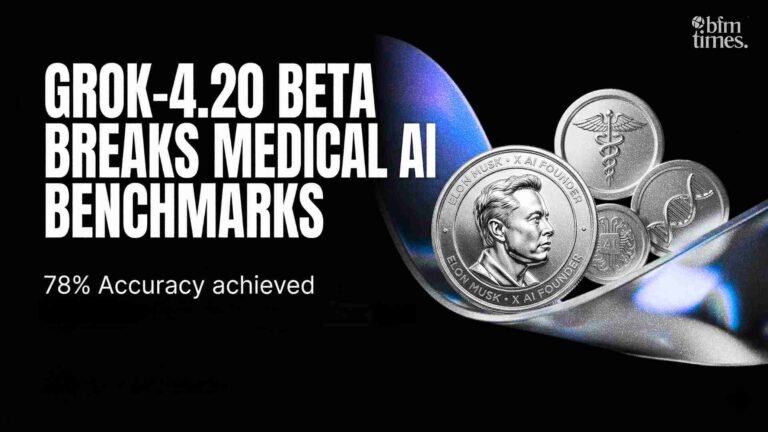
One of the reasons why Grok-4.20 succeeds is that it aims at minimizing the so-called “hallucinations”—the propensity of AI to create facts. Grok-4.20 recorded the highest non-hallucination rate of 78 percent on the Artificial Analysis Omniscience test in the medical industry, where accuracy is paramount. This is much more than most general-purpose models, which emphasize creative output rather than factual accuracy.
The Multi-Agent version of the model is especially special. It uses several sub-agents that operate concurrently to confirm information and cross-reference medical literature to provide a final answer. This collaborative model enables the model to manage its 2 million token context window effectively, and can thus read a whole medical textbook or years of patient history in one prompt.
Pricing and Accessibility
xAI has been able to price the Grok-4.20 Beta competitively despite its high-end performance. The reasoning-enabled model is estimated at about 2 dollars per million input tokens and 6 dollars per million output tokens. This positioning implies that xAI is aiming at the enterprise and research markets with the goal of attracting developers away from more costly proprietary models that do not offer the same degree of real-time search integration.
Another strength of the model is its capability to invoke native tools. In the medical context, Grok-4.20 can independently make decisions about when it needs to find the most recent peer-reviewed research on X or the entire web to base its responses on the most recent information possible.
Context
Grok-4.20 is released at a time when the AI industry is highly fragmented. Although the period before 2025 was characterized by the dominance of the so-called generalist models, 2026 has witnessed a transition to vertical AI, i.e., models with specific medicine, law, and engineering tunings. The success of xAI in the medical Arena directly competes with Google Med-PaLM and specialized versions of GPT-5. Using the huge real-time data stream of the X platform and massive compute power, xAI is trying to fill the gap between a search engine and a diagnostic assistant.
Also Read: Will Elon Musk’s X Money Include Crypto? Fiat-Only Version is Scheduled for April Launch
Frequently Asked Questions
Where can I find the Grok-4.20 Beta to ask medical questions?
The model is currently available to SuperGrok and Premium+ subscribers on the X platform. Users must navigate to the model selection menu and specifically choose “Grok-4.20 (Beta)” or “Grok-4.20 Reasoning” to utilize the advanced healthcare features.
Does Grok-4.20 replace a human doctor?
No. xAI and medical professionals underline that Grok-4.20 is a second opinion tool. It is created to help in research, clarify complicated medical terms, and generalize information, yet all clinical choices are to be made by qualified healthcare specialists.
What makes the “Multi-Agent” version different?
The Multi-Agent version uses between 4 and 16 separate AI agents to work on a single problem. This is ideal for deep research where one agent might focus on search, another on reasoning, and a third on verifying the facts provided by the first two.
Why is the model named 4.20?
In keeping with Elon Musk’s well-known affinity for internet culture and memes, the version number is a playful reference. However, xAI has clarified that the technical improvements in the model are a serious step forward for the company’s “frontier” AI goals.
Does Grok-4.20 have a larger context window than GPT-5?
Grok-4.20 supports a context window of 2 million tokens. This is significantly larger than many contemporary models, allowing it to process approximately 1.5 million words at once, which is essential for analyzing long-form medical records or entire clinical trials.
Disclaimer: BFM Times acts as a source of information for knowledge purposes and does not claim to be a financial advisor. Kindly consult your financial advisor before investing.