


Bitcoin was the first successful cryptocurrency that prevented the double-spending problem. It was introduced as a decentralized, peer-to-peer currency by the mysterious cryptographer Satoshi Nakamoto in October 2008, when its white paper was released. The network became active on January 3, 2009, with the creation of its first block (the Genesis Block).
In the early days of Bitcoin, the network attracted participants seeking to mine rewards. These rewards were worth millions over the subsequent years, often creating many Bitcoin whales.
Between 2014 and 2024, several governments attempted to restrict its use, adoption, and circulation, but all failed. By the end of this period, several governments had begun adopting it themselves.
By 2025, Bitcoin was widely accepted as a strategic asset similar to Gold and Silver. In later years, it rose in popularity as a reserve asset for companies, governments, and many others.
History of Bitcoin
It was not the first cryptocurrency. Indeed, it was the first one to succeed in preventing people from copying and pasting its code to create an endless supply.
The first concept of internet money or digital currency was introduced as early as 1983, when David Chaum’s e-cash and later DigiCash were published. However, these earlier forms were rather digital versions of fiat and not even close to an independent cryptocurrency.
The next series of iterations of digital currencies (based on code) was indeed an attempt to create independent cryptocurrencies. Some of them were widely circulated in the market as early as 1996 (e-gold, BitGold, QQ Coins), and attempts were made until the time of Bitcoin’s launch.
Bitcoin’s immediate history dates back to October 31, 2008, when Satoshi Nakamoto (self-published email ID: satoshin@gmx.com) published the Bitcoin White Paper on bitcoin.org and introduced it on several online forums.
It was successful because it prevented double-spending. A problem in earlier digital currencies was that, unlike fiat notes, which are unique and cannot be copied to spend, digital currencies (being code) could be copied to create an endless supply (crashing their value). This currency solved this problem via a network of transaction verifiers called miners, whose sole job was to validate transactions and add them to the network’s memory.
Bitcoin Pizza by Laszlo Hanyecz
By May 2010, this currency had a fairly decent network, and there were several miners who were working to secure the transactions (by verifying them) and, in return, getting a 50 Bitcoin reward per block.
Among those miners was Laszlo Hanyecz, who successfully spent 10,000 Bitcoins for two large Papa John’s pizzas on May 22, 2020. This was the first ever recorded it’s transaction. The price for the two pizzas was indeed paid by Jeremy Sturdivant, who paid $25 and had the two pizzas delivered to Hayenicz.
Bitcoin ETFs
Bitcoin ETFs were the most important event in the last decade for the adoption of this currency. The first ten Bitcoin ETFs were approved in the US on Jan 10, 2025.
With ETFs, anyone could simply buy it without having to go through the hassle of securing it. As a result, ETFs brought billions of dollars in liquidity to Bitcoin, taking it from $30,000 to $100,000 in 2024.
Government Adoption
Bitcoin Treasury adoption by three governments, notably Bhutan (since the early 2010s), El Salvador (since 2022), and the USA (since 2025), brought the attention of everyone. An official treasury would mean there is less likelihood of Bitcoin being restricted for public use in the future.
With the USA adopting a treasury, this currency made new ATHs and sustained above $100,000 for much of 2025.
Corporate Adoption
Several corporate bodies, including MicroStrategy, GameStop, and Metaplanet, began accumulating the currency with debt, aiming to generate a high return on assets relative to the cost of debt.
Treasury buying brought significant liquidity into the crypto markets, helping it reach $126k in mid-2025.
Notable People Suspected to be Satoshi Nakamoto at Some Point
- Len Sassaman
- Hal Finney
- Dorian Nakamoto
- Shinichi Mochizuki
- Ross Ulbricht
- Elon Musk
- Peter Todd
- Drug Cartels
- The US CIA
- The Russian FSB
- Chinese MSS
How Does it Work?
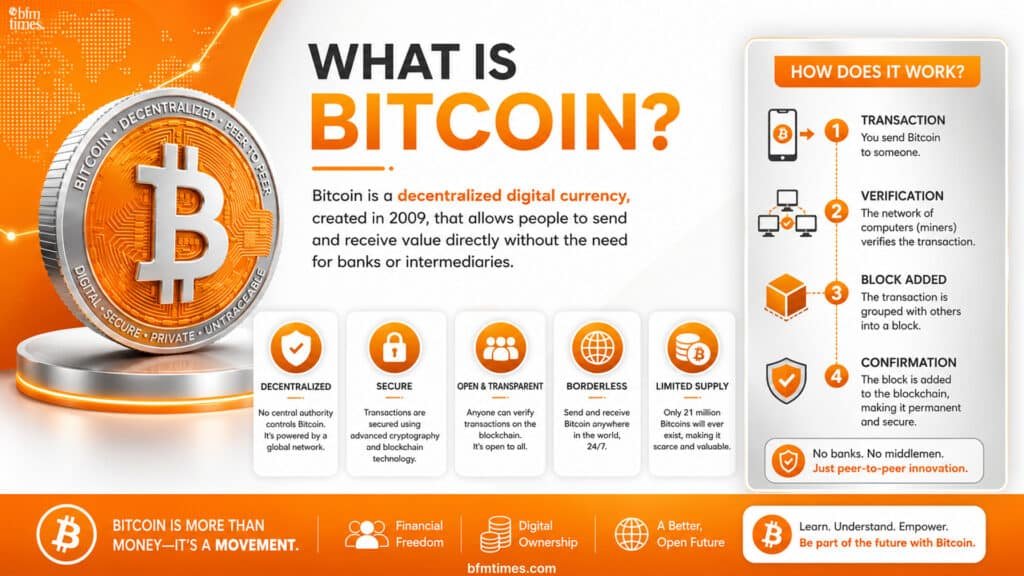
Bitcoin works on the Proof of Work consensus mechanism. Here, each computer on the network acts as a blockchain node, verifies transactions, and adds them to the blockchain in exchange for a reward.
Here are the steps a consensus mechanism takes to ensure a transaction is valid.
- The user initiates a transaction from their wallet.
- The transaction gets deposited in a memory pool.
- A Bitcoin Miner picks up the transaction and runs an algorithm to check its validity.
- Once the transaction is found valid, it is broadcast to other miners on the Bitcoin blockchain.
- Other miners run the same algorithm, and when a certain number of miners produce the same result, the transaction is considered valid.
- At this stage, the miners are said to be in consensus on its validity, and the transaction is added to the blockchain.
#NOTE: Due to increasing competition, most nodes work in groups and share the block reward when they successfully mine a block.
Disclaimer: BFM Times acts as a source of information for knowledge purposes and does not claim to be a financial advisor. Kindly consult your financial advisor before investing.