

By using this site, you agree to the Privacy Policy and Terms of Use.
Accept

Global Decentralized Hackathon Show – Register Here

Digital Assets Week - 15% Off
Next Block Expo - 20% Off
BFM Times
Trending Event
  • Home
  • BFM Talks
    • Finance
    • Startup
    • Investment
    • Web3
  • Press Release
  • Partners
  • Events
  • Market Live
  • Converter
  • Exchanges
  • Accelerator
  • Token Sale
Reading: $3.4 Billion Stolen: North Korea Drives Record $2 Billion Crypto Theft Year This year
Share
  • bitcoinBitcoin(BTC)$88,461.00
  • ethereumEthereum(ETH)$2,938.38
  • tetherTether(USDT)$1.00
  • binancecoinBNB(BNB)$880.22
  • rippleXRP(XRP)$1.90
  • usd-coinUSDC(USDC)$1.00
  • solanaSolana(SOL)$126.65
  • tronTRON(TRX)$0.296458
  • staked-etherLido Staked Ether(STETH)$2,937.75
  • dogecoinDogecoin(DOGE)$0.123133
Trending Event
  • Accelerator
  • Finance
  • Investment
  • Web3
  • Featured
  • Startup
  • News
  • Explained
  • Price Analysis
  • Token Sale
Search
  • Home
  • BFM Talks
    • Finance
    • Startup
    • Investment
    • Web3
  • Press Release
  • Partners
  • Events
  • Market Live
  • Converter
  • Exchanges
  • Accelerator
  • Token Sale
Have an existing account? Sign In
Follow US
  • Home
  • BFM Talks
  • Press Release
  • Partners
  • Events
  • Market Live
  • Converter
  • Exchanges
  • Accelerator
  • Token Sale
© 2025 All Rights Reserved.
BFM Times > Web3 > $3.4 Billion Stolen: North Korea Drives Record $2 Billion Crypto Theft Year This year
Web3News

$3.4 Billion Stolen: North Korea Drives Record $2 Billion Crypto Theft Year This year

Jim
Last updated: January 2, 2026 1:11 pm
Jim
Published: January 2, 2026
Share
North Korea
North Korea
SHARE

Key insights

  • North Korea-linked hackers stole over $2 billion in crypto last year.
  • There were fewer attacks, which led to much larger losses than in previous years.
  • Personal wallet theft rose sharply, while DeFi losses stayed low.

North Korea’s exploits reached a new high last year. Data from Chainalysis shows a rise in stolen value, even as the number of attacks fell. 

Contents
    • Key insights
  • North Korea Crypto Theft Pushes Total Losses Higher
  • Fewer Attacks Deliver Far Greater Returns
  • Laundering Patterns After Major Thefts
  • Personal Wallet Theft Hits More Users

While over $3.4 billion was stolen this year, North Korean hackers were responsible for around $2 billion.

This trend indicates how threat actors are now focusing on fewer but far larger targets. 

Related: North Koreans Hackers Stealing Crypto with Fake Zoom Calls

North Korea Crypto Theft Pushes Total Losses Higher

According to Chainalysis, hackers from North Korea stole about $2.02 billion. That figure stands as a 51% increase from the prior year, and the new total pushed all-time losses tied to the country to roughly $6.75 billion.

Attack frequency dropped, yet the stolen value surged. This change came from a handful of very large hacks, with the February 2025 attack on Bybit alone accounting for $1.5 billion.
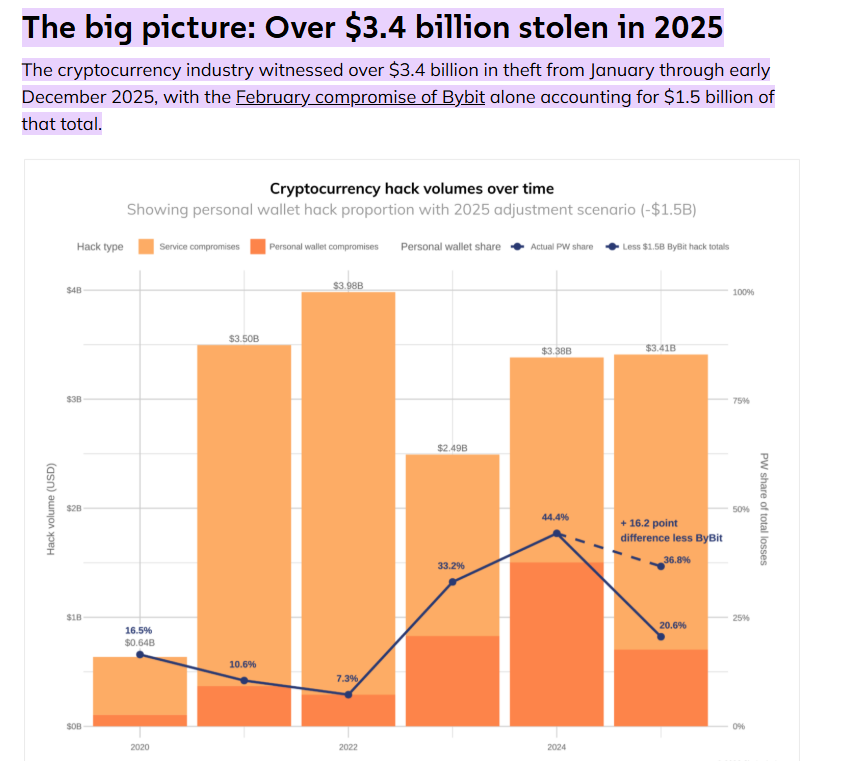
Billions stolen in a year | source: Chainalysis

Service providers also faced the biggest losses as centralised platforms saw rare but massive private key compromises that erased large sums in minutes.

According to Chainalysis, over $3.4 billion in crypto vanished across the industry by early December and North Korea-linked actors caused most of the damage.

Fewer Attacks Deliver Far Greater Returns

Data from the hacks show that there is a growing gap between average losses and extreme cases. Last year alone, the largest hack exceeded the median incident by more than 1,000 times. 

This is also the first time the gap crossed that level.
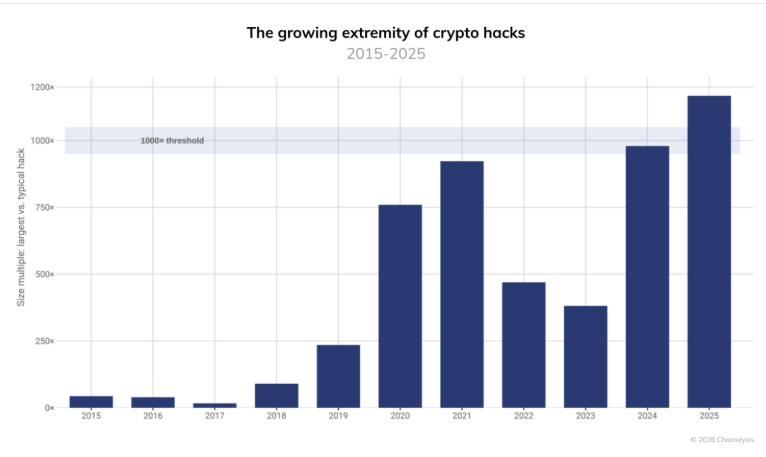
Median crypto hack occurrences are rising | source: Chainalysis

Chainalysis also notes that only three attacks caused 69% of all service losses. This concentration shows how single breaches now define yearly outcomes. In all, smaller incidents still happen but they barely move totals.

North Korea reportedly stole the most from 2022 to date, with these attacks clustered at the highest value ranges. Other criminals also showed a wider spread of smaller thefts.

Laundering Patterns After Major Thefts

Chainalysis also called attention to clear laundering habits from North Korean hackers. According to the analytics platform, hackers rarely move stolen funds in huge chunks and tend to keep transfers below $500,000.

Other criminals often move funds in larger batches and this contrast helps analysts spot patterns.

They also reportedly used cross-chain bridges heavily, including Celer and Stargate to help move assets across networks.

North Korea-linked actors also tend to avoid lending protocols and peer-to-peer exchanges. They also interact less with decentralised exchanges than other groups.

Personal Wallet Theft Hits More Users

Thefts from North Korea now dominate headlines, yet individual users also face heavy risk. Wallet compromises reached about 158,000 incidents and that figure nearly tripled the counts from 2022.

Unique victims climbed to at least 80,000 and adoption growth partly explains the rise. Despite higher counts, total value stolen from individuals fell to $713 million. That amount dropped from $1.5 billion the year before and attackers may have targeted more users but took less per person.

Solana recorded the highest number of victims (around 26,500) while Ethereum and Tron showed the highest theft rates per active wallet. 

Overall, this year’s thefts show that hackers have developed patience and planning. Fewer attacks caused record losses and that approach may continue.

This all means that crypto crime did not disappear. Instead, its shape changed and those changes might offer clues for prevention.

Disclaimer: BFM Times acts as a source of information for knowledge purposes and does not claim to be a financial advisor. Kindly consult your financial advisor before investing.


ZCash Price Analysis 2026
China’s Yield Bearing CBDCs Might Disrupt Stablecoin Markets Soon
Most Popular Chains in 2025 Have an Unusual Winner, Not Ethereum, Neither Solana
How do blockchains stay secure without a central authority?
We Have Narrowed Down Satoshi Nakamoto to These 4 People and 1 Group
Share This Article
Facebook Email Copy Link Print
Previous Article FED Feds Are Hunting Teen ‘Scattered Spider’ Hackers – And Their Favourite Loot Is Your Crypto
Next Article XRP Price XRP Price Faces Early 2026 Pressure Despite Huge ETF Success
Leave a Comment

Leave a Reply Cancel reply

Your email address will not be published. Required fields are marked *

- Advertisement -
Ad image

Latest Posts

RSI
Trading indicator: RSI (Relative Strength Index)
Finance
supply and Demand
Supply and Demand
Finance
Central Bank Interest Rates
Finance
Coinbase
Everything To Know About Coinbase, The Largest Crypto Exchange In The US
Explained

You Might Also Like

BFM Times Airdrop
News

BFM Times Celebrates This Festive Season with a $600 Airdrop, Register to Win

December 25, 2025
US Act
NewsWeb3

US Senate Moves to Vote on the CLARITY Act This Month

January 10, 2026
Tether
Web3News

Tether Now Holds More Bitcoin Than Most Countries – Is Tether Quietly Building A Shadow Sovereign Wealth Fund?

January 2, 2026
MST Blockchain
News

MST Blockchain Leads India as First Next-Gen Layer-1

January 16, 2026

Follow Us on Socials

We use social media to react to breaking news, update supporters and share information

Facebook X-twitter Instagram Linkedin Reddit Pinterest Telegram Youtube
BFM Times

For the Phenomenal Times

BFM15

Quick Links

  • Privacy Policy
  • Press Release
  • Events
  • Partners
  • Submit Your Post
  • About Us
  • Advertise
  • Career
  • Contact Us
  • Jobs

Newsletter

You can be the first to find out the latest news and tips about trading, markets...

Please enable JavaScript in your browser to complete this form.
Loading
Ad image
© 2026 All Rights Reserved.
Join Us!
Subscribe to our newsletter and never miss our latest news, podcasts etc..
Please enable JavaScript in your browser to complete this form.
Loading
Welcome Back!

Sign in to your account

Username or Email Address
Password

Lost your password?