


Key Insights
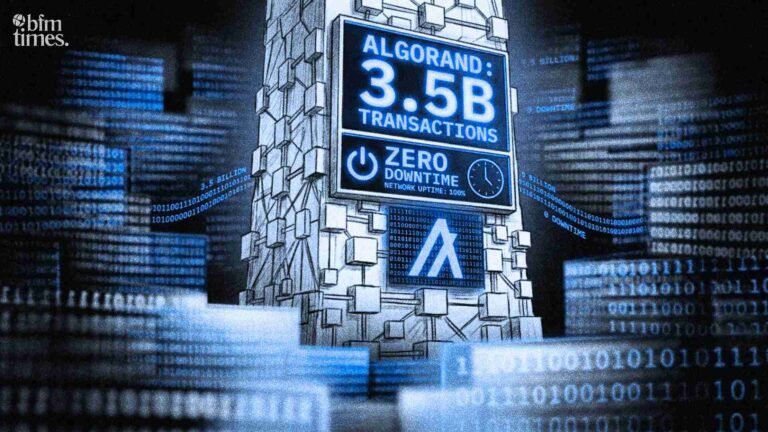
- Milestone Achieved: Since its launch in 2019, the Algorand network has already passed the 3.5 billion cumulative transaction milestone.
- Perfect Availability: The Algorand Foundation states that the protocol has had 0 downtime and zero protocol failures in six years.
- On-Chain Velocity: The throughput is believed to have increased dramatically, with the increase from 2 billion to 3.5 billion taking much less time than previous billions.
- Glassnode Take: Utility and the network’s valuation have been decoupled, claim on-chain researchers, citing “high-frequency institutional use cases.”
- Algorand Branding Update: The Algorand Foundation has made an effort to rebrand itself, moving away from its “Pure Proof of Stake” moniker and towards “Real World Impact” and “Enterprise Reliability.”
The Efficiency Machine: Why 3.5 Billion is Important to Algorand
The Algorand blockchain system, based on the technology that was created by Turing Award Winner Silvio Micali, has managed to accomplish what many in an industry full of fluctuations find difficult to accomplish. Even before the year 2026, the network has managed to conduct more than 3.5 billion transactions. While total transaction figures are often seen as vanity metrics elsewhere, things are not the same in the case of Algorand; the network has not been down even once.
The bulletproof mechanism of Algorand has been its “Instant Finality” and PPoS (Pure Proof of Stake), allowing it to overcome even the most powerful industry players such as Solana and Ethereum, which have struggled with congestion or even outages. The milestone is not only a figure but a testimony to the protocol’s ability to support high-frequency workloads without the performance degradation normally experienced during peak market volatility.
The Glassnode Angle: Analyzing the On-Chain Surge
From a standpoint of data provided by Glassnode, which is considered one of the most popular sources of on-chain market intelligence, it is possible to observe a clear pattern of “Utility Acceleration.” In the past, the initial billion transactions on Algorand took close to 1,300 days to be completed. The speed, however, has been growing exponentially. The increase from 3 billion to 3.5 billion was achieved within a fraction of that time, driven by a boom in Real-World Assets (RWAs) and computerized financial protocols.
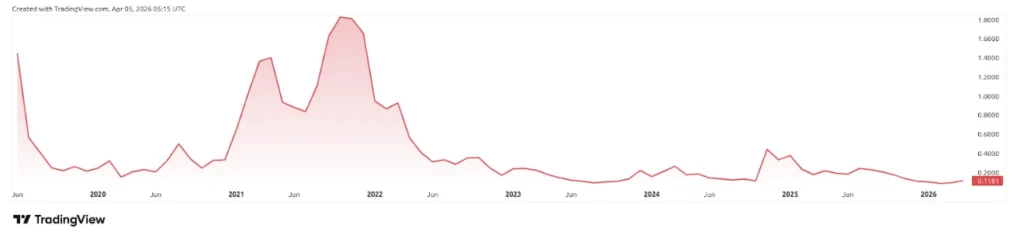
Based on the analysis of Glassnode indicators, even though the price of $ALGO was unable to break through the resistance ranging from $0.15 to $0.25 in the 2024-2025 cycle, both “Active Addresses” and “Transaction Count” metrics are not correlated with the price. This implies that the institutions are using the network as a settlement layer and not merely a retail speculation vehicle. Glassnode analysts tend to use Network Value to Transactions (NVT) ratios to determine whether an asset is overvalued.
In the case of Algorand, the NVT ratio has been at an all-time low, which means that the actual utility of the network (measured by the amount of value transferred) is much greater than the current market capitalization of the network implies. Long-term holders view this as a major concern, as they believe that the 3.5 billion mark is the beginning of a utility-driven price correction.
Marketing Outlook: From Academic to Impactful
The Algorand Foundation has experienced a tremendous change in its marketing strategy. Over the years, Algorand was considered the so-called academic blockchain, which was highly complementary in terms of its security but did not always attract the attention of the general crypto audience.
The new marketing roadmap includes the following key pillars:
- Institutional Trustworthiness: Focusing greatly on the idea of Zero Downtime to attract the interest of TradFi organizations, looking forward to tokenizing bonds and credits.
- Development Convenience: Due to the development of AlgoKit and built-in Python functionality, the initial entrance barrier was reduced significantly, leading to a change in marketing messaging towards “Build in the language you know.”
- The “Quantum-Resistant” Advantage: With quantum computing threats on the horizon, Algorand is positioning itself as one of the few post-quantum secure blockchains, which is a significant selling point to government and enterprise-level contracts.
Context: The Road Ahead
Despite the technical victories, Algorand faces a competitive landscape dominated by the “Big Three”: Bitcoin, Ethereum, and Solana. In order to drive market capitalization of Algorand, the Algorand Foundation should transfer its current 3.5 billion transactions momentum into evident consumer acceptance of the technology. The addition of EURQ and USDQ (MiCA-compliant stablecoins) in late 2025 has given the liquidity required to have a DeFi revival. With the network approaching the 4 billion mark, the focus will likely shift from “how many transactions” to “what is the value of those transactions.”
Also Read: Ethereum Market Analysis: $1,551 & $1,070 Support Levels
Frequently Asked Questions
Has Algorand ever actually crashed?
No. Throughout all of its history, starting from 2019, the Algorand protocol has had an uptime rate of 100%. Individual dApps (decentralized apps) or wallets might fail; however, the underlying blockchain network has never stopped producing blocks.
What does 3.5 billion transactions mean in comparison to other blockchains?
Algorand’s 3.5 billion represents a high volume of successful “non-vote” transactions, whereas Solana has higher raw transaction counts (which frequently include consensus messages), positioning Algorand as one of the most active “true utility” networks in the industry.
What has been the recent explosion in transactions?
Institutional tokenization initiatives (such as the digital bonds of the Italian banking sector) and the emergence of high-frequency DeFi aggregators such as P.E.R.A. are the main forces.
Why is the price not tracking the growth of the transactions?
It is the Decoupling Effect that Glassnode observed. The majority of the volume on Algorand is from enterprise use cases with low-margin fees, which do not necessarily generate the immediate “buy pressure” characteristic of retail-driven meme coin ecosystems.
Does ALGO make a good investment in 2026?
According to analysts, if the utility-to-price decoupling is solved, ALGO can have a road to the $1 milestone. This is, however, subject to the larger market conditions and the institutional adoption.
Disclaimer: BFM Times acts as a source of information for knowledge purposes and does not claim to be a financial advisor. Kindly consult your financial advisor before investing.