The Avalanche (AVAX) price forecast in the period of 2026 to 2030 is gaining popularity among cryptocurrency investors across the globe. It is a token used in one of the most advanced blockchain platforms that are both fast and scalable. In addition to this, the cost to deploy subnets on the platform was lowered by 99.9% due to the Etna upgrade.
- What Is Avalanche?
- AVAX Price Today: Where Does It Stand in 2026?
- Avalanche (AVAX) Price Prediction 2026
- Avalanche (AVAX) Price Prediction 2027
- Avalanche (AVAX) Price Prediction 2028
- Avalanche (AVAX) Price Prediction 2029
- Avalanche (AVAX) Price Prediction 2030
- AVAX Price Prediction Table 2026-2030
- Is AVAX a Good Investment for 2026 to 2030?
- Conclusion
The Defi TVL in Avalanche reached $9.89 billion in 2025. Additionally, BlackRock holds $53.8 million worth of AVAX. Last but not least, the introduction of AVAX futures by the CME group in May 2026 represents yet another noteworthy indicator of rising institutional confidence. We will analyze these years individually and give you all the necessary information in our next blog post.
What Is Avalanche?
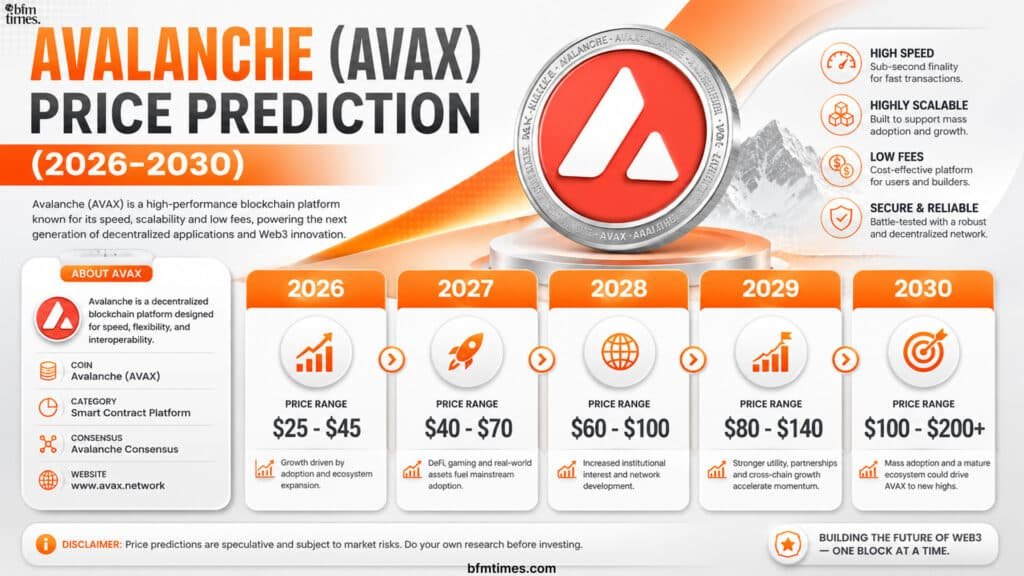
The Avalanche network is a high-performance Layer 1 blockchain built by Ava Labs. It was launched in September 2020 by Emin Gun Sirer, Maofan Ted Yin & Kevin Sekniqi. The network offers sub-second transaction finality & processes thousands of transactions per second. Its unique triple chain architecture allows it to tackle different roles in an efficient manner.
The AVAX coin is used to pay for gas fees and for staking and voting in the governance of the network. The ecosystem has formed relationships with financial institutions like JPMorgan and Stripe. Even FIFA and Toyota have created their own subnets on the Avalanche platform.
What Is New With Avalanche in 2026?
The AVAX futures contracts were introduced by the CME Group under regulation on 29 May 2026. The Institutional-level instruments for pricing discovery are now available for the first time for the AVAX market.
The Japanese firm Progmat, the most prominent security token issuance platform, is transferring billions of dollars worth of assets to the Avalanche blockchain in June 2026. Grayscale submitted an S-1 amendment with the U.S. The Securities and Exchange Commission to convert its Avalanche Trust to a spot ETF with staking benefits. The Kraken started several AVAX staking instruments with a promotional 10% annual percentage yield to lure retail investors.
AVAX Price Today: Where Does It Stand in 2026?
The price of the AVAX coin is currently around $9.34. The market capitalization of Avalanche is about $4.03 billion. The circulating supply is 431.77 million AVAX coins. The blockchain platform is conducting 2.5 million C-Chain transactions per day.
In the last 30 days, there have been 15 green days. In the last month, the rate gained by 5.95%, whereas in the past week, it gained 1.58%. This shows that the cryptocurrency price is recovering since it is getting back on track as it was after attaining its bottom level and now is trading above $9.00. The Avalanche price prediction until 2026-2030 shows the present price is an ideal buy.
Avalanche (AVAX) Price Prediction 2026
The AVAX price for 2026 is expected to range between $21 & $100 across various analyst models. The best-case forecast puts AVAX at a peak of $100 if it clears key resistance levels. The estimated average price range for 2026 stands at approximately $40 to $71. The more cautious estimates show that the price of AVAX will range between $21 and $54 in 2026. The approval of the Grayscale spot ETF and staking reward can prove to be an important factor in a price breakout this year. The AVAX price prediction for 2026 will hinge on the institutional acceptance and CME futures listing.
Avalanche (AVAX) Price Prediction 2027
The year 2027 is expected to be one of the strongest years for the AVAX price. The AVAX price in 2027 is forecast to range from $28 to $107. The average price range is expected to be in between $40 and $71. According to AMB Crypto, the price range for AVAX by 2027 would be somewhere between $60 and $80. AVAX staking will be greatly influenced by the roadmap of Evergreen Subnets for enterprise use. Future staking solutions for institutions by Kraken, and other major exchanges, will take a bigger chunk of the circulating AVAX token.
Avalanche (AVAX) Price Prediction 2028
The year 2028 follows the next Bitcoin halving cycle. These events have historically driven very strong bull markets for top-tier Layer 1 tokens like AVAX. For 2028, the prices of AVAX are forecasted to be between $50 and $202. For the year 2028, the estimated average prices are around $126. The key determinants of AVAX price for 2028 would include expansion of subnets, increased usage of DeFi TVL & more institutional assets in the form of tokenisation on Avalanche platform. Provided the TVL on Avalanche stays above $10 billion, the prices of AVAX may approach $150 or higher levels.
Avalanche (AVAX) Price Prediction 2029
In 2029, it could be possible that AVAX tests prices not experienced since the height of the bullish market cycle in 2021. The prices of AVAX in 2029 are expected to trade between $81 and $324. The estimated average price is about $202. Under bullish scenarios with rapid RWA and enterprise subnet adoption, the prices of AVAX are expected to touch $220 to $324. In 2029, the lowest price level will remain above $81. The continued burn of AVAX through gas fees & network usage will steadily reduce the available supply creating strong upward price pressure over time.
Avalanche (AVAX) Price Prediction 2030
The year 2030 is the big milestone year for long-term AVAX investors. The AVAX price in 2030 is expected to range between $29 & $518. The most widely cited average price target for 2030 sits at around $100 to $324. The base-case forecast supported by most analysts puts AVAX between $29 & $103 as the most likely trading range for 2030. Hitting $100 is achievable but will require strong ecosystem growth & a bullish macro environment.
AVAX Price Prediction Table 2026-2030
The table below gives a simple year-by-year summary of the Avalanche (AVAX) price prediction from 2026 to 2030.
| Year | Minimum Price | Average Price | Maximum Price |
| 2026 | $21 | $40–$71 | $100 |
| 2027 | $28 | $60–$80 | $107 |
| 2028 | $50 | $126 | $202 |
| 2029 | $81 | $202 | $324 |
| 2030 | $29 | $100–$324 | $518 |
The data above reflects analyst consensus from multiple expert models. It should not be taken as financial advice. The crypto market is unpredictable & all predictions carry significant risk.
Is AVAX a Good Investment for 2026 to 2030?
The Avalanche network is one of the technologically sophisticated and supported Layer 1 projects within the cryptocurrency space. It features a maximum cap on the total supply, which totals 720 million coins, as well as a deflationary gas fee burning model. The AVAX coin is currently trading well below its historical high of $146 seen back in 2021. The considerable difference between the historical price level and the present price level around $9-$10 provides an extremely promising opportunity for a buy position in the project. Here are some projections for the Avalanche (AVAX) price prediction 2026-2030.
Conclusion
Avalanche (AVAX) price prediction 2026-2030 is a very interesting one. It is about the enterprise-ready blockchain platform finally having its token price reach its adoption levels. The Avalanche (AVAX) price prediction suggests that prices could range between $40 & $100 in 2026 & even higher up to $324 in 2030.
Such predictions are based on actual facts such as the launch of CME Futures, filing of Grayscale ETFs, investments by BlackRock & the Progmat Migration. The momentum that is being built up around AVAX is unparalleled compared to what has been witnessed before in any other cycle in the market. It is highly recommended for investors to be well-informed and base their investments on proper research since there lies an exceptionally promising future ahead for Avalanche.
Disclaimer: BFM Times acts as a source of information for knowledge purposes and does not claim to be a financial advisor. Kindly consult your financial advisor before investing.