
Trust is the foundation of every transaction. In the digital world, that trust is hard to build. Data can be faked and records can be changed and systems can be hacked. That is why blockchain immutability has become such a powerful concept. It promises something most digital systems cannot: that is a permanent, tamper-proof record that no one can alter.
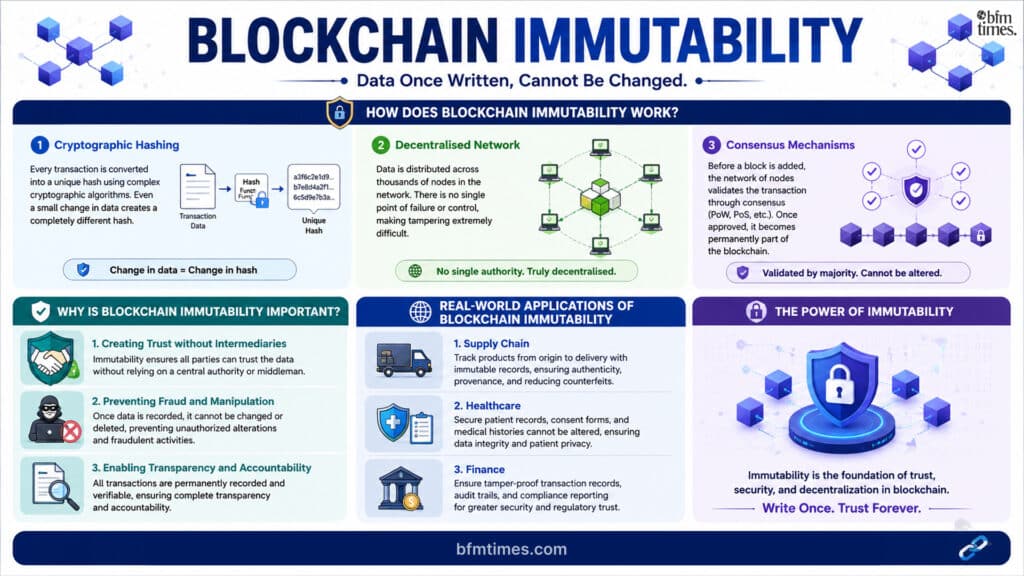
What Is Blockchain Immutability?
Blockchain immutability means that once the data has been recorded on the blockchain, it cannot be altered, deleted, or even modified in any way. It creates an indelible digital record. In simple terms, it is like writing using ink that cannot be erased.
It should be noted that this is unlike what happens when you use a traditional database. The information on the traditional database is easily accessible by the admin, who can either modify or delete it. With a blockchain, that just cannot happen.
This explains why blockchain technology has proven to be one of the most reliable systems.
How Does Blockchain Immutability Work?
The Blockchain immutability is not magic. It is achieved through a smart combination of three core technologies working together.
- Cryptographic Hashing
Each block in a blockchain has a unique digital footprint known as a hash. This hash is created by algorithms such as the SHA-256 algorithm. Each hash consists of a 256-bit output generated by every block depending on the data contained within it.
Here comes the crucial thing – each block has a hash from the preceding block. This makes the blockchain have links among its blocks. Changing any single bit of information in the previous block will result in a changed hash. Thus, this block won’t be able to link to the following blocks anymore.
This means that for altering a block, all the subsequent blocks have to be recalculated simultaneously across thousands of computers.
- Decentralised Network
Blockchain is not stored in a single computer but rather is present in numerous computers around the world referred to as nodes and which each hold a copy of the blockchain. Once there is any change in the data, each node modifies its version of the blockchain.
To successfully hack the blockchain, one must modify information in more than half of all the nodes simultaneously. Hacking of blockchains like those of Bitcoin networks would cost an awful amount of money; for example, it would require over $1.74 million worth of electricity charges in a single hour.
- Consensus Mechanisms
In order for a new block to be appended, a consensus must first be achieved among all parties involved within the network. Proof of work and proof of stake are examples of consensus protocols. In both approaches, consensus must first be achieved by the majority before validating any transaction. None of the parties will have the power to impose their own record in the blockchain.
Why Is Blockchain Immutability Important?
Blockchain immutability is not just a technical feature. It has real-world significance that touches many industries.
- Creating Trust without Intermediaries
Transactions in the past require banks, lawyers, or brokers who function as intermediaries. The blockchain technology eliminates the need for intermediaries. The ledger is trusted on its own because there is no requirement for a third party to verify it.
- Preventing Fraud and Manipulation
When the information is recorded in blockchain technology, it becomes impossible to change it. This results in reduced incidents of fraud. The cases of fraud during trade finance have reduced by 42% in organizations adopting blockchain technology ledgers.
- Enabling Transparency and Accountability
Every transaction is visible to all participants on a public blockchain. Nothing can be hidden after the fact. This level of transparency builds accountability in systems that previously lacked it.
Real-World Applications of Blockchain Immutability
The power of blockchain immutability is being put to use across many sectors today.
- Supply Chain
The implementation of immutable ledgers has reduced the time spent reconciling accounts between buyers and sellers by 40%. Walmart uses blockchain technology for tracking food products. What used to take days or even weeks is now done in seconds. All the transactions of a particular product from its production to sale are recorded permanently.
- Healthcare
Patient medical files stored on an immutable ledger cannot be tampered with or falsified. It will allow healthcare organizations to exchange data. At the same time, patients will be able to decide who gets access to their data.
- Finance
Financial organizations adopt blockchain technology to generate a history of transactions that is permanent and auditable. The processing period for letters of credit has been reduced to 4 days, down from 10 days with the help of blockchain technology.
Blockchain Immutability vs Traditional Databases
How does an immutable blockchain compare to a traditional database?
| Feature | Blockchain (Immutable) | Traditional Database |
| Data Modification | It is not possible once confirmed | It can be edited or deleted anytime |
| Control | Decentralised | Centralised |
| Transparency | High | Low |
| Fraud Risk | Very Low | Higher |
| Trust Requirement | Minimal (trustless system) | Requires trusted admin |
| Auditability | Complete and permanent | Partial or reversible |
The comparison makes it clear. The Blockchain immutability offers a level of security and trust that no traditional database can match.
What is the Future of Blockchain Immutability?
According to predictions, the blockchain industry worldwide will reach $57.64 billion by 2025. This development will primarily occur due to the high level of trust offered by blockchain’s immutability.
Blockchain is being used for various purposes in many governmental organizations. These include creating an immutable identity for citizens and secure online voting systems. The same technology enables enterprises to make their supply chain records immutable and financial firms to settle their transactions.
The use of innovative blockchain technologies such as zero-knowledge proof is being combined with the concept of immutability to ensure verification and privacy.
Conclusion
The immutable nature of blockchain technology is one of the most revolutionary characteristics of modern technology. In blockchain, every transaction that is created on the blockchain is going to be permanent.
The use of cryptography, decentralisation, and consensus ensures that blockchain technology offers a mechanism for creating trust within its architecture. Every sector ranging from finance to health and logistics to governance is using the immutable characteristics of blockchain. Given the importance of digital trust, it is mandatory to understand and utilise the blockchain’s immutable nature.
Disclaimer: BFM Times acts as a source of information for knowledge purposes and does not claim to be a financial advisor. Kindly consult your financial advisor before investing.