
Key Insights
- According to Cathie Wood, the CEO of ARK Invest, the era when Bitcoin suffered 85%-95% drops is over, as the 50% drop currently can be regarded as a win.
- As per Wood, the adoption of institutions in Bitcoin has resulted in permanent changes to its volatility, which has made it move from a testing ground into a legitimate asset class.
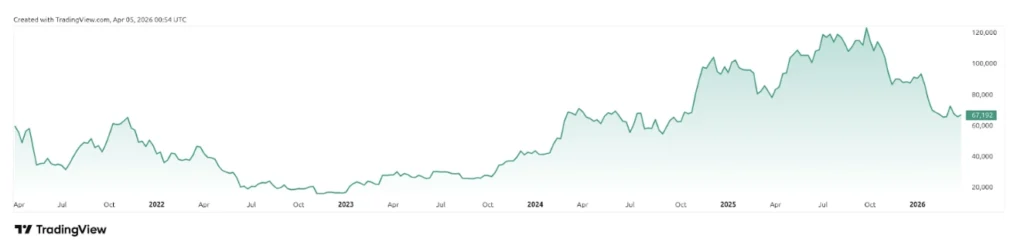
- The on-chain metrics show that the maximum drawdown for the ongoing cycle stands at 52% based on the all-time high of $126,200, significantly lower than in previous cycles.
- While Wood remains optimistic with a target price of $1.2 million in 2030, according to analysis by Tony Severino, the market is likely to plunge by 72% to the $34,000 mark.
ARK Invest CEO Cathie Wood has described the recent 50% price drop in Bitcoin as a historic milestone, a “win” for the cryptocurrency. In a high-profile CNBC interview, Wood opined that the infamous period of 85% to 95% wipeouts may be a thing of the past, indicating a structural change in the behavior of the world’s largest cryptocurrency when it is under market stress. “They will count that a real victory,” said Wood, adding, “50% is as far as they will go. The 85-95% crashes of an extremely new technology are over. This is now a tested technology, a tested monetary system, a new asset category.”
Glassnode Confirms Volatility Compression
On-chain analytics provider Glassnode provides the most convincing evidence for Wood’s thesis. The current market cycle has recorded a peak-to-trough decline of about 52% according to their latest “Percent Drawdown Since ATH” measures. This value is a sharp contrast to the historical DNA of Bitcoin bear markets.
To see the scale of such a change, it is necessary to refer to Glassnode’s historical overlays. During the 2013-2015 cycle, Bitcoin fell by about 87%. Following the 2017 peak, the asset lost 84% of its value. The bear market of 2021-2022 was also nearly 78% down as the price dropped to around $15,600, compared to the high of $69,000. The present floor, which is set after Bitcoin reached a record high of $126,200 in October 2025, shows much higher price retention. This compression of volatility implies that the “diamond hands” of today are no longer mere retail players but are now institutional treasuries and ETF providers that consider sub-$100,000 levels as generational entry points and not exits.
The 2030 Target and the Institutional “Floor”
ARK Invest continues to be ultra-bullish, with a price forecast of $1.2 million per BTC in 2030. Wood’s confidence is based on the institutionalization of the asset. As more spot ETFs are launched and more companies move Bitcoin to their balance sheets, the market’s liquidity profile has deepened. This depth serves as a shock absorber. When sell-side pressure is high, the institutional algorithmic buying bid depth usually prevents the cascading liquidations that characterized previous years. Wood claims that Bitcoin has already moved beyond a highly speculative, risk-on asset to a global store of value that investors are becoming more reluctant to completely sell, even in times of macro uncertainty.
Maturity Thesis Not Accepted by All Analysts
Despite the positive statistics provided by Glassnode and ARK, a vocal segment of the technical analysis community remains skeptical. Market technician Tony Severino has disputed the “shallow bottom” narrative, suggesting that the ongoing correction may still go much deeper. Severino’s model targets a 72% overall decline from the Bitcoin price high, which would put the bottom at around $34,000. This would be tantamount to washing away years of gains and challenging the resolve of the new institutional cohort. Moreover, Bloomberg Intelligence analyst Mike McGlone has recently cautioned that the wider crypto bubble could still revert to the $10,000 to $20,000 price point if global liquidity tightens.
Context: A History of Bitcoin Drawdowns
Bitcoin’s history has been characterized by its ability to survive disastrous failures:
- The Mt. Gox Era (2013): A 93% crash that made many people declare the technology dead.
- The ICO Boom (2017): A crash of 84 percent that wiped out thousands of so-called altcoins.
- The FTX/Luna Collapse (2022): A 78% crash that rewrote the regulatory book.
- The Institutional Era (2025-2026): A 52% drawdown that is currently being tested.
If Bitcoin retains the current values suggested by Glassnode’s Realized Price models, it will confirm the asset has reached a new stage in its lifecycle. For Wood and ARK Invest, the ‘victory’ is not that the price is high, but that it is no longer capable of falling as far as it once did.
Also Read: Pantera CEO: China and Global Blocs to Buy 1M Bitcoin
Frequently Asked Questions
What does a drawdown mean in the world of Bitcoin?
A drawdown is a percentage change from the asset’s most recent all-time high to the lowest point prior to another peak. It is the main measure that is applied to determine the extent of a bear market.
What is so good about a 50% decline that Cathie Wood is celebrating a victory?
A 50 percent decline is a mild drop in the history of Bitcoin. Past cycles recorded declines of more than 80%. When the asset loses half of its value, but then levels off, it shows that it is now less volatile and more appealing to traditional investors.
What does Glassnode have to do with this analysis?
Glassnode offers on-chain data, which tracks the flow of real coins within the blockchain. This enables analysts to visualize the average price investors purchased their Bitcoin (Realized Price) and the number of those in profit or loss.
Could Bitcoin still drop to $34,000?
Yes. Although Wood and Glassnode note that the market is currently stable, technical analysts such as Tony Severino believe that historical mean reversion can only be achieved by further purging of speculative positions before a new bull market can commence.
What became of the $1.5 million target of ARK?
ARK Invest has recently adjusted its 2030 bull case from $1.5 million to $1.2 million. Cathie Wood observed that even though Bitcoin is still a leading store of value, the blistering emergence of stablecoins to facilitate payments has somewhat neutralized some of the estimated utility of Bitcoin in the global remittance market.
Disclaimer: BFM Times acts as a source of information for knowledge purposes and does not claim to be a financial advisor. Kindly consult your financial advisor before investing.