Executive Summary
- Senate leadership has confirmed the formal markup process for the CLARITY Act in the second half of April 2026.
- Senator Bernie Moreno is issuing an ultimatum that the failure to pass the bill by May 2026 will kill legislation on digital assets until at least 2027.
- The “Yield War” is about the potential ban on passive stablecoin interest, which is a direct threat to almost 20% of Coinbase’s earnings.
- Coinbase, along with other crypto companies, is working on a counterproposal to fight the intense lobbying from traditional banking giants such as JPMorgan Chase.
THE APRIL WINDOW: Washington’s Final Stand for Crypto Clarity
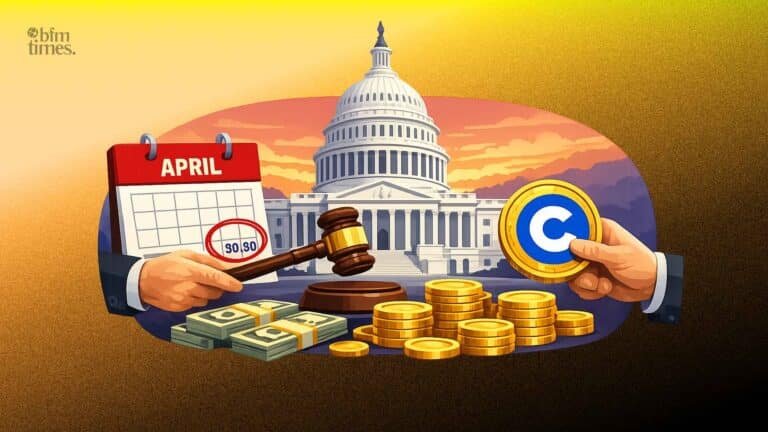
The clock is now officially ticking on the American crypto space. Senate leaders have made the announcement that the Digital Asset Market CLARITY Act is set to move forward in the second half of April with a critical committee markup. This sets the stage for what is sure to be a high-velocity legislative push to bring the legislation to the floor for final passage as early as May.
But the way forward is complicated by the billion-dollar math problem posed by the issue of stablecoin yields.
Senator Bernie Moreno, R-OH, who is one of the primary architects behind the Senate’s push on market structure, has made an ultimatum to both crypto enthusiasts and banking detractors. “If this doesn’t cross the finish line in May, the window closes. We are looking at a legislative desert for digital assets that will last until 2027. This is the only train leaving the station.”
The $1.35 Billion Yield Trap
At the heart of the impasse is the particular clause included in the current draft, which differentiates between “passive yield” and “activity-based rewards.”
In the current draft, users would not be allowed to earn interest on their stablecoins like USDC held in their accounts. While the bill does permit “activity-based” rewards, it prohibits the payment of interest. This is the part of the bill that the industry is fighting hardest against.
In the case of Coinbase, the current draft is existential. As mentioned earlier, in 2025, stablecoins generated $1.35 billion in revenue for the company. This is 19% of the company’s revenue. It is generated primarily as interest on the massive reserves backing USDC. By prohibiting the distribution of this yield to users, the CLARITY Act would essentially eliminate the reason for millions of users to hold stablecoins on the platform.
A Clash of Titans: Armstrong vs. Dimon
Not only has the legislative battle spilled out into the halls of Congress, but it also now pits the old guard against the new guard in the world of finance. According to reports, the CEO of Coinbase, Brian Armstrong, and the CEO of JPMorgan Chase, Jamie Dimon, have repeatedly clashed over the economics of the bill.
Banking lobbyists, led by the American Bankers Association, claim that the yield-bearing stablecoins represent “unregulated shadow banks.” They argue that if crypto companies can offer high-yield savings products without the capital requirements and oversight of a commercial bank, it represents an unlevel playing field and siphons deposits away from the traditional banking system.
Armstrong is said to have countered this argument by stating, “Americans should earn more money on their money,” and the banking lobby is merely trying to stifle competition and preserve the status quo.
The Crypto Counter-Strike
Coinbase has already rejected the current draft twice. In a unique display of industry coordination, Coinbase is leading a group of large crypto companies to draft a counterproposal. This group hopes to tone down the language on yield before the draft “hardens” in April.
The industry’s negotiating power is not just based on policy grounds, but also on political muscle. Coinbase is a big contributor to the Fairshake Super PAC, a political action committee that has a war chest of nearly $190 million to spend on elections. Senators who know this balance of power are caught in a delicate dance between the power of the banking committee and the money of the crypto lobby.
The Path to the CLARITY Act
The Digital Asset Market CLARITY Act is the result of a long period of regulatory confusion in America. After the GENIUS Act was passed in the House in 2025, which primarily dealt with basic definitions of stablecoins, the Senate took on the task of crafting a more comprehensive framework.
The United States has traditionally lagged behind countries such as the EU’s MiCA and Hong Kong in terms of crafting a regulatory framework for digital assets. This is where the CLARITY Act aims to fill the gap about digital asset regulation in America, achieving this through:
- Definition of Jurisdiction: Drawing a “bright line” between the SEC and CFTC.
- Stablecoin Guardrails: Federal regulation of issuers, with 1:1 backing.
- Consumer Protection: Mandatory disclosures and anti-fraud provisions for exchanges.
The “Yield Ban” was added to the bill at a late stage, apparently at the behest of members of the Senate Banking Committee, who remain unconvinced of the benefits of crypto on financial stability.\
Frequently Asked Questions
What is the difference between passive yield and activity-based rewards?
Passive yield is simply earning interest by holding a certain asset in a wallet. Rewards based on activity require a person to “do something” in order to earn a reward, like making a payment at a merchant or a certain type of transaction on a blockchain network.
Why is Coinbase so opposed to this bill if it gives regulatory clarity?
Coinbase wants regulatory clarity; however, a huge chunk of its revenue is impacted by the yield provisions in this bill. They say the bill “breaks” stablecoins and gives unfair advantages to banks.
What happens if the bill does not pass in May?
Senator Moreno has said that due to the legislative calendar, it will not be possible to revisit digital asset legislation with this level of momentum. It will likely leave the industry in a “regulation by enforcement” state until a new Congress convenes in 2027.
Will I still be able to earn rewards on stablecoins if this passes?
Yes, but only on those tied to specific actions. You will no longer earn “4% APY” simply for holding your USDC in a Coinbase account. You might earn rewards for using a crypto debit card or engaging in decentralized finance (DeFi) protocols.
Disclaimer: BFM Times acts as a source of information for knowledge purposes and does not claim to be a financial advisor. Kindly consult your financial advisor before investing.