


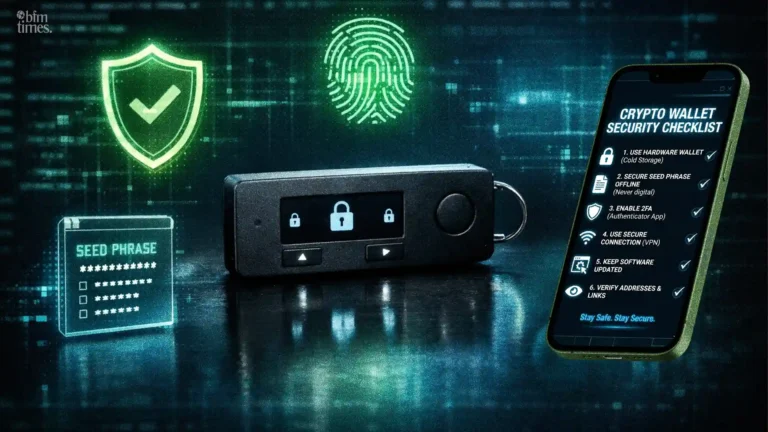
The crypto wallet security checklist is a necessity in 2026 as the theft of digital assets is still developing beyond the simple leakage of personal keys. Phishing approvals, social engineering, device exploits, and smart contract manipulation are areas of attack by today’s attackers. Hundreds of millions of dollars of digital assets have been emptied using wallet drainers and unscrupulous token allowances, as well as hacked authentication.
- Tier 1: The Crypto Wallet Safety Tips to Use Every Day for Crypto wallet security checklist
- How to Secure Crypto Wallet, Private Keys, and Seed Phrase Protection
- Upgrade Physical Backups
- Enhance Authentication Other Than SMS
- Device Hardening
- Tier 2: Hardware Wallet: Security Best Practices for Crypto wallet security checklist
- Selection of Secure Hardware Wallet Architecture.
- Air-Gapped Signing of Transactions.
- The 25th Word Passphrase
- Supply Chain Verification
- Tier 3: Risk Management of Smart Contracts and Approval for Crypto wallet security checklist
- Protecting against Guidebot Ice Phishing.
- Standards Token Approval Audits.
- Transaction Simulation Tools.
- The 90/10 Wallet Separation Model
- Tier 4: Distributed Trust: MPC and Multi-Signature Security for Crypto wallet security checklist
- Emergency Procedures: Compromise Response.
- Frequently Asked Questions
- In summary: Security as an Ongoing Process.
- Also Read:
It is a research-based crypto wallet security checklist that is structured and should be established to offer everyone a user-friendly list of hardware protection, smart contract protection, identity isolation, and the emergent layer of security, such as MPC or multi-signature wallets. Whether you are a small-scale holder of cryptocurrencies or running a large-scale infrastructure with crypto wallets, it is no longer a choice how you make sure your Crypto wallet security checklist is secure; it is a requisite to asset survival.
Tier 1: The Crypto Wallet Safety Tips to Use Every Day for Crypto wallet security checklist
All-powerful crypto wallet security checklist assessments start with project hygiene. The majority of the losses are as a result of exploitable errors, but not state-of-the-art cryptography failures.
How to Secure Crypto Wallet, Private Keys, and Seed Phrase Protection
The master key is your seed phrase. Their assets are forever destroyed in case you are caught.
Best practices:
- Do not store seed phrases on a screen (do not take screenshots, load to the cloud, or write an email).
- Do not use password stores to save seeds.
- Store offline, paper-based.
- Back up stores in physically secured locations.
Under the security guidance of Bitcoin.org, the system uses the principle of storing backups offline as an essential measure of self-custody.
Upgrade Physical Backups
Paper degrades. Fire and water destroy it.
The current good practice of wallet security suggests the use of stainless steel seed-storage plates that can withstand fire and corrosion.
Enhance Authentication Other Than SMS
According to NIST Digital Identity Guidelines (SP 800-63B), SMS-based authentication should be discouraged because of SIM swapping.
Instead:
- Use authenticating secure private keys that are hardware-based in FIDO2.
- Enable app-based 2FA
- Only work with wallets with the help of special email addresses.
Isolation plays a great role in exposing attack surfaces. Source.
Device Hardening
Adhering to Mobile Security recommendations of OWASP:
- Enable full-disk encryption
- Always keep the operating systems up-to-date.
- Do not use rooted or jailbroken models.
- Turn off device-to-device clipboard sharing.
When you are getting to know how to secure Crypto wallet security checklist assets, the initial defense mechanism is device hygiene.
Tier 2: Hardware Wallet: Security Best Practices for Crypto wallet security checklist
As balances are built up, hot wallets are no longer adequate. Here are wallet security best practices:
Selection of Secure Hardware Wallet Architecture.
Hardware wallets will ensure that secure private keys are not exposed to the internet, though the design philosophies vary.
Key considerations:
- Firmware transparency Open-source firmware Open-source Enclosure transparency
- Isolation of a secure element chip.
- Firmware checking procedures.
- Image of vendors and audit disclosure.
The discussion of the safeguard element models versus the entirely open-source models is one that remains in comparison, and it defines the security debate. You need to take the right option based on the threat model: transparency and physical chip-based protection.
Air-Gapped Signing of Transactions.
USB stacks and Bluetooth stacks are becoming more popular targets of modern attacks.
In air-gapped wallets, QR-code signing is employed to remove either data cables or wireless communication.
This drastically eliminates any threat of remote exploits and assists in defensive measures to protect crypto from hackers through connectivity layers. Source.
The 25th Word Passphrase
Hidden wallet accounts are developed by adding a passphrase (also referred to as the 25th word).
Benefits:
- Ensures plausible deniability.
- Invulnerable even to exposure of the seed phrase.
- Produces containerized storage.
This is one of the wallet security best practices that long-term owners must engage in.
Supply Chain Verification
Prior to hardware activation:
- Buy it directly from the official manufacturers.
- Check tamper-evident packages.
- Check the authenticity of the firmware at the time of installation.
In 2026, the subject of supply chain attacks continues to increase.
Tier 3: Risk Management of Smart Contracts and Approval for Crypto wallet security checklist
The threat in the modern environment is not necessarily the theft of a key. It is hereditary exploitation.
Security researchers have reported wallet drainer campaigns that lead users to approve the malicious token usage instead of extracting the private keys.
Protecting against Guidebot Ice Phishing.
The term “ice phishing” is used in reference to fraudulent deals that appear as legal minting of NFTs or token swaps.
Protection checklist:
- Confirm the address of contracts prior to communication.
- Not to be shown through social media DM links.
- Ensure the authenticity of the website using the official authorities.
Standards Token Approval Audits.
Revoking unused tokens’ approvals is one of the least common tips to consider for the safety of the crypto wallet.
Regularly:
- Blockchain explorers’ token allowances. Checks
- CANCEL farm superfluous smart contract permissions.
- Do not issue open-ended token approvals.
Bounty approvals enable rogue contracts to empty tokens without additional validation.
Transaction Simulation Tools.
Through transaction simulation tools, the preview of the signature execution is viewed before the confirmation is made.
These tools:
- Disclose secret transfers of tokens.
- Identify bad contract logic.
- Reduce blind-signing risk.
- Always avoid signing something you do not know.
The 90/10 Wallet Separation Model
- To take adequate security measures against crypto-hackers:
- Keep assets in 90 percent of cold storage.
- Transfer to DeFi and NFT through a different hot wallet.
This type of sandbox will prevent endangering long-term holdings by experimentation. Source.
Tier 4: Distributed Trust: MPC and Multi-Signature Security for Crypto wallet security checklist
A current crypto wallet security checklist allows more than single-key protection.
Multi-Party Computation (MPC)
The MPC wallets divide key material into many devices instead of producing a seed phrase.
Advantages:
- Eradicates a single-point-of-failure seed store.
- Limits the chances of physical theft of backups.
- Available control is distributed.
This model is becoming the government of institutions and sophisticated retail users.
Multi-Signature Wallets
There are wallets with multiple signatures; multiple approvals are needed to transfer money.
Example setup:
- 2-of-3 configuration
- Two hardware wallets
- One secure backup device
Money is transferred when the confirmation is made, and the risk of compromise is considerably lowered.
Social Recovery Models
The use of account abstraction and a system of recovery through guardians makes it possible to restore wallets without exposing seed phrases.
This innovation helps to eliminate the physical backups and sustain decentralization. Source.
Emergency Procedures: Compromise Response.
Despite the elaborate crypto wallet security checklist, accidents might still take place.
Immediate response steps:
- Withdraw all smart contract permissions.
- Move the remaining money over into a newly created secure wallet.
- Disconnect the wallet from all the decentralized applications.
- Hash of document transactions to be used in reporting.
Speed is critical. Money is emptied from wallets in minutes by automated drainers.
Frequently Asked Questions
Is Trust Wallet legal in India?
Yes, using Trust Wallet as a non-custodial Crypto wallet security checklist in India is legal because India does not ban self-custody wallet apps, though crypto trading and taxation rules still apply.
What are the best self-custody crypto wallets?
The best self-custody Crypto wallet security checklist in 2026 includes Ledger (Nano X / Nano Flex), Trezor (Model T / One), Bitkey, Tangem cards, Trust Wallet, MetaMask, and Zengo for secure control of private keys and diverse asset support.
In summary: Security as an Ongoing Process.
By the year 2026, the crypto wallet security checklist will no longer focus on seed phrase security. It involves device security, smart contracting, identity isolation, hardware architecture-related decisions, and distributed trust.
To grasp the idea of how to manage the crypto wallet resources, consider this Crypto wallet security checklist:
- Offline key storage
- Hardware isolation
- Approval audits
- Transaction simulations
- The use of multi-signature or MPC.
DMP protection is not a single setup. It is a continuous field that has to be updated and revised frequently.
With the increase in blockchain use, as well as the development of threat actors, the best practice of wallet security has to develop with the same accuracy. The ones who consider security a system rather than a tool will not be harmed in the decentralized economy.
Also Read:
Best Private Crypto Wallets in 2026 | Stay Anonymous
Who Controls How Much Bitcoin in 2026? Is BTC Centralized Now?
Best Altcoins for Long-Term Investment: Top Picks & How to Choose
Disclaimer: BFM Times acts as a source of information for knowledge purposes and does not claim to be a financial advisor. Kindly consult your financial advisor before investing.