


Pointwise Summary
- Satoshi Nakamoto, the creator of Bitcoin, foresaw in 2010 that the network could shift to something more powerful if the quantum threat was not imminent.
- A new whitepaper by Google Quantum AI shows that it now takes 20 times fewer resources to break the encryption of Bitcoin than previously estimated.
- Developers are accelerating the implementation of BIP-360, a proposal to adopt quantum-resistant signatures before the industry-estimated 2029 deadline.
As Bitcoin was valued at less than a cent and hardly anyone outside of the niche cryptography community knew anything about it in the summer of 2010, its pseudonymous creator, Satoshi Nakamoto, was already considering the end of the world as we know it. Satoshi wrote a short yet deep Bitcointalk forum post about the impending threat of quantum computing. Satoshi wrote: “In case it comes slowly, we still can change to something more powerful.”
In April of 2026, that gradual transition has come to the most critical juncture. This week, Google has issued a bombshell report by its Quantum AI division that has successfully raised the alarm. The study indicates that the time frame in which Bitcoin stands a chance to improve its cryptographic base is shrinking at a quicker rate than expected. Nonetheless, instead of causing a collapse, the market is considering this as the final stress test of Satoshi’s vision of a flexible, living protocol.
The 500,000 Qubit Threshold
It was believed over the years that the industry would need about 10 million physical qubits to break the Elliptic Curve Digital Signature Algorithm (ECDSA) that secures all Bitcoin wallets. The new whitepaper of Google, which is called “Safeguarding Cryptocurrency by Disclosing Quantum Vulnerabilities Responsibly,” has broken that comfort zone.
The researchers showed that using “optimized circuits,” a quantum computer with only 500,000 physical qubits would be able to compute a private key based on a public key in under nine minutes. This is a very sinister timing. Since the average block time of Bitcoin is ten minutes, a quantum attacker would, in theory, be able to hijack a transaction as it waits in the mempool. They would be able to view your broadcasted transaction, calculate your private key, and send a fraudulent transaction with a higher fee to be certain that it will be verified first.
Reaction in the Market: Two Charts
The price of Bitcoin has been very resilient despite the seriousness of the Google report. BTC has recovered to trade around $68,900 as of Wednesday afternoon after a short decline to $66,250 after the news.
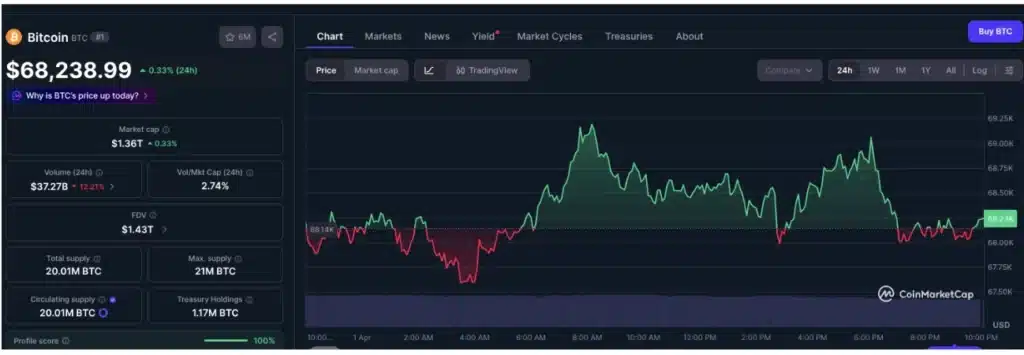
The April 1, 2026, chart displays a recovery that is in the shape of a V. Although the selling pressure was high at the time of the release of the Google whitepaper, the volume is still high, which indicates that the long-term holders are considering the quantum upgrade as a technical achievement and not a terminal failure. The present price is still way above the support levels that were set in the first half of this year.
Also, there have been tremendous inflows in specialized assets such as the Quantum Resistant Ledger (QRL). QRL has gained more than 40 percent in the past 24 hours, rs reaching $1.69. This price movement indicates an increasing quantum hedging approach of institutional investors who desire to be exposed to protocols that already use hash-based signatures, res such as XMSS, which are mathematically resistant to the Shor algorithm.
The BIP-360 Transition
The developer community of Bitcoin is not sitting idle. A draft proposal called BIP-360 was formally added to the repository of Bitcoin Improvement Proposals in February 2026. BIP-360 seeks to add Lattice-based Signatures to the Bitcoin protocol. These signatures are very large compared to the existing ones, and it will take a delicate balancing act to ensure that the blockchain does not bloat.
One of the developers of the proposal, Hunter Beast, says that Satoshi knew that this day would come. The protocol was constructed with the knowledge that cryptography is not a static entity. “It is literally replacing the engine of a plane whilst it is flying. It is challenging, but that is exactly what Bitcoin was meant to endure.”
Background: The Long Game of Cryptography
This was not a mere conjecture by Satoshi in 2010; this was a design philosophy. The initial implementation of Bitcoin employed Pay-to-Public-Key-Hash (P2PKH) specifically because it conceals the public key until the time when a user wants to spend their coins. This gives a quantum shielding to dormant addresses. It is only upon spending your Bitcoin that your public key is visible to the network.
Nevertheless, the Google report emphasizes that in the 6.9 million BTC that are stored in older legacy wallets, the public keys have already been exposed. The most vulnerable are these coins of the Satoshi era. Unless the network is switched to a quantum-resistant standard by 2029, these billions of dollars of digital gold may be a honey pot to the first nation-state to gain quantum supremacy.
Also Read: Google Research: Quantum Computers Could Hijack Bitcoin Transactions in 9 Minutes
Frequently Asked Questions
Is a quantum computer stealing my Bitcoin?
No. The quantum computers that are presently in use can execute a fraction of the qubits needed to crack ECDSA. Even the most developed systems are many orders of magnitude away before they can be a viable threat to production blockchains.
What will be the case when I fail to transfer my Bitcoin to a new wallet?
Provided that Bitcoin adopts a soft fork to quantum-resistant signatures, you will probably have to transfer your money out of your existing address to a new address that is called PQC (Post-Quantum Cryptography). Failure to do so before quantum computers are large enough may put your funds in jeopardy.
Why is Google threatening the industry?
Google claimed that it is pursuing a responsible disclosure policy. They are also giving the developers the time they require to execute the upgrades without triggering a panic in the market by offering a timeline (they are aiming at 2029 to complete the migration).
Will it be a hard fork of the transition?
The majority of developers are developing a soft fork solution that would not break compatibility with the current network. Nevertheless, a chain split may occur in case the community is unable to come to an agreement on the post-quantum algorithm to be employed.
Is it not Bitcoin alone that is at risk?
No. The whole financial system in the world, such as banking encryption, HTTPS web security, and government databases, is based on the same encryption. In fact, Bitcoin is more advantageous than most conventional banks since it can be improved through community consensus without the need to have a central authority to correct its old systems.
Disclaimer: BFM Times acts as a source of information for knowledge purposes and does not claim to be a financial advisor. Kindly consult your financial advisor before investing.