



Key Insights
- Price of Bitcoin: Currently, Bitcoin’s price stands at $76,785, having recovered from a “choppy” April yet being far lower than its October 2025 peak of $125,835.
- The Strategy: The “HODL” or hold on to it strategy remains Strategy’s (previously Microstrategy) strategy of choice, although the company’s shares have fallen by 40% since reaching their peak in 2025.
- Era of Institutions: The idea that “Four-year Cycles make everything” appears to be put into question with 2026 representing an “Institutional Era” based on macro-liquidity rather than halvings.
- Community Views: Retail traders seem less and less convinced that “HODL is your best strategy”, increasingly favoring a “HODL until you need it” or “HODL/trade” approach.
Digital Gold Stands Steady In April
With April 2026 drawing to a close, the Bitcoin market is at a pivotal moment. Following a dramatic 2025 in which the leading cryptocurrency surged well above $120,000, the first three months of 2026 have been a sober reminder of the digital asset’s volatility. For the “HODL” community, this has been a time of trial; for sceptics, it is evidence that the strategy may be out of fashion in a market increasingly dominated by Wall Street ETFs and corporate treasuries.
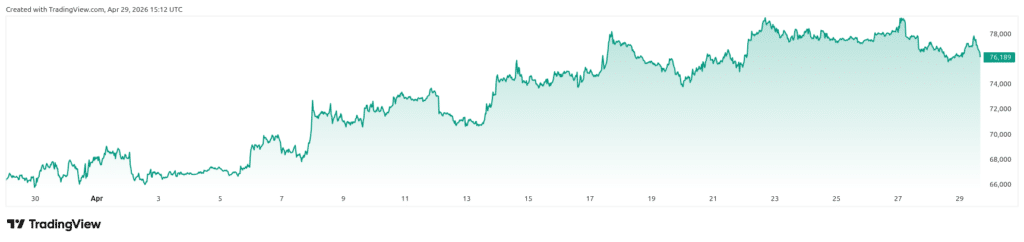
April has been a wild ride. Bitcoin was trading around $93,924 on April 1st. It then fell to the $70,000s in the middle of the month, causing concerns of a more significant bear market. But as of April 29th, the asset has settled at $76,785, with institutional investors returning to the market and a “risk-on” attitude spreading throughout the global economy.
Visualizing The Recovery
To determine where we are at the moment, one can look at the intraday performance on platforms like TradingView or Coinbase. At present, the chart seems to have formed a “bullish pattern” on the 4-hour chart, with the price being currently restrained just below a supply area at $78,200. As per experts, any clear break above the level of $80,000 would create a short squeeze effect resulting in an assault on the level of $100,000.
Responses from the internet
The HODL debate is perhaps most active on Reddit, where the community is still coming to terms with the psychological effects of high-stakes trading. In a recent popular post on r/Bitcoin, “Is HODL still the best strategy?”, the community is split between the veterans and the doubters.
- The “Balls of Steel” Veterans: Long-term investors have tales of extreme stamina. One user, gilmeye, observed that the strategy is effective but “you need the balls to hold 10 years minimum” and described their experience of buying at $17k to $20k and then seeing it plunge to $3k without selling a single Satoshi. Another user, doctordyck, similarly expressed this “buy the dip” philosophy, confessing they bought the top at $69k in 2021 and continued buying down to $16k. For such investors, HODLing is about seeing Bitcoin “for what it is, rather than what its price is”.
- The Logic of Position Sizing: A dissenting voice was Prestigious-Stay-312, who suggested that HODL doesn’t work for many people because of the position sizing. “Most people don’t lose because they picked the wrong asset. They lose because they size it like it shouldn’t move,” the user wrote. The implication is that if an investor can’t hold through a 30% to 50% drawdown without selling, they have probably invested more than they can afford to lose.
- Doubters and Short-Term Realities: Not all were sold on the “buy and hold” strategy. Others, such as captainorganic07, cautioned against the “sunk cost fallacy” – that not selling during a big drawdown is not always courage but may be a lack of a stop-loss plan. Others said “HODL is king” only if you have the time; as user MrKillerKiller_ said, buying at the end of a run-up could lead to waiting years for a return on investment.
- The Corporate Whale: Strategy’s 10-Year Bet
While the retail crowd is moved by every $5,000 swing, corporate America is not. Bitcoin bulls at Strategy recently revealed a jaw-dropping $2.5 billion buy in the early April lows. For companies such as Strategy, Bitcoin is a “10-year treasury asset” rather than a “10-month trade”.
The theory is straightforward: the world’s M2 money supply is growing and Bitcoin’s scarcity makes it the perfect hedge against fiat currency debasement. Since Strategy first began its Bitcoin treasury policy in August 2020, its share price has risen more than Bitcoin, with a return of more than 1,260% versus Bitcoin’s 590%. This “high-beta” play has positioned it as a Bitcoin HODL stock.
Real-time Market Data
The latest figures from CoinMarketCap show that Bitcoin dominance is still above 60%. This dominance is a sign that the market is in a “flight to quality” as investors move away from risky altcoins and back to the “macro anchor” that is Bitcoin.
A Changing Macro Environment: Post Halving
Bitcoin investors have traditionally followed the “Four-Year Cycle” of hype and bust that coincides with the halving events. But the 2026 forecast from Grayscale Research puts us on the “Dawn of the Institutional Era” where this cycle could end.
Two years after the April 2024 halving event. Historically, 2026 would be a “bear year”. But we are witnessing a market supported by:
- Spot ETFs: Over $56 billion of net inflows have transferred a substantial amount of Bitcoin supply into regulated, long-term institutional funds.
- Monetary Policy: Despite the Fed’s decision to keep interest rates at 3%, the expectation of further cuts is positive for risky assets.
- Gold Divergence: On the contrary, Bitcoin’s correlation with gold has been negative (-0.17), despite its recent rally to an all-time high of $4,784. Hence, Bitcoin acts as a “high-tech growth stock” rather than a “defensive commodity.”
Disclaimer: BFM Times acts as a source of information for knowledge purposes and does not claim to be a financial advisor. Kindly consult your financial advisor before investing.