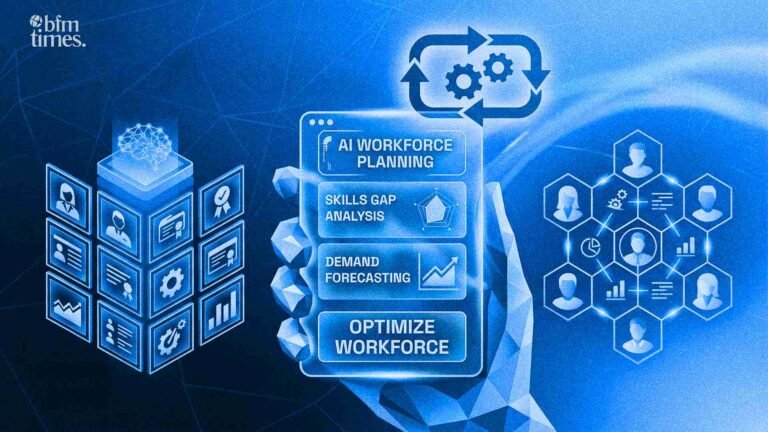
In today’s fast-paced world, organizations are required to become smarter, faster, and more agile. Effective decision-making is vital. In order to achieve success, companies need to make better hiring decisions, build strategies, and develop their teams. Fortunately, the implementation of AI in workforce planning allows HR specialists to do exactly that.
- What Is AI in Workforce Planning?
- Why Does AI in Workforce Planning Matter More Than Ever?
- What Are the Key Ways AI Transforms HR Workforce Planning?
- Smarter Talent Forecasting
- Faster and Smarter Hiring
- Identification of Skills Gaps and Reskilling/Upskilling Employees
- Reducing Employee Turnover
- Real-Time Performance Insights
- What Are the Key Benefits of AI in Workforce Planning?
- How Are HR Leaders Using AI Workforce Planning Today?
- Agentic AI: The Next Frontier
- Skills-Based Planning Is Replacing Job-Based Planning
- Learning and Workforce Planning Are Merging
- What Challenges Do Organizations Face With AI in Workforce Planning?
- How Can You Build an AI-Ready HR Function?
- What Does the Future of AI in Workforce Planning Look Like?
- Conclusion
- Frequently Asked Questions (FAQs)
In this article, readers will gain insights into the How AI in Workforce Planning Transforms HR featured on BFM Times.
What Is AI in Workforce Planning?
Workforce planning is all about anticipating the company’s needs and ensuring that the right number of employees with relevant expertise are hired for specific positions.
Traditionally, workforce planning was a manual process. Spreadsheets and intuition played a central role. It was slow, reactive, and often led to poor decision-making.
AI in workforce planning is a game-changer. With advanced algorithms, predictive analytics, and machine learning, this method allows for better planning. AI tools consider multiple factors, including current skills and expertise, performance trends, strategic business goals, and the labor market.
The output? HR leaders receive actionable insights to support workforce strategy development, hiring, and training.
The transition from reactive to proactive workforce management can be done with ease.
Why Does AI in Workforce Planning Matter More Than Ever?
There are several compelling reasons why implementing AI in workforce planning is more urgent than ever before. First of all, statistics:
- Almost 62% of organizations are currently leveraging AI technology.
- About 72% of HR experts state that artificial intelligence improves workforce planning.
- Approximately 12% of HR specialists actively engage in strategic workforce planning with a horizon of 3+ years.
About 74% of firms experience difficulties recruiting employees with relevant skills.
All these figures show that there are serious challenges related to workforce planning. Luckily, AI presents an efficient solution.
The Skills Shortage Has Become a Reality
Currently, there is a skills shortage in the majority of countries worldwide. According to the World Economic Forum, 85% of employers are planning to invest in workforce upskilling by 2030. Experts predict that 120 million workers will be left behind due to the inability to undergo reskilling.
Using AI for workforce planning allows for identifying the potential shortages within 3 years. This way, organizations are able to tackle the issue before it becomes critical.
What Are the Key Ways AI Transforms HR Workforce Planning?
Smarter Talent Forecasting
One of the greatest benefits of applying AI technology to workforce planning is improved talent forecasting. Advanced algorithms are used to analyze historical data, strategic business plans, and industry trends to determine when and where the workforce should be expanded.
This helps HR teams:
- Plan hiring timelines in advance
- Avoid last-minute, costly urgent hires
- Match staffing levels to business demand
Schedule employees to reduce labor costs by up to 18%.
Faster and Smarter Hiring
Hiring employees is one of the most time-consuming HR processes. Fortunately, AI solutions allow speeding up this process significantly.
AI-powered hiring tools can:
- Screen resumes in seconds instead of hours
- Match candidates to roles with 67% better accuracy
- Reduce time-to-hire by an average of 50%
- Cut recruitment costs by up to 30%
About 75% of recruiters claim that AI technology makes the screening process faster. This allows HR professionals to spend more time on establishing relationships with applicants.
Identification of Skills Gaps and Reskilling/Upskilling Employees
Having information about the existing skills of employees is vital. Identification of skills gaps plays an important role as well. Otherwise, it would be impossible to think about developing effective strategies related to upskilling and reskilling the workforce.
Workforce planning tools based on AI help HR specialists create a skills inventory. Furthermore, such solutions also take into account each particular employee’s skills and abilities, not just his/her title.
With this data, HR teams can:
- Find existing skills gaps
- Create programs of reskilling and upskilling tailored specifically to their needs
- Connect employees with internal opportunities, taking their skills into account
Using AI to switch the point of view from jobs to abilities is extremely helpful for the future of any organization.
Reducing Employee Turnover
Thanks to advanced AI technologies, HR specialists can predict when an employee is planning to quit the company. They can detect early signs that one of your top performers is dissatisfied with his/her current situation. As a result, you’ll be able to intervene and save him/her from quitting.
These steps might include:
- Offering new development opportunities
- Adjusting compensation
- Providing better work flexibility
Using this attrition model based on AI allows companies to save millions of dollars per year.
Real-Time Performance Insights
Insights Into Real-Time Employee Performance
Historically, performance reviews of employees happened once or twice a year. During this time, some issues could escalate and turn into something more serious. However, thanks to AI solutions, HR professionals have an opportunity to receive constant feedback regarding the performance of employees and their teams.
By 2025, almost 70% of companies will use AI tools for analyzing the performance of their workforce in real-time. This tendency is expected to grow even more in 2026.
What Are the Key Benefits of AI in Workforce Planning?
| Benefit | Impact |
| Forecast of skills gap | Up to 3 years in advance |
| Savings because of not hiring | Up to 25–30% |
| Improvement of hiring accuracy | Up to 40% |
| Decrease in time-to-hire | Up to 50% |
| Increase of workforce efficiency | Up to 40% |
| Improvement of decision-making processes | Up to 60% |
| Accuracy of predicting workforce trends | Up to 90% |
| Savings because of workforce scheduling | Up to 18% |
| Employee turnover prediction | Up to 87% accuracy |
How Are HR Leaders Using AI Workforce Planning Today?
Agentic AI: The Next Frontier
In 2026, HR management gets access to a brand-new tool called agentic AI. This technology is capable of performing several complex tasks automatically without human assistance.
At the moment, 48% of large companies have decided to introduce agentic AI. According to predictions, this number is expected to grow drastically during the following year, achieving an incredible 327% by 2027.
In five years, 80% of organizations plan to involve both AI agents and human workers in their workforce. It means that in the near future, HR leaders will have to manage not only teams consisting of only humans but hybrid ones as well. This is the reason why workforce planning processes need to be changed as well.
Skills-Based Planning Is Replacing Job-Based Planning
Several firms decided to change the way they treat their workforce. Instead of asking questions about how many project managers an organization needs, they think about the required competencies.
Thanks to new AI-based workforce planning solutions, these companies can create internal marketplaces of talent. Thanks to that, they are able to connect employees to the projects based on their skills and competencies, and not titles.
This provides excellent agility for these companies, and that is why they can mainly rely on in-house talents, not external hires.
Learning and Workforce Planning Are Merging
One of the amazing achievements brought by the use of artificial intelligence in workforce planning includes combining it with learning. In fact, this process can be described by the term Skills Intelligence Loop.
It consists of the following stages:
- Data collection from various applications used by employees
- Creation of predictive models of skills gaps
- Development of learning modules
- Putting new skills into practice
- Sending back performance data to the loop
The whole point here is that learning and workforce planning should be combined into one continuous process.
What Challenges Do Organizations Face With AI in Workforce Planning?
Despite having lots of benefits, the implementation of AI-based solutions is far from easy. Several obstacles need to be addressed if a firm wants its AI tools to be fully functional.
Integration Issues
Currently, about 47% of organizations are struggling to combine AI-based solutions with their existing HR technology stack. Outdated systems that are unable to share data with other applications slow down digital transformation significantly.
Unless a firm can successfully integrate AI solutions with its HR infrastructure, it won’t be able to achieve desired results. Integration shouldn’t be taken care of later.
Governance and Ethics Concerns
Using AI-assisted employment decision-making requires a responsible approach from HR teams. Some practices including emotion detection at work, had already been forbidden in certain regions.
Various regulations governing the use of AI in HR emerged around the world. They touch upon issues like compliance, biases, transparency, and accountability.
Almost half of all businesses faced challenges associated with compliance when implementing AI solutions for their operations. Good governance practices are required to avoid sanctions.
Skill Gaps Among HR Professionals
Ironically, 33% of businesses lack enough experts in artificial intelligence on their staff. HR specialists need to work with such tools, which require certain knowledge and training.
Because of this reason, only 73% of HR directors implemented AI in their activities before 2025. For individual contributors, this number is much lower, 65%.
How Can You Build an AI-Ready HR Function?
To unlock the true power of AI-based workforce planning solutions, HR functions have to prepare. They have to be AI-ready. Here are the steps that organizations should take.
- Prioritize data – AI is only as good as the data it uses. If a company wants to make its workforce planning process smarter, it first has to improve data quality and then build on top of this foundation.
- Integrate AI with organizational goals – Any AI solution applied in workforce planning should have one specific objective. Whether this objective is reduced turnover or quicker hiring, each tool should serve one business purpose.
- Ensure active HR involvement in the AI strategy – According to AIHR, 89% of HR functions are already undergoing some kind of restructuring or plan to do so within the next two years. HR should participate in the AI transformation actively and contribute ideas.
- Incorporate communication – Around 70% of employees expect more transparent AI in HR functions by 2025. Fairness and trust are key principles when implementing AI-based solutions.
- Start small, then scale – HR departments don’t necessarily need to implement AI-based solutions in all areas at once. Start with talent forecasting or skills gap analysis – whatever the priority is. From there, scaling will follow.
What Does the Future of AI in Workforce Planning Look Like?
There are numerous upcoming trends in AI-assisted workforce management that HR leaders should pay attention to.
- Adding AI agents to the teams – More than half of talent leaders have plans to incorporate autonomous agents into their teams by 2106.
- Hyper-personalized development – AI technologies will be able to generate personalized development programs for every employee, not just the top leaders of the business.
- Real-time compliance monitoring – AI will track HR actions and provide information on the risks of violating regulations on a constant basis.
- Cross-department collaboration – IT, finance, and HR will collaborate, using shared data on the workforce from their AI systems.
- Continuous planning cycles – Annual workforce planning will eventually disappear, making room for continuous cycles powered by AI.
By investing in AI in workforce planning today, HR functions gain an important competitive edge. Companies that delay implementation will fall behind slowly but surely.
Conclusion
The evidence presented above is compelling and irrefutable. AI in workforce planning is not a fleeting trend. It is an evolution that has already happened in the world’s best businesses.
From predictive talent forecasting to filling skill gaps immediately, the introduction of AI into workforce planning processes helps HR leaders make smarter, faster, and fairer decisions. It saves money, facilitates recruiting, increases retention rate, and ensures that organizations’ workforce remains competent.
Those businesses that adopt AI in workforce planning will enjoy greater stability. They will waste fewer resources coping with talent shortages and will have time to shape the future of their organization.
It all starts today. Is your HR department ready for this transformation?
Also Read: Best AI Legal Research Tools in 2026
Frequently Asked Questions (FAQs)
What is the main benefit of AI in workforce planning?
AI enables HR departments to make better predictions regarding their future talent needs and helps reduce hiring costs. AI closes skill gaps promptly and increases workforce planning efficiency up to 40%.
Is AI in workforce planning suitable for small businesses?
Absolutely! Any size of a business can leverage AI solutions to hire employees faster, track their performance, and forecast their staffing needs accurately.
Does AI replace HR professionals in workforce planning?
No, it will not replace HR teams. Instead, AI will give them valuable assistance in decision-making and data analysis. Employees will continue making important choices themselves.
Disclaimer: BFM Times acts as a source of information for knowledge purposes and does not claim to be a financial advisor. Kindly consult your financial advisor before investing.