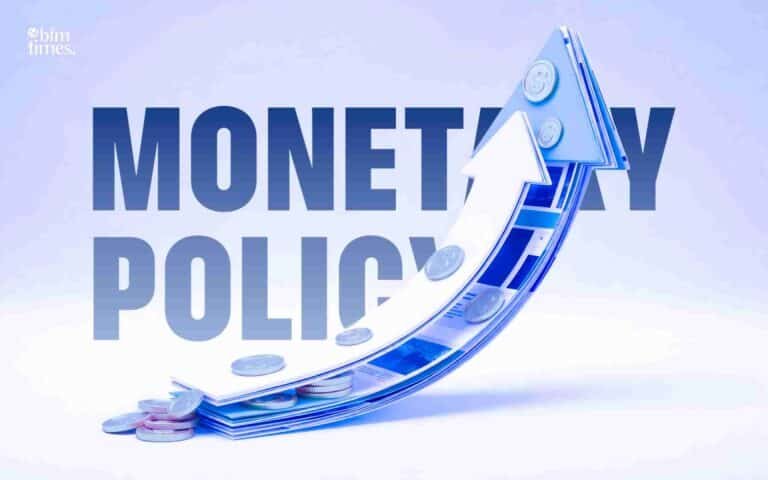
The Economic changes never stop. They depend on the decisions regarding finances which are made by people who lead the country. The economy is the most influential factor that determines our earning and spending. What does monetary policy mean? These are steps taken by the central bank in order to control money supply and manage interest rates in the economy. This blog will take you through what monetary policy is & what is really going on right now in 2026.
What is Monetary Policy?
Monetary policy refers to the means through which the central bank controls the movement of money within an economy. It is the management of the money supply and interest rates towards attainment of important economic objectives. The Federal Reserve in the United States defines monetary policy as the actions & communications used to encourage maximum employment, stable prices & moderate long-term interest rates.
The central bank is the main authority that runs the monetary policy. The Federal Reserve is the central bank of the United States. The European Central Bank handles monetary policy in the eurozone. These institutions make decisions that affect every person, business & financial market in the world.
It is important to know that monetary policy is different from fiscal policy. The Fiscal policy covers government spending & taxation. Monetary policy focuses only on money supply & the cost of borrowing. Both work together to keep the economy in balance.
What are the Two Main Types of Monetary Policy?
Monetary policy operates in two main directions. It either pushes the economy forward or slows it down. These two directions are the foundation of every central bank decision.
- Expansionary Monetary Policy:
This form of monetary policy can be employed when there is an economic slowdown. This involves the reduction of interest rates so as to encourage spending and investments and make it easier for borrowers to obtain loans. The effect is an expansion of money supply in the economy. The Federal Reserve adopted this monetary policy during the financial crisis in 2008 and pandemic in 2020.
- Contractionary Monetary Policy:
This type of monetary policy is used when inflation is rising too fast. The central banks increase the interest rate, making it more difficult for the borrowers to borrow funds. This will lower expenditure and reduce money circulation within the economy. Inflation is curbed by this means. The Fed has been utilizing this form of monetary policy in the period from 2022 to 2023, raising interest rates eleven times.
What are the Key Tools Used in Monetary Policy?
The Central banks use several tools to carry out monetary policy. Each tool works in a different way to influence borrowing, spending & money supply. The main tools used in 2026 are:
- Interest Rate Decisions: It is the most direct tool. The central bank sets the base interest rate. The Federal Reserve currently holds its benchmark rate in the 3.50% to 3.75% range as of April 2026. It has kept this rate steady since January 2026.
- Open Market Operations: The central bank buys or sells the government bonds in the open market which directly affects the money available in the banking system. Buying the bonds adds money to the system & selling the bonds removes it.
- Reserve Requirements: The central bank sets the amount of money that banks must keep in as reserve. By lowering this requirement frees up more money for the banks to lend. By raising the reserves the amount of money in the system gets tightened.
- Quantitative Easing (QE): This is a more sophisticated tool used when interest rates are near to zero. The central bank creates new money to buy the long-term government bonds & other securities. It pushes large amounts of cash into the financial system to encourage lending & investment.
What are Monetary Policy Goals?
Monetary policy is much more than the management of interest rates. There is an additional objective behind such policies. The central bank’s dual mandate established by the US Congress can be seen from the following table.
| Goal | What It Means | Current Status in 2026 |
| Maximum Employment | To keep the job levels as high as possible. | The Labor market will remain steady in 2026. |
| Price Stability | To keep the inflation near 2% per year. | The US inflation is at 3.8% in April 2026. |
| Moderate Long-Term Interest Rates | To keep the long-term borrowing costs reasonable. | The 10-year Treasury yields are rising slightly. |
What is Happening in Monetary Policy 2026?
Monetary policy as it stands in 2026 appears to be well-balanced. The Federal Reserve has already made three cuts in interest rates in late 2024 & early 2025. Such reductions have resulted in lowering the target rate to between 3.50% & 3.75%. This figure has been maintained throughout the first six months of 2026.
The FOMC met on April 28 & 29, 2026 & voted to keep rates unchanged. It maintained the reserve balance rate at 3.65%. The next FOMC meeting is scheduled for June 16 to 17, 2026. It is being watched closely by markets around the world.
The US inflation rate was 3.8% during the year April 2026. It continues to be higher than the 2% target. The driving factors have to be the increased energy & shelter prices. The Fed is looking at these signs of inflation very cautiously in making its next move.
The Monetary policies globally in 2026 will definitely see a change. The OECD inflation forecast for 2026 is expected to reduce to about 3%. It will get closer to the 2% target. Some of the central banks will likely lower their interest rates during the second half of 2026 based on changes in the inflation trend.
How Monetary Policy Affects Everyday Life?
The influence of monetary policy is not limited to the world of economics & banking but covers all aspects of our life & affects everyone.
The first effect is related to loans & mortgages. If the central bank decides to raise its rate, you will have to pay more for your mortgage & loan rates. If the opposite happens, your payment will drop significantly.
The second effect is linked to savings. High interest rates will increase savings income whereas low interest rates will bring poor income from saving.
The third effect deals with employment since monetary policy will boost or inhibit business development and, therefore, will increase or decrease employment opportunities correspondingly.
Finally, the last effect is associated with investing as higher interest rates will favor bond investing & decrease share price. In case of lower interest rates, people are more likely to invest in stocks & cryptocurrency.
Conclusion
Monetary Policy is one of the strongest instruments that a central bank possesses to direct the economy. It influences the cost of loans, the amount of money, and the rate of the economic process. It determines the life of all citizens ranging from the interests on mortgages to prices of the necessities. The Fed maintains the range of 3.50% to 3.75% for its rate in 2026 while observing the rate of inflation. The next FOMC meeting in June 2026 might become critical. Acquaintance with the concepts of monetary policy and its principles enables everybody to make the correct financial decisions. This is not a notion from academic textbooks but an engine that drives finances all over the globe.