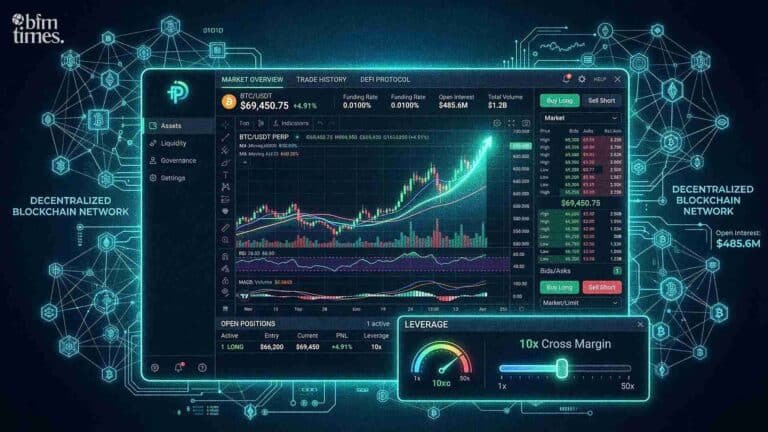
The past few years in the cryptocurrency market have been dominated by volatility, so you will be forgiven if you missed a great transformation quietly unfolding in the market, like Decentralized Perpetual Exchanges, also known as Perpetual DEXs. While most of the focus in the market has been towards meme-coin cycles and spot prices, the perpetual DEXs niche has grown from niche DeFi experiments to a multi-trillion-dollar derivative industry to rival the leaders of traditional finance. What started as a few protocols for allowing leveraged trading without custodial middlemen is now restructuring how risk, leverage, and liquidity can be managed in the decentralized world.
$12 trillion is the major milestone crossed by the Perpetual DEXs market by the end of 2025, and about 65% of this volume was generated in one calendar year. This shocking growth means Perpetual DExs are no longer just a niche but a primary method for sophisticated price discovery. DEXs will no longer be known as just a “DeFi” alternative.
Also Read: Best of 2026 for Hardware Wallets, which secure your Crypto Storage.
Understanding Perpetual DEXs
Before we move on to the current state of the market, let’s explain exactly what we mean by Perpetual DEXs.
Derivative instruments that do not settle on a particular date and enable traders to predict price movements of the underlying asset are known as Perpetual contracts. Instead, their price peg is maintained with a funding rate mechanism that works by periodically balancing shorts and longs to mirror the underlying spot price. This technique was popularized in the industry by centralized exchanges like Binance Futures and BitMEX, where the largest share of global exchange volume is from derivative trading accounts.
This technique is brought on-chain by Perpetual DEXs, which enables the handling of margins, executions, settlements, and collateral with smart contracts on decentralized networks. Under this system, no centralized middleman is needed; traders maintain custody of their assets, and there is permissionless and transparent execution.
The Evolution: From Simple Swaps to Complex Synthetics
The starting point for decentralized trading can be traced back to the rather simple Automated Market Makers (AMMs) system, such as Uniswap, which enables users to exchange tokens. The key breakthrough of decentralized trading, however, was derivatives and more specifically, Perpetual Futures.
A crypto-native innovation, perpetual swaps do not expire and enable traders to maintain positions indefinitely as long as there is enough collateral to cover losses. Centralized Exchanges(CEXs) used to dominate this market due to the high-performance entry-level requirements that came with handling order books and real-time trade matching.
Technical obstacles like slow block times, toxic MEV (Maximal Extractable Value), and high gas fees that put retail traders at a disadvantage hindered early attempts at decentralized perpetual futures. However, these obstacles were relieved as the industry transformed from Layer 1 blockchains to Layer 2 blockchains with scaling solutions and the rise of app-chains (app-specific chains).
Also Read: Can Blockchain Data Ever Be Deleted?
The Three Waves of Innovation
- The Order Book Pioneers (dYdX): dYdX cemented its place in decentralized finance by moving the matching engine off-chain while keeping settlement on-chain to create a similar accessible system as Centralized exchanges while maintaining its non-custodial security.
- The Oracle-Based Liquidity Pools (GMX): GMX entered the scene with a “multi-asset pool” model (GLP) that allows traders to play against a pool of liquidity providers instead of buyer-seller matching. This fixed the notable bootstrapping problem for liquidity and enabled trades with zero-price impact.
- The High-Performance App-Chains (Hyperliquid): This is the most recent wave of innovation that introduced High-performance App-chains like Hyperliquid that involved building derivatives-optimized custom blockchains. This innovation has enabled massive throughput and sub-second latency in trades. This has led to Hyperliquid taking over 70% of Perpetual DEXs market share in 2025 and exceeding $20 billion in daily volume.
Between the period of 2024 and 2025, there was an exponential growth in Perpetual DEXs, with cumulative trading volume in this industry exceeding $12 trillion, and about $7.9 trillion out of that generated in the single calendar year of 2025. Notable monthly thresholds were also crossed in Perpetual DEX trading, with over $1 Trillion monthly volumes and as high as $1.2 trillion in late 2025.
The Technical Engine: How Trillions are Traded On-Chain
We can trace the success of these platforms to not just marketing wins but also innovative fits of engineering. Some of the core technical innovations at the center of the exponential growth of Perpetual DEXs include:
1. The Funding Rate Mechanism
Due to the absence of an expiration date in decentralized markets, we could theoretically expect the gap between the price of perpetual contracts and the underlying spot price to grow larger forever. The funding rate mechanism deals with this issue by ensuring periodic payments between short and long traders to incentivize and tether the contract price to the spot price. When the perp price is higher than spot, longs pay shorts; when it’s lower, shorts pay longs. This is a self-correcting mechanism that has been transformational for the perpetual futures market.
2. Virtual AMMs (vAMMs) and Hybrid Models
The vAMMS is made popular by protocols like Perpetual protocols, which provide liquidity with the aid of constant product formulas without requiring the pooling of actual assets all the time.
3. Decentralized Oracles
A market is only as efficient as its price feed, which is what makes the introduction of decentralized oracles transformational for perpetual DEXs. Decentralized oracles like Pyth or Chainlink provide price feeds that aggregate price information from many sources to prevent “scam wicks” (artificial price spikes that trigger liquidations, which was a common issue in the early stages of decentralized trading.
The Institutional Shift: Why the Trillions Moved
The collective move of funds from Centralized exchanges to decentralized ones is not just driven by technological innovation but also by factors that affect traders’ trust in the system.
Self-Custody and Counterparty Risk
The shock that was sent to the world from the collapse of FTX in late 2022 cemented the realization that “not your keys, not your coins” is true of derivatives, too. Perpetual DEX enables traders to maintain control of their collateral without any custodian. This is done by holding the funds in a smart contract that they can interact with directly.
Composability and Capital Efficiency
The liquidity provided by Perpetual DEXs is almost unmatched, and traders can use positions in the market, which are often represented as a token, as collateral on other platforms to borrow stablecoins. This is a very efficient way of capital allocation that is almost impossible in centralized finance.
Transparency and Verifiable Solvency
The absence of middlemen ensures traders do not have to worry about liquidations happening in “black boxes” that put their funds at risk without their knowledge. With Perpetual DEX, all trades and liquidations are available to be monitored on the public ledger.
Also Read: Centralized vs Decentralized Exchanges Explained: CEX vs DEX Guide
A New Derivatives Frontier
The past few years have seen perpetual DEXs move from the periphery to a core element of the crypto derivatives market, and their rapid growth to trillions of dollars in trading volume shows their transformational effect on how derivatives are being structured and executed. While the lead is still taken by centralized exchanges in terms of scale, decentralized perpetual futures represent a fundamental shift to transparent, accessible, and composable financial infrastructure.
It started as loose threads of experiments in non-custodial trading and is not a fast-growing market, rivaling traditional finance ventures in scale and sophistication. As this platform grows, liquidity deepens, and institutional participation rises, we can expect globally transformational effects on the derivatives market in the coming decades.
Disclaimer: BFM Times acts as a source of information for knowledge purposes and does not claim to be a financial advisor. Kindly consult your financial advisor before investing.
What are perpetual DEXs in the crypto market?
Perpetual DEXs are decentralized exchanges that allow traders to trade perpetual futures contracts without intermediaries.
How did perpetual DEXs grow into a multi-trillion-dollar market?
They expanded rapidly due to high demand for leveraged trading, decentralized access, and continuous futures contracts without expiry.
Why are traders using perpetual DEXs instead of centralized exchanges?
Many traders prefer them for their transparency, self-custody of funds, and permissionless access to derivatives trading.