



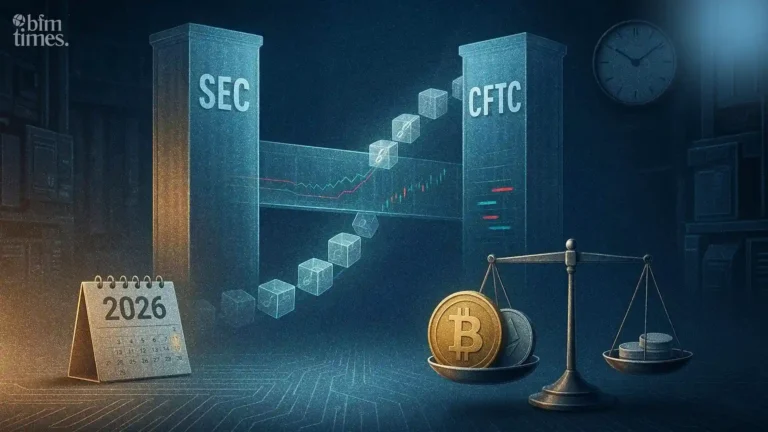
- In 2026, a historic Memorandum of Understanding was signed by the U.S. Securities and Exchange Commission and the Commodity Futures Trading Commission to coordinate on a single Crypto Regulation Framework.
- Paul S. Atkins (SEC Chairman) and Michael S. Selig (CTF Chairman) signed the agreement.
- The initiative proposes the Joint Harmonization Initiative, which seeks to provide an answer regarding the type of digital assets that are considered to be securities or commodities.
- The activity and trading risks related to blockchain will be monitored by regulators in real-time with a coordinated system of sharing market data.
- Project Crypto is also liberalized by the policy to become an inter-agency venture on the market structure of digital assets.
- The regulators are also moving in a direction of a minimum effective dose policy, which is an indication of a deeming but smarter Crypto Regulation Framework.
- The framework has the potential to impact future U.S. laws, including the GENIUS Act, that could determine 10 years of crypto regulations worldwide.
Related: Paul Atkins Debuts “SEC Project Crypto”: Absolute Rules for 2026
- What Happened: The New Crypto Regulation Framework Explained.
- Why the Crypto Regulation Framework is Important to the Future.
- How the Joint Harmonization Initiative is Working.
- Forecast Scenarios: Potential Market Outcomes
- Where Project Crypto Fits in the New Framework
- Who Benefits: Signals of Institutional Adoption.
- Risk Analysis: What Is the Problem with the Crypto Regulation Framework?
- Expert Profile: Leadership Behind the Framework
- Conclusion: A Kickstart of U.S. Crypto Policy.
What Happened: The New Crypto Regulation Framework Explained.
A coordinated Crypto Regulation Framework between the SEC and the CFTC is a significant step toward regulatory clarity of digital assets in the United States.
Over the years, overlapping regulatory oversight and multiple legal disagreements have existed among the regulators of crypto markets. The new accord tries to address these ramifications by trying to create transparent coordination between the securities and derivatives regulators.
The new Crypto Regulation Framework is aimed at three areas of operation:
- Regulatory coordination
- Market data sharing
- Categorization of asset transparency.
This trend represents the break with enforcement-based policymaking and systematic regulatory cooperation.
To the crypto market players, such as exchanges and developers, the policy change is one of the regulatory moments of the last several years. Source.
Why the Crypto Regulation Framework is Important to the Future.
This Crypto Regulation Framework is not just another regulation announcement.
The digital assets have become a trillion-dollar international financial market, and regulatory fragmentation has been the greatest barrier to development.
Through coordinating oversight, the regulators are looking at:
- Avoid overlapping of jurisdiction.
- Promote institutional involvement.
- Encourage blockchain technology.
- Enhance market transparency.
A foreseeable Crypto Regulation Framework would open up to companies that have not been keen to venture in the U.S. due to uncertainty in the legislation.
This change in policy is believed to influence the regulation of digital assets in most parts of the world by many analysts. Source.
How the Joint Harmonization Initiative is Working.
The Joint Harmonization Initiative is at the center of the new Crypto Regulation Framework.
This program harmonizes the standards of regulation between the SEC and CFTC in order to lessen conflicts in the policies and ease compliance.
The initiative is dominated by three areas of policy.
Product Classification
One of the largest challenges related to crypto regulation has always been the determination of whether a token is a security or a commodity.
The Crypto Regulation Framework, which was introduced, tries to make more concrete guidelines on classifications to minimize legal conflicts.
Intermediary Compliance
Crypto exchanges usually trade in securities and commodities. The move is meant to ease regulatory duplication for the firms operating in both markets.
Tokenized Collateral
The program further discusses the possibility of digital assets being used as collateral in financial markets, such as derivatives clearing systems. Source.
Suggested: Best Crypto News & Alert Platforms
Forecast Scenarios: Potential Market Outcomes
| Scenario | Regulatory Outcome | Market Impact |
| Conservative | Slow implementation of the Crypto Regulation Framework | Limited institutional adoption |
| Balanced | Clear token classification rules emerge | Moderate institutional inflows |
| Accelerated | Congress passes digital asset legislation supporting the framework | Major institutional capital entry |
In the accelerated scenario, the Crypto Regulation Framework would transform the ways of the global crypto markets.
Where Project Crypto Fits in the New Framework
The other significant change is the growth of Project Crypto.
Project Crypto is an SEC internal project, but currently a part of the Crypto Regulation Framework that the SEC collaborated with the CFTC to formulate.
The program focuses on:
- Market structure of blockchain.
- Digital assets custody models.
- On-chain compliance systems
- Financial infrastructure that has been tokenized.
This project will have an impact on regulatory standards in the future.
Who Benefits: Signals of Institutional Adoption.
Regulatory uncertainty has long been cited by institutional investors as a barrier to crypto adoption.
That would change with a unified Crypto Regulation Framework.
Several developments underscore institutional interest:
- Asset managers are investigating tokenized investment assets.
- Banks to test blockchain settlement systems.
- Exchange of derivatives that are widening the trading of crypto.
Better regulation can make more institutions venture into the digital asset market.
In fact, most analysts think that the Crypto Regulation Framework could turn into a driver of the next stage of the crypto market maturity. Source.
Risk Analysis: What Is the Problem with the Crypto Regulation Framework?
The Crypto Regulation Framework continues to have a number of threats, in spite of its potential.
Regulatory Complexity
The digital asset markets change more rapidly than the regulatory frameworks, complicating the design of policies on a long-term basis.
Legislative Uncertainty
Comprehensive digital asset bills have to be enacted by Congress to outline the regulatory power to the fullest extent.
Global Competition
Other jurisdictions have already stipulated more explicit regulatory frameworks for digital assets.
Despite all these difficulties, synchronized regulation is a significant change to the previous regulatory fragmentation.
Expert Profile: Leadership Behind the Framework
The treaty is an example of collaboration between two principal regulatory leaders.
Chairman ofthe SEC, Paul S. Atkins, has stressed the need to have predictable regulation that encourages innovation.
CFTC Chairman Michael Selig has pursued the challenges of coordinated regulation of markets in digital assets and derivatives trading.
The two regulators believe in the philosophy of minimal effective dose, that is, regulation should be carried out only to ensure market integrity without retarding technological development. The new Crypto Regulation Framework consists of their cooperation. Source.
Also Read: Signs of a Bottom: Crypto Market Sees Quick Recovery Amid US-Israel-Iran War
Conclusion: A Kickstart of U.S. Crypto Policy.
The mutual accord between the SEC and the CFTC is a significant step towards regulating digital assets.
It is through the creation of a collaborative Crypto Regulation Framework that regulators hope to end years of confusion with a more regulated framework.
Provided the framework can be properly implemented and backed up by legislation, it could:
- Improve regulatory clarity
- Speed up the institutional adoption.
- Enhance the American presence in digital finance.
The Crypto Regulation Framework can eventually become an example of how authorities in any country of the world can control the blockchain-based financial system.
Disclaimer: BFM Times acts as a source of information for knowledge purposes and does not claim to be a financial advisor. Kindly consult your financial advisor before investing.
What does the SEC–CFTC crypto regulation framework aim to achieve?
It aims to clarify oversight by assigning the SEC to crypto securities and the CFTC to digital commodities while improving coordination between regulators.
Why is the SEC–CFTC framework important for the crypto industry?
It reduces regulatory uncertainty and provides clearer rules that can encourage institutional participation and innovation in digital assets.
How will the new framework affect crypto exchanges and projects?
Crypto platforms may face clearer registration, disclosure, and compliance requirements under coordinated SEC and CFTC oversight.