




Pointwise Summary
- The bank has also Standard Chartered forecast, in its recent research note, that Ethereum (ETH) is likely to reach 40,000 US dollars by the end of 2030. This is expected to result in a 2,000% price increase.
- The bank’s team, led by Geoff Kendrick, has also identified 2026 as the Ethereum Year. This is expected to result in an explosion in Ethereum prices, similar to that experienced in 2021.
- The price increase in Ethereum is expected to be driven by Ethereum’s dominance in decentralized finance, stablecoins, and tokenized real-world assets (RWAs).
- The successful execution of Pectra and Fusaka upgrades is also expected to increase Ethereum’s throughput tenfold. This is likely to result in significant growth in market capitalization, as it has in the past.
- The bank also believes that though Bitcoin is facing tough times at present, Ethereum’s utility-driven approach is likely to gain significant traction in the hands of institutions like corporate treasuries and ETFs.
In a recent research note that has generated considerable interest in the cryptocurrency space, Standard Chartered Bank reaffirmed its price forecast for Ethereum (ETH), targeting 40,000 US dollars by 2030.
The 2026 Inflection Point
Geoff Kendrick, Global Head of Digital Assets Research at Standard Chartered, emphasized that 2026 is when Ethereum is expected to decouple from general market volatility. “2026 will be the year of Ethereum, much like 2021 was,” he stated. According to the bank’s revised roadmap, the cryptocurrency is expected to climb to $7,500 by the end of 2026, reach $15,000 in 2027, and eventually hit the $40,000 mark by 2030.
This outlook persists despite the year starting poorly, with Bitcoin’s “digital gold” narrative being negatively impacted by macroeconomic and geopolitical factors. Nonetheless, the bank pointed out that the value of Ethereum is no longer speculative but rather dependent on usability.
Dominance in Stablecoins and Tokenization
The dominance of Ethereum in the realm of stablecoins/tokenization is a key component of the $40,000 price thesis. Currently, stablecoins make up 40% of all Ethereum transactions. The bank estimates that the market for stablecoins/tokenized real-world assets (RWAs) is expected to reach $2 trillion by 2028, with the majority of the volume transacting on the Ethereum blockchain.
This is already being reflected in the institutional accumulation of ETH, with Bitmine Immersion Technologies significantly increasing their holdings, which currently make up approximately 3.4% of the total circulating ETH supply.
Scaling to a Trillion-Dollar Ecosystem
The Ethereum technical roadmap has been successful in delivering on several key milestones. Having delivered on the success of the “Pectra” upgrade, which enabled account abstraction and staking, the Ethereum roadmap is now progressing with further scalability enhancements.
“Analysis shows that higher throughput equates to greater market capitalization,” said Kendrick. “This is what we’re targeting in the next two years: tenfold scalability improvements. This will enable fractions of a cent in fees. This is what we need for high-frequency trading in the global financial system.”
External Catalysts: The Clarity Act
Another external factor that is likely to influence Ethereum is the changing regulatory environment in the United States. This is likely to be the final catalyst that influences Ethereum prices. The bank is expecting the “Clarity Act” to be passed in early 2026, which will include all the essential legal frameworks and guidelines for DeFi players and stablecoin issuers. This is likely to be the “green light” for conservative pension funds and insurance giants to invest in Ethereum protocols.
Context: The Current Market Landscape
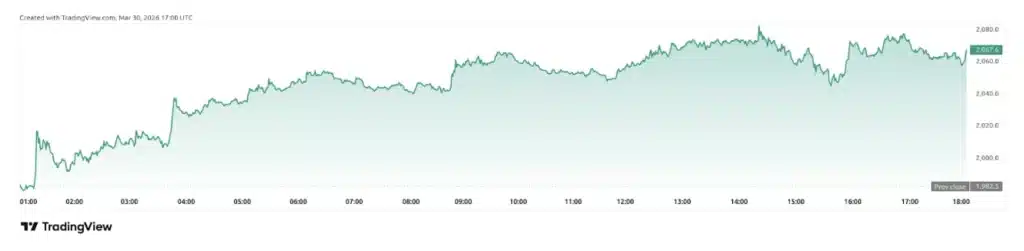
The Ethereum market is in a challenging technical landscape at least until the end of March 2026. Although the long-term outlook is good, the Ethereum price chart is in a “falling channel” at the moment due to high interest rates.
The Ethereum price is reportedly testing the $2,000 mark at the moment, which is significantly lower than the highs seen in 2025 but could be the “accumulation zone” if the investor is targeting the 2030 mark. As per CoinMarketCap, although the Ethereum price is stagnant at the moment, the daily active addresses on the Ethereum network are at a record high of 2.0 million users.
Also Read: Ethereum Signals: Huge Structural Breakout: Technical and On-Chain Data Both Show Bullish Shift
Frequently Asked Questions
Is it realistic for Ethereum to make a 2,000% profit?
While it is unlikely to make a 2,000% profit, Standard Chartered is basing this on Ethereum achieving the total addressable market for the global financial system moving onto blockchain. In other words, if Ethereum is able to achieve the market cap for a $19 trillion tokenized asset market, then it will be able to achieve a price point that is in line with that market cap to secure that value.
What does it mean for my ETH if Pectra and Fusaka upgrades are implemented?
These upgrades don’t require anything from users; instead, they make Ethereum more efficient. This is because these upgrades will eventually be able to pay gas fees with stablecoins instead of ETH.
Why is Standard Chartered more bullish on Ethereum compared to Bitcoin?
This is due to the fact that Bitcoin is being dragged down by macro headwinds, whereas Ethereum is being driven up by structural demand. The bank is expecting that, eventually, the ETH/BTC ratio will get back to 2021 highs of 0.08.
What is the biggest risk to Ethereum’s price achieving $40,000?
The biggest risk is execution risk. This is due to the fact that if upgrades to achieve 10x throughput are delayed, or if competitors like Solana capture a larger share of the stablecoin market, Ethereum may struggle to reach these high valuation models.
Disclaimer: BFM Times acts as a source of information for knowledge purposes and does not claim to be a financial advisor. Kindly consult your financial advisor before investing.