

Decentralized exchanges (DEXs) have now become part of crypto trading platforms as users become more interested in self-custody, on-chain visibility, and permissionless markets. The top DEXs in 2026 are no longer just mere swap tools; they can now handle cross-chain swaps, perpetual futures, MEV insurance, and sophisticated routing, competing with centralized exchanges on cost and liquidity.
- What is a DEX, and how do decentralized crypto exchanges work
- Best decentralized exchanges: how we selected the top DEXs for 2026
- Top Dexs DeFi trading platforms to use in 2026
- 1. Uniswap (v4)
- 2. PancakeSwap
- 3. Curve Finance
- 4. Orca
- 5. 1inch (Aggregator)
- 6. SushiSwap
- 7. GMX (Perps DEX)
- 8. Bisq (Privacy / P2P)
- ChangeNOW (Hybrid Non-Custodial Swap Service)
- Top DEXs for 2026 at a Glance
- DEX with low fees: where traders save the most
- Best non-custodial exchanges for privacy & self-custody
- DEXs vs. CEXs: Which is right for you in 2026?
- DEX vs CEX Comparison
- Risks of using Top DEXs and how to reduce them
- Step-by-step guide to using a DEX safely
- Frequently Asked Questions
- Conclusion
With increased regulation of centralized platforms, decentralized crypto exchanges are increasingly becoming prevalent as substitutes for users seeking to have control over their money, fewer rules, and access to the global market. This guide simplifies the functioning of top DEXs, compares the best decentralized exchanges of 2026, the risks and fees, and assists you in selecting the proper platform given your trading and experience level.
What is a DEX, and how do decentralized crypto exchanges work
Decentralized crypto exchanges allow trading on-chain without transfers of custody of your assets to a third party. Users do not have accounts; instead, they can directly trade with smart contracts by connecting non-custodial wallets.
How Top DEXs work:
- AMMs (Automated Market Makers): Liquidity pools are traded with instead of traditional order books.
- Liquidity pools: The user deposits tokens into pools and incurs swap fees.
- Order-book Top DEXs: Some platforms recreate on-chain centralized-style order books.
- Wallet connections: You trade in MetaMask, Trust Wallet, Phantom, or hardware wallets.
Key mechanics traders should understand:
- Slippage: Movement in the price due to low liquidity or high trades.
- Impermanent loss: Temporary liquidity providers’ loss.
- Gas fees: Network cost in executing trades.
- MEV protection: systems that decrease front-running.
- Cross-chain swaps: Trade on more than one blockchain without bridges.
Best decentralized exchanges: how we selected the top DEXs for 2026
Not all top DEXs are equal. In order to find the best decentralized exchange of 2026, we used practical parameters that focused on the practical needs of trade.
Selection criteria:
- Liquidity depth: Low slippage and sound pricing.
- Fee structure: Swapon fees, LP fees, gas efficiency.
- Security model: Audits, exploit history, and governance maturity.
- Chain support: Ethereum, Solana, BNB Chain, Arbitrum, Optimism.
- UX improvements: intelligent diversion, mobile access, and human-centric.
- Decentralization: DAO and non-custodial custody.
In this way, the platforms included in this list will be the most trusted top DeFi trading platforms in 2026 that can be offered to traders.
Top Dexs DeFi trading platforms to use in 2026
The top DEXs of AMMs, aggregators, perps, and privacy-oriented models are provided below. Every profile demonstrates strengths, risk and optimal usage.
1. Uniswap (v4)
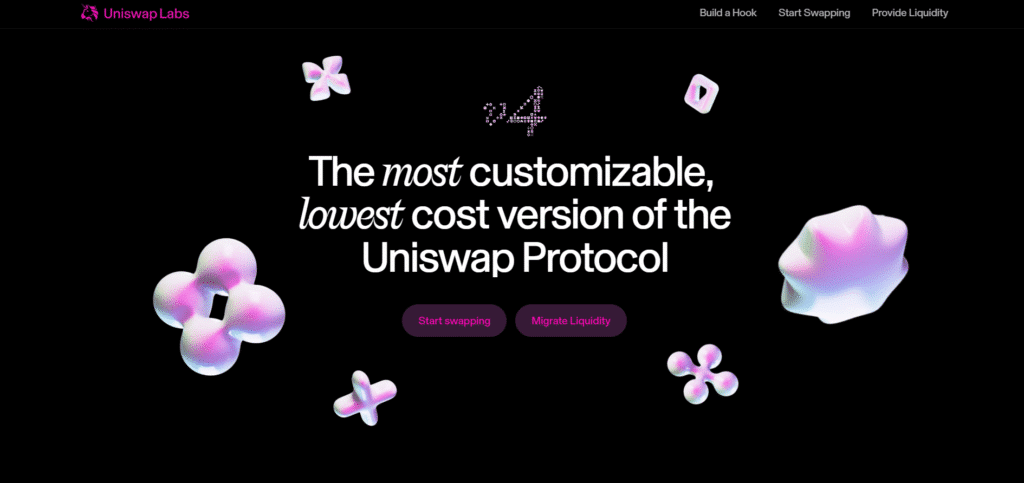
Uniswap v4 is also one of the most popular AMM-based exchanges, boasting extensive liquidity and coverage across various chains. Its hook-based design enables custom pool logic and fee models to enhance capital efficiency and routing.
Uniswap is an Ethereum‘s leading Layer 2-network protocol, which lowers gas costs but still has a high level of liquidity. Its interface is user-friendly, and the improved MEV protection and the optimization of the routing are offered to advanced users.
- Best for: Large token swaps, high liquidity, and blue-chip assets.
- Key strengths: liquidity depth, multi-chain support, and strong audits.
- Risks: Smart-contract exposure, high slippage, and occasional illiquidity in pairs.
- Use-case: Fixed-income spot trading of major tokens.
Want the full breakdown? Visit the official website: https://v4.uniswap.org/
2. PancakeSwap
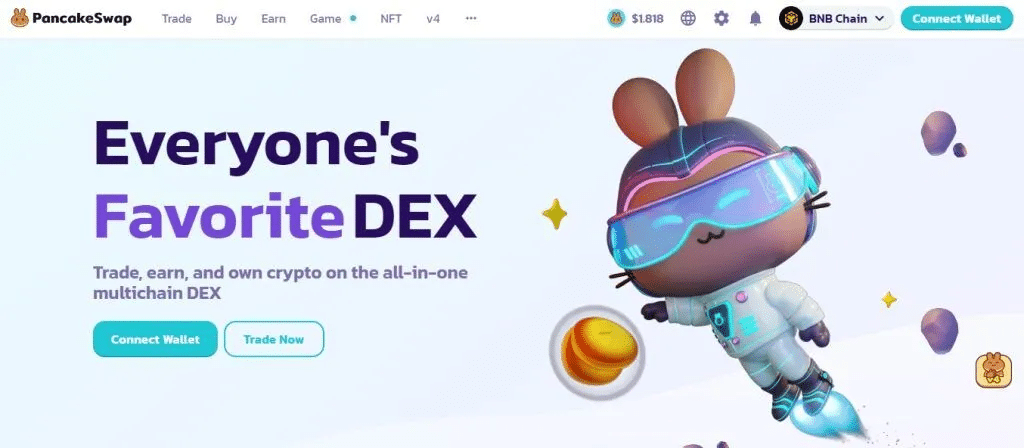
The dominant AMM on the BNB Chain is PancakeSwap that has spread to Ethereum networks and Layer 2 networks. It is characterized by reduced transaction costs and high velocity in comparison to Ethereum mainnet-only top DEXs.
It is a platform that combines swaps, liquidity pools, yield functionality, and cross-chain routing. It has a low gas environment, which makes it an attractive DEX with low fees to small traders.
- Best for: Low-charge swaps and new tokens.
- Key strengths: low costs, quick confirmation, and multi-chain.
- Risks: Increased exposure to scam tokens, poor liquidity quality.
- Use-case: BNB Chain and L2 retail trading.
Want the full breakdown? Visit the official website: https://pancakeswap.finance/home
3. Curve Finance
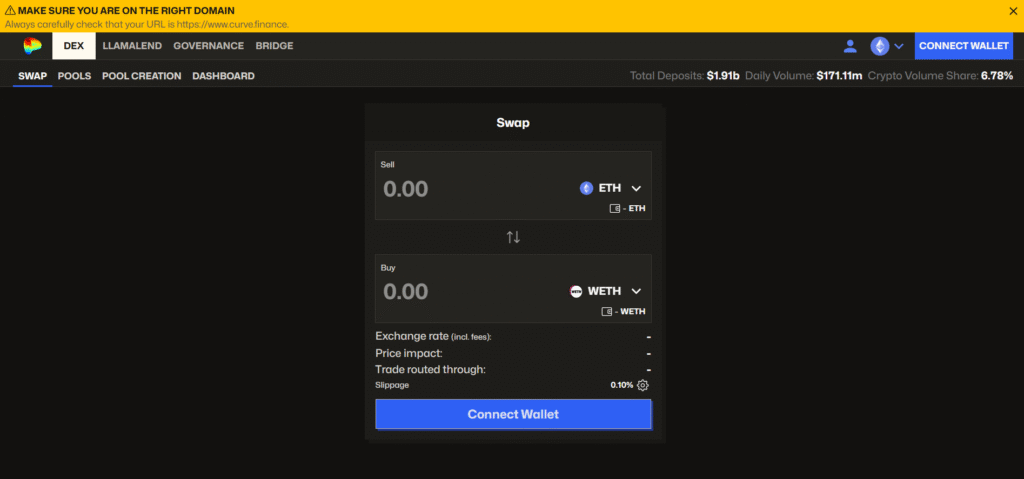
Curve Finance deals with stablecoin swaps and correlated-asset swaps. The design of AMM reduces the slippage of assets that are typically traded at similar prices, which is why it is most effective with stablecoin strategies and liquidity providers.
Curve is a stable swaps router on aggregators and DeFi protocols. Most coverage is on liquidity pools of stablecoins and minimal coverage on volatile tokens.
- Best for: Stablecoin swaps and low-slippage trades.
- Key strengths: stable asset, ultra-low slippage.
- Risks: Low token diversification.
- Use-case: Stablecoin trading and liquidity.
Want the full breakdown? Visit the official website: https://www.curve.finance/
4. Orca
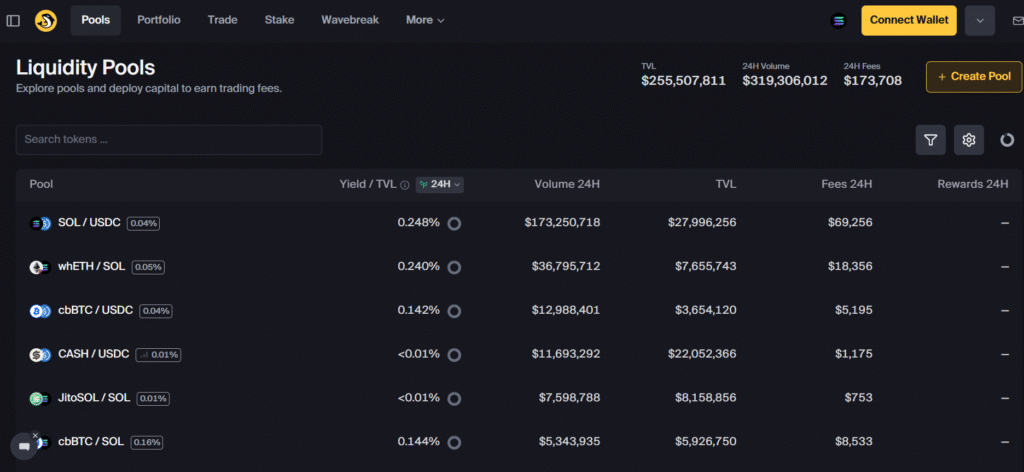
Orca is an accessible DEX based on Solana, which has fast execution and low-fee characteristics. Its interface is focused on simplicity and is easy to use even by those users who are unfamiliar with on-chain trading.
On the platform, Solana would have low throughput and gas prices, which would ease the burden on traders who transact frequently. The Solana-native assets have the strongest liquidity.
- Best for: Solana eco-trading.
- Key strengths: low fee, quick confirmation, easy-to-use user interface.
- Risks: Solana network dependability issues.
- Use-case: Solana retail swaps.
Want the full breakdown? Visit the official website: https://www.orca.so/
5. 1inch (Aggregator)
1inch combines various top DEXs and routes and executes trades at a minimum slippage and cost. It does not have its own liquidity, but it locates the most favorable price among pools and chains.
1inch is an appropriate tool for traders who seek to maximize the quality of the execution with advanced routing, partial fills, and MEV protection.
- Best for: Best-price routing
- Key strengths: Smart routing, MEV protection.
- Risks: Reliance on the DEX liquidity.
- Use-case: Price-optimal swaps.
Want the full breakdown? Visit the official website: https://1inch.com/
6. SushiSwap
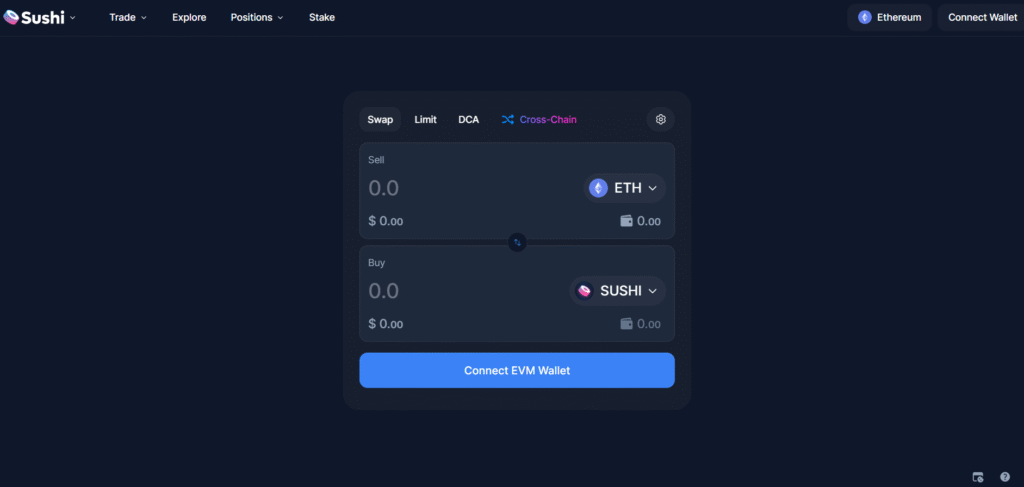
SushiSwap is a multi-chain DeFi platform based on swaps, liquidity, and lending integrations that is built on the model of an AMM. It deals with the governance of the communities and cross-chain availability.
Chain liquidity is different and has been simplified through UX advancement to be accessible to non-technical users.
- Best for: Cross-chain trading
- Key strengths: Multi-chain access, DAO governance.
- Risks: Fragmented liquidity
- Use-case: Multi-chain swaps and LP.
Want the full breakdown? Visit the official website: https://www.sushi.com/ethereum/swap
7. GMX (Perps DEX)
GMX is a custody-free, leveraged trading perpetuals exchange that is decentralized. It facilitates synthetic trading with the extensive liquidity of major assets.
GMX is suitable for sophisticated traders who are interested in derivatives with no centralized risk. Leverage, however, augments liquidation risk.
- Best for: Perpetual futures trading.
- Key strengths: On-chain perps, low slippage.
- Risks: Liquidation risk, smart contract risk.
- Use-case: Non-custodial leverage trading.
Want the full breakdown? Visit the official website: https://gmx.io/
8. Bisq (Privacy / P2P)
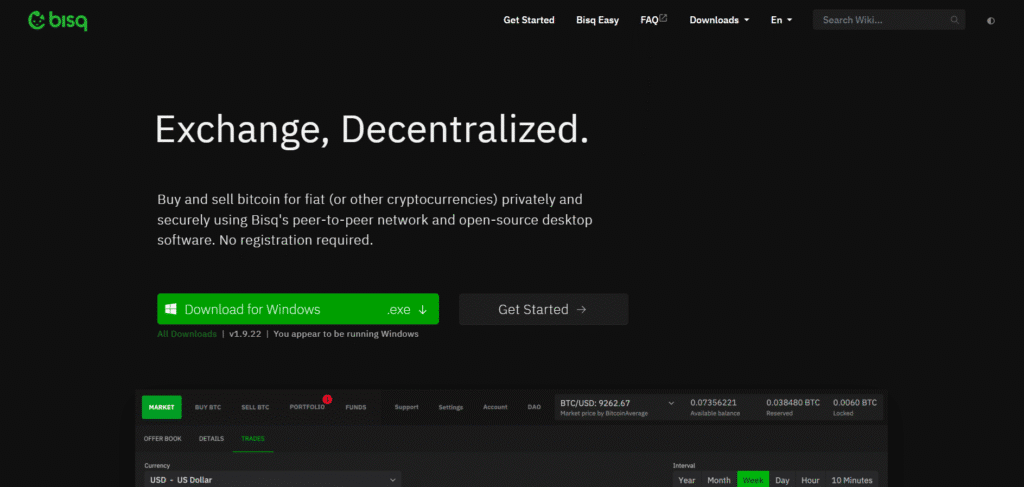
Bisq is a peer-to-peer DEX, paying attention to privacy and censorship resistance. It is decentralized, serverless, and fiat-to-crypto trading without KYC.
This has worse liquidity than AMM DEXs and a more technical UX, but is still one of the strongest and best non-custodial exchanges to be used by privacy-conscious users.
- Best for: Privacy-first users
- Key strengths: No KYC, P2P model
- Risks: Reduced liquidity, reduced speed of execution.
- Use-case: Fiat on/off-ramps without intermediates.
Want the full breakdown? Visit the official website: https://bisq.network/
ChangeNOW (Hybrid Non-Custodial Swap Service)
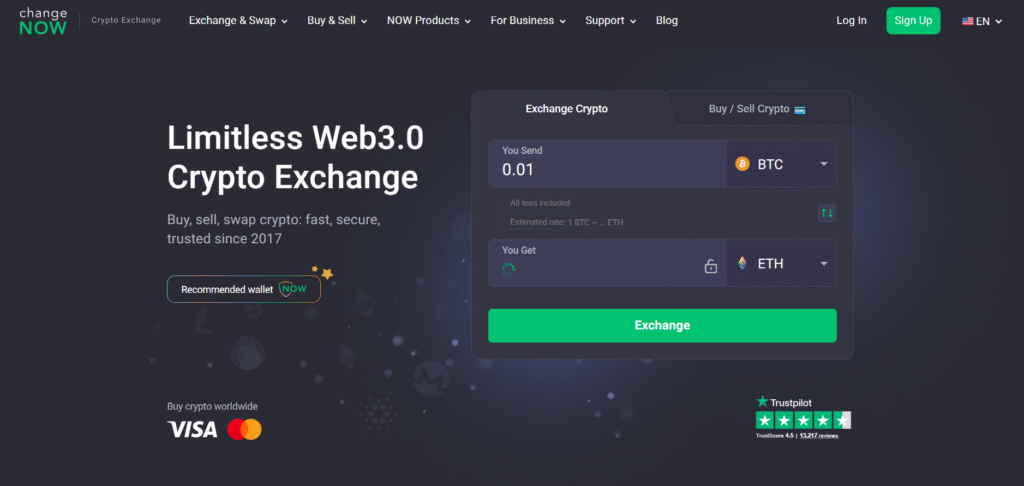
ChangeNOW is non-custodial and provides instant swaps between chains. It brings liquidity providers together backstage, which allows cross-chain swaps without wallet custody.
The user experience is accessible, and the fee may be steeper than pure AMMs because of convenience pricing.
- Best for: Swaps occur between two currencies.
- Key strengths: convenience, no custody.
- Risks: Increased charges, dependence on third-party liquidity.
- Use-case: Rapid cross-chain swaps.
Want the full breakdown? Visit the official website: https://changenow.io/
Top DEXs for 2026 at a Glance
| DEX | Type | Main Chain(s) | Typical Fees | Best For |
| Uniswap | AMM | Ethereum, Arbitrum, Optimism | 0.05%–0.30% + gas | Deep liquidity swaps |
| PancakeSwap | AMM | BNB Chain, Ethereum, L2s | Low swap fees | Low-cost trading |
| Curve | AMM | Ethereum, L2s | Very low on stables | Stablecoin swaps |
| Orca | AMM | Solana | Minimal gas | Solana trading |
| 1inch | Aggregator | Multi-chain | Route-dependent | Best pricing |
| SushiSwap | AMM | Multi-chain | Standard AMM fees | Cross-chain swaps |
| GMX | Perps DEX | Arbitrum, Avalanche | Funding + fees | Non-custodial leverage |
| Bisq | P2P DEX | Multi-asset | Trade fees | Privacy trading |
| ChangeNOW | Hybrid Swap | Multi-chain | Spread-based | Simple cross-chain swaps |
DEX with low fees: where traders save the most
Locating a DEX with low fees is related to the chain selection and efficiency of routing.
Ways traders reduce costs:
- Take advantage of Layer 2 networks in order to reduce gas charges.
- Trading at a time when there is low network congestion.
- Routing optimally with aggregators.
- Prefer stablecoin pools with low slippage
Top DEXs with low fees are useful to those who trade regularly and with small transaction volumes that gas fees have significant returns.
Best non-custodial exchanges for privacy & self-custody
The best non-custodial exchanges are those that give preference to wallet-based trading and data collection.
Privacy trade-offs:
- No KYC improves privacy
- Lower liquidity increases slippage
- UX cannot be so intuitive.
Convenience vs. anonymity Aggregators are used with P2P models to offer a compromise between privacy and convenience.
DEXs vs. CEXs: Which is right for you in 2026?
Top DEXs are more focused on control and transparency, whereas centralized exchanges are more focused on convenience and compliance.
DEX vs CEX Comparison
| Feature | DEX | CEX | Who should choose it |
| Custody | User-controlled | Exchange-held | Self-custody users |
| KYC | Usually none | Mandatory | Privacy users |
| Liquidity | Variable | Deep | High-frequency traders |
| Fees | Gas + swap | Trading + withdrawal | Cost-sensitive users |
| Risk | Smart contract risk | Custodial risk | Risk-aware users |
Risks of using Top DEXs and how to reduce them
Key risks:
- Smart contract exploits
- Slippage and impermanent loss.
- MEV and front-running
- Fake tokens and phishing
How to reduce risk:
- Use reputable Top DEXs
- Verify token contracts
- Limit wallet approvals
- Avoid unknown pools
Step-by-step guide to using a DEX safely
- Set up a non-custodial wallet
- Connect to the DEX interface
- Check the addresses of token contracts.
- Adjust slippage tolerance
- Check transaction information.
- Revoke unused approvals
Frequently Asked Questions
What are the top DEXs for crypto?
The best decentralized exchanges in 2026 include Uniswap, SushiSwap, Curve Finance, and PancakeSwap for broad liquidity, security, and deep multi-chain support.
Which Top DEXs are more popular?
Uniswap remains the most popular DEX by trading volume and user activity, especially on Ethereum and Layer-2 networks.
What is the future of Tops DEXs?
The future of top DEXs points toward higher cross-chain interoperability, deeper liquidity, on-chain order books, lower fees, and greater integration with DeFi and Web3 applications.
Conclusion
The top DEXs in 2026 will allow traders to have greater control, transparency, and flexibility than previously experienced. The most decentralized exchanges have now equaled the centralized platforms in terms of UX and execution quality, regardless of whether you think about low fees, deep liquidity, or privacy-first trading. The selection of the appropriate top DEX is determined by your preference for the chain, the level of risk, and your trading objectives. Through a thorough comprehension of fees, liquidity, and smart-contract risks, users can comfortably use decentralized crypto exchanges as a component of a self-custody-first approach.
Disclaimer: BFM Times acts as a source of information for knowledge purposes and does not claim to be a financial advisor. Kindly consult your financial advisor before investing.