



Key Insights
- According to Google Research, XRP Ledger (XRPL) has implemented post-quantum ML-DSA signatures on its AlphaNet instance.
- The shift is based on the lattice-based cryptography, namely the CRYSTALS-Dilithium algorithm.
- XRP Ledger is now among the limited number of large blockchains to have protocol-level testing of readiness for Q-Day.
- Recent testing findings indicate that there is a trade-off between long-term security and the size of the signature (64 bytes to approximately 2,420 bytes).
- Experts in the industry caution that the elliptic curve cryptography (ECC) that is being used by Bitcoin and Ethereum may be compromised in a few years.
Summary: The Race Against Q-Day: How the XRP Ledger is Future-Proofing the Global Financial Backbone with Google-Backed Research
The blockchain community has long talked of the so-called Q-Day, when a quantum computer is powerful enough to break the encryption used to secure the billions of dollars of digital assets. Although it is an issue that is regarded as a far-off problem in many networks, the XRP Ledger (XRPL) has officially entered the testing stage of its defense strategy. The latest research report by Google Quantum AI has indicated the ledger development, namely, the implementation of post-quantum ML-DSA signatures on its AlphaNet test case.
The Google report highlights that there is a shrinking window of migration. In the case of blockchains such as Bitcoin and Ethereum that use Elliptic Curve Cryptography (ECC), the threat is existential. A quantum computer with enough qubits has the potential to generate a private key based on a public key in less than nine minutes, according to the modeling by Google.
The AlphaNet Breakthrough
The testing is already running on an AlphaNet instance, which is a special developer environment where the XRPL team is stress-testing the integration of the CRYSTALS-Dilithium algorithm. The ML-DSA (Module-Lattice Digital Signature Algorithm) standard that was recently finalized by NIST is based on this lattice-based cryptographic technique.
The research notes that the design of the XRP Ledger supports native and protocol-level key rotation. This is a very important difference. The XRPL does not bind an account to a particular cryptographic curve, as is the case with networks, but instead, users can update their signing keys without updating their account address. It is this crypto-agility that will allow the shift to quantum resistance to be achievable without all users having to transfer their assets to an entirely new blockchain.
Performance vs. Protection
Though the advantages of security are obvious, the transition is associated with technical challenges. Conventional signatures are small, which is usually approximately 64 bytes. On the contrary, the ML-DSA signatures under test on AlphaNet are much larger, about 2,420 bytes. The growth in data size implies that every transaction will take up a larger space on the ledger, and this may affect throughput and storage needs among the validators. The existing AlphaNet testing is aimed at establishing the best compromise between these heavy signatures and the high-performance speed that the XRP Ledger is reputed to have.
Market Situation and Price Movement
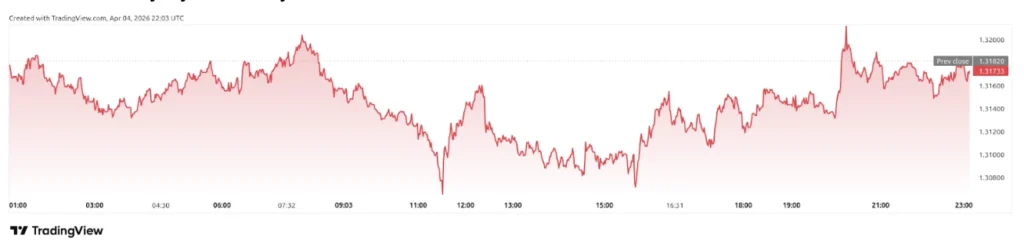
The announcement of the acknowledgment by Google has given a new momentum to the usefulness of XRP as an institutional-grade asset. At the beginning of April 2026, XRP demonstrated a strong performance in the fluctuating market. The support level of 1.30 is being followed closely by the analysts.
According to market observers, although Bitcoin and Ethereum are the most important assets, their quantum vulnerability is starting to be included in the institutional risk assessment of the long term. Since the XRP Ledger is in control of two-thirds of all short-term U.S. Treasury bill tokens, the shift to quantum resistance is not only about defending retail holders, but also about defending the plumbing of modern finance.
Background: The relevance of Quantum Vulnerability Today
This is because of the “harvest now, decrypt later” approach, which makes it urgent. Malicious players can be gathering encrypted blockchain data now, and when quantum computers are finally developed in the next 5-10 years, they will be decrypted. In case a blockchain is unable to update its signatures until quantum computers have attained a specific qubit count, all past transactions and all addresses that are not currently active (such as the holdings of Satoshi Nakamoto in Bitcoin) will be targeted. The XRPL is trying to seal that window before it opens by deploying ML-DSA at this point in time.
Also Read: Is XRP a Good Investment in 2026? Legal Clarity, ETFs & XRP Utility Explained
Frequently Asked Questions
What is ML-DSA?
ML-DSA is an acronym of Module-Lattice Digital Signature Algorithm. It belongs to the new NIST standards of post-quantum cryptography. It applies complicated lattice math, which is thought to be inefficiently solvable even by quantum computers.
Is it safe to keep my XRP at this time?
Yes. The quantum computers that are capable of breaking the existing encryption are not yet available in a large-scale, stable form. The existing AlphaNet research is proactive, to make sure that the network is available many years before the threat is actualized.
Will this alter my utilization of the XRP Ledger?
To the average user, the transition will most probably be smooth. The major modifications are on the protocol level. Nevertheless, in the future, users will likely be asked to rotate their keys to a quantum-secure version.
What does this mean against the security of Bitcoin?
Bitcoin is now utilizing ECDSA (Elliptic Curve Digital Signature Algorithm). Although it has been suggested to make Bitcoin quantum-resistant, its decentralized nature makes a coordinated upgrade difficult. The key rotation that is inherent in the XRP Ledger provides the latter with a structural advantage in the implementation of new standards.
Disclaimer: BFM Times acts as a source of information for knowledge purposes and does not claim to be a financial advisor. Kindly consult your financial advisor before investing.