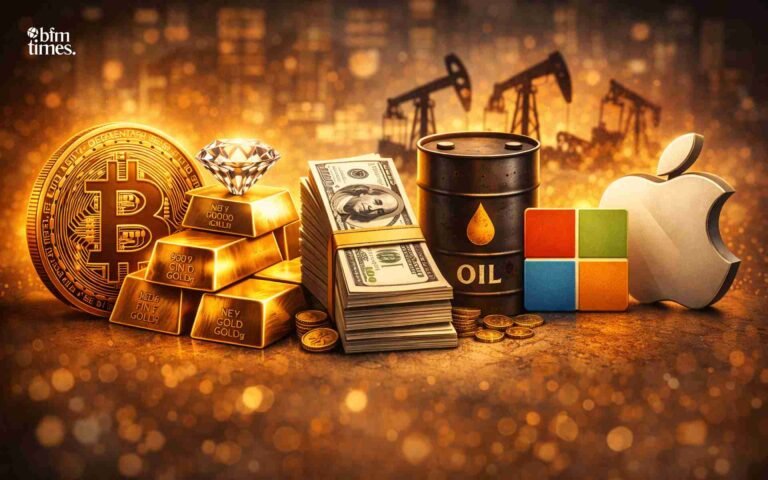
Assets are the base of wealth, power, and economic stability. From the man on the street building his personal fortune to the state seeking to strengthen its economy, assets play a crucial role everywhere. Some assets do better than others based on their scarcity, demand, and large-scale importance. By examining the world’s most valuable assets, we can discern where true value lies and why certain resources dominate global markets.
Definition of Valuable Assets
A very important element is one that has large economic value and is able to produce income, preserve value, or present long-term benefits. Assets may be physical, financial, or digital in nature and may not have equal value, which may be a result of demand, usefulness, and limited availability.
In short, we see as very valuable those things be it of the personal, professional or public which we put a protection, an investment of time or money into and we count on for our community’s growth.
Significance of Valuable Assets
Valuable resources are what global economies run on. They play a role in trade, investment decisions, geopolitical issues and also in technological progress. Countries that have abundant valuable resources tend to have stronger economic positions and greater global influence.
At a personal level, which is to say at home and in one’s day-to-day life, having valuable assets is a way for people to feel secure financially and also to protect what they have in an economically uncertain climate.
Importance of Valuable Assets
Valuable assets’ importance lies in what they do for wealth and stability. They see to it that businesses grow, which in turn supports governments via tax and export revenues and also give individuals a way to save and grow their money over time.
Assets also play a role in a crisis. When currencies are weak or markets drop, some strong assets hold or even see growth in their value.
Usage of Valuable Assets
Valued resources are used in different ways based on their type:.
- Governments that run them for the betterment of national economies.
- Businesses use it in production and for investment.
- Investors use them for wealth preservation
- Individuals use them for financial security
- Their use goes out to industrial applications as well as long-term investment and daily consumption.
Examples: Top 5 World’s Most Valuable Assets.
- Premium Gold: Gold has for aeons been a valued asset. It is rare, tough, and in the good graces of people worldwide. Central banks include it as a reserve element, and investors use gold as a safe haven in times of economic instability. Its value wavers strongly because of the ever-present global demand.
2. Property Development: Land and property we see great value around the world. Real estate is an excellent source of long-term growth and also produces steady income via rent. Also, it is a feature that residential, commercial, and industrial properties play a large role in global wealth.
3. Petroleum (Crude Oil): Oil is a key element in the modern world. We see it in transport, industry and energy production. Also, countries that have large oil reserves are very powerful in a political sense, which makes oil a very important strategic and economic asset.
4. Shares and Equities: Shares of large corporations, which are another way to own parts of businesses that produce profit. Also, we see that major stock markets trade trillions of dollars worth of stock. What we do see is that, over time, equities have been among the best assets for long-term growth.
5. Information and Digital Assets: In the age of technology data has become a very precious resource. Companies we are seeing collect and analyse data to improve products, target customers better, and fuel innovation. Also included in this growing asset category are cryptocurrencies, digital platforms, and intellectual property.
Benefits of Valuable Assets
Valuable assets offer several advantages: Valuable resources present the following benefits:.
- Wealth Creation
- They see to it that individuals and institutions see growth in financial terms over time.
- Inflation Protection
- Assets such as gold and real estate also protect against.
- Economic Stability
- Strong assets that fuel national and global economies.
- Income Generation
- Many which produce regular income, for example, rent and dividends.
- Long-Term Security
- Assets serve as a buffer during economic hard times.
Disadvantages of Valuable Assets
Though they are important, they also have issues:
- High Entry Cost
- Many assets require large investments.
- Market Volatility
- Asset values may change as a result of economic or political events.
- Maintenance and Management
- Assets in the form of real estate do require maintenance and management.
- Liquidity Issues
- Some assets do not easily become cash.
Conclusion
Global wealth is held in what we may term the top 5 assets which are gold, real estate, oil, stocks and digital assets. Each of these assets plays a different but important role in the world’s economy and financial systems. Although they bring great benefits of stability, growth and security they also present risks and issues. By understanding these assets better, individuals and nations are able to make more informed financial and investment decisions in today’s ever-changing world.
Disclaimer: BFM Times acts as a source of information for knowledge purposes and does not claim to be a financial advisor. Kindly consult your financial advisor before investing.