

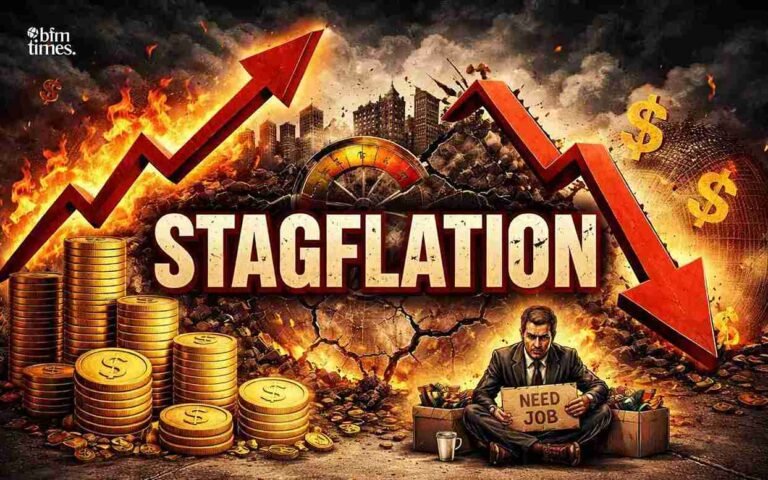
Stagflation is a term in economics that may sound complex but it plays out very practically in our daily lives. Picture as your grocery bills increase, you are laid off from your job, and at the same time your salary does not go up. That which is at once that which we avoid and that which we experience is what we mean by stagflation. Also it is what puts pressure on governments and individuals because the usual tools used to fight off inflation or a recession do not work well when we have both at the same time.
Definition
Stagflation is a term we use for an economic situation that has high inflation, slow or no growth, and high unemployment at the same time. Usually as the economy grows fast we see inflation rise, and when growth slows we see unemployment go up. Stagflation is that which breaks that trend by including the bad elements of both.
In the 1970’s that term came into use which saw many countries dealing with rising prices at the same time that their economy was doing poorly. Since then, stagflation has been identified as the greatest challenge for policymakers which is that remedying one issue only tends to create more of the other.
Significance
Stagflation is a key indicator of large-scale economic issues. It is a sign that the economy is not reacting to what we typically do like interest rate cuts or government spending. At times of high inflation central banks raise interest rates. Also, in a slow-growth environment, higher rates may, in fact, cause the economy to slow down even more.
In terms of households we see that stagflation decreases purchasing power. What we note is that people are paying more on basics like food, fuel, and housing and also that the job situation is not secure. As to businesses we note that high costs combined with weak demand reduce profit which in turn dissuades them from investing.
Importance
Understanding of stagflation is key which in turn enables governments, investors, and citizens to prepare for tough economic times. Also unlike regular inflation or recession stagflation requires careful balanced decision-making.
For policymakers to avoid long term damage we must see the early signs of stagflation. For investors it puts forth the value of protecting wealth from inflation which in the same breath means to stay away from assets that perform poorly in a weak growth environment. For average Joes and Jane it is about being aware which in turn helps in the planning of finances, control of expenses, and making better career moves.
Usage
In today’s world stagflation is a term which is used in economic analysis, news reports and policy discussions. We see it to describe times when the normal economic rules break down. In the media we often see reports of stagflation which accompany reports of rising inflation at the same time we have weak job numbers.
Investors apply this concept by which they shift portfolios into assets that do better during times of inflation. Also governments use the idea of stagflation to put forth difficult policy decisions and that sometimes there may not be easy solutions.
Examples
In the 1970’s we saw the greatest example of stagflation which played out in the U.S. and U.K. Oil price shocks which sent energy costs through the roof brought about high inflation. Also at the same time economic growth was slow and we saw an increase in unemployment.
In other cases we see that in the world of developing economies supply shortages, poor productivity and bad policy choices lead to price increases which do not produce great growth. Also we have recently noted a global return to the issue of stagflation which is a result of supply chain issues, rising energy prices, and geopolitical conflicts.
Benefits
At first look stagflation appears to have no benefits, which in large part is true. But also it may bring in some positive long-term results.
It also sees that which encourages individuals and businesses to put in place efficient practices, reduce waste and innovate. In some cases tough economic times force economies into more sustainable growth models in the long run.
Disadvantages
Stagflation is a great issue that is widespread. We see that high inflation which in turn eats into savings and also reduces real income. Also slow growth which in turn presents few job options and low wage growth. Also rising unemployment puts strain on social structures and increases inequality.
For governments, stagflation which is a fact that they have to deal with does not present them with many policy options. When they raise interest rates in an attempt to control inflation what they see instead is that it increases unemployment, and when they try to stimulate growth what they in turn see is that the prices go even higher. Also for businesses that are trying to plan in this environment of unstable costs and uncertain demand, which should be a more stable time for planning becomes a very difficult task.
Overall we see that stagflation drops confidence in the economy, delays investment decisions, and slows progress.
Conclusion
Stagflation is a rare yet powerful economic issue that brings together inflation, unemployment, and slow growth into one very painful package. It affects all from the government out to the man on the street trying to put food on the table. Though it may not present itself in the short term as a positive force, what stagflation does is to provide us with the chance to better prepare for it and make informed financial choices.
In an uncertain economic climate what was the domain of the economist is no longer — what is at play in terms of stagflation is information which any person trying to make their way through the variable economic landscape will do well to understand.
Disclaimer: BFM Times acts as a source of information for knowledge purposes and does not claim to be a financial advisor. Kindly consult your financial advisor before investing.