The Polygon (POL) price prediction for 2026 to 2030 is a topic every crypto investor watches closely. It is one of the most talked about Layer-2 tokens in the market today. This blog covers the key price targets & growth factors that could shape the POL’s future.
What Is Polygon?
Polygon has become the most prominent scaling solution for the Ethereum chain. It plays an important role in minimizing the fees and boosting the speed of transactions within the network. The network recently completed its migration from the native token MATIC to POL token.
The POL coin acts as a payment method for gas in the network. It is also used for staking and governance purposes in the multi-chain environment of Polygon 2.0.
What is the Polygon (POL) Current Market Overview?
The POL token is currently trading at around $0.20. It has seen pressure from broader market corrections. The Layer-2 space is very competitive & POL is working hard to stay relevant. The network always pushes forward with new upgrades in order to grow its user base.
One of the core parts of Polygon’s roadmap is the AggLayer. This is Polygon’s cross-chain settlement layer which helps in connecting multiple blockchains with shared liquidity & security. This infrastructure play is key to the Polygon (POL) price prediction for the years ahead.
Polygon Price Prediction 2026
The year 2026 is a big one for Polygon. This year the AggLayer is expected to reach full maturity. This will allow many chains to share liquidity & settle on a single secure layer. This upgrade could attract new developers & increase demand for the POL.
The Gigagas roadmap is also in motion for 2026. It targets over 100,000 transactions per second on the Polygon PoS network. This will bring the Polygon chain closer to being capable of performing at the same speed as that of Visa’s.
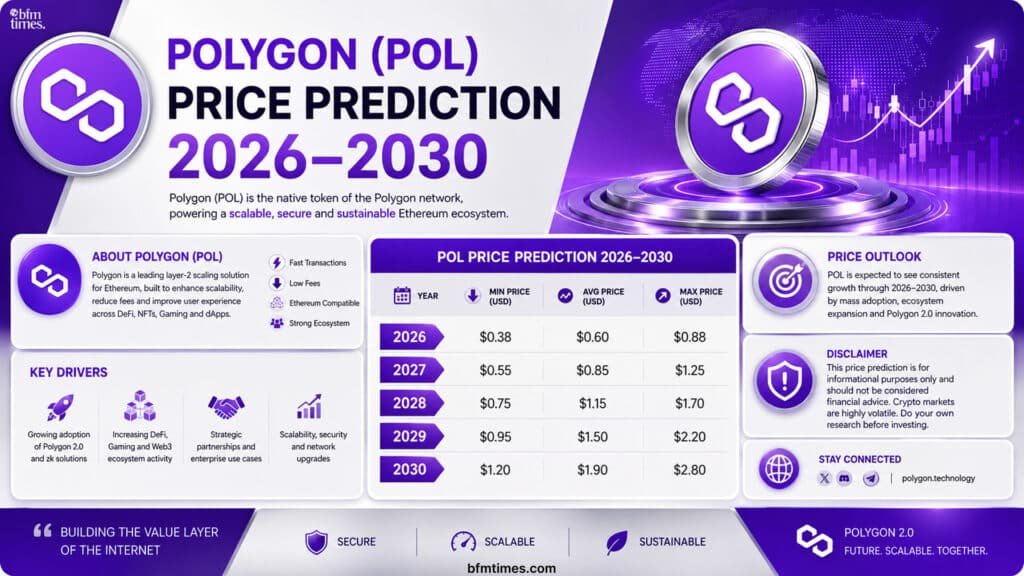
The Polygon (POL) price prediction for 2026 shows a minimum of $0.08 & a maximum of $0.75. The average is expected to sit around at $0.22. These numbers depend on how well the network executes its upgrades. They also rely on Bitcoin & Ethereum performing well in the market.
Polygon Price Prediction 2027
The year 2027 brings more potential growth for POL. It is expected to trade between $0.23 & $0.30. The average price is forecasted at around $0.25. This growth depends on the network continuing its Gigagas roadmap progress.
The RWA sector is also expected to be worth trillions of dollars by this time. Polygon PoS is positioning itself as the go-to chain for the stablecoin payments & asset tokenization. These use cases will create stronger demand for the POL.
Polygon Price Prediction 2028-29
The period from 2028 to 2029 could see much bigger price moves for the POL. The next Bitcoin halving is scheduled for 2028. This event causes a ripple effect across all the major cryptocurrencies & gives POL a strong boost during this cycle.
The Polygon (POL) price prediction for 2028 expects a high of around $1.93 & a low of around $0.32. This wide range indicates high market uncertainty. The 2029 prediction shows a possible high of $3.09 & a minimum near $0.43.
These estimates are made assuming a sustained growth of DeFi and gaming in Polygon. It is also important to take into account the development of the AggLayer network. The more chains that will join the AggLayer network, the higher will be the need for POL in the settlement transactions.
Polygon Price Prediction 2030
The Polygon (POL) price prediction for 2030 is expected to reach a maximum of $4.94 in a bullish scenario. The average price is forecasted to be around $3.09. This growth assumes that the Polygon stays relevant in the enterprise blockchain space.
Benjamin Cowen, a financial analyst, estimates that the POL coin can be anywhere from $3.00 up to $9.85 by the year 2030. This is contingent upon a rapid expansion within decentralized finance (DeFi) along with multichain interoperability. For this, the AggLayer would have to become the de facto standard for cross-chain settlement.
The lowest estimated price of the Polygon in 2030 will be $1.23, but it is still a considerable rise from today’s price level. The POL token prediction for 2030 is optimistic overall.
What are the Key Factors Driving the Polygon (POL) Price Prediction?
The main forces that will shape the POL price from 2026 to 2030 are:
- The AggLayer is the main interoperability hub for Ethereum-aligned chains.
- The Gigagas upgrade enables the global payment-level transaction volumes.
- The Real-world asset tokenization & stablecoin settlement on Polygon PoS.
- The Institutional adoption & DeFi growth drives consistent demand for POL.
- The Bitcoin halving cycles create positive market sentiment for the altcoins.
- Regulatory clarity makes crypto more accessible to the traditional investors.
Is Polygon (POL) a Good Investment?
The Polygon has strong fundamentals & a clear long-term roadmap. The team is building real infrastructure for the blockchain world. The AggLayer & the Gigagas upgrades show serious commitment to scaling. These factors support a positive Polygon (POL) price prediction across the coming years.
There are risks involved too. It faces strong competition from the other Layer-2 chains like the Arbitrum & Optimism. The token also carries 2% annual inflation which can dilute the value. The Regulatory changes in major markets also impact the price. Investors are expected to do their own research before making any financial decisions.
Conclusion
The Polygon (POL) price prediction for 2026 to 2030 shows a token with strong long-term potential. The network is building serious infrastructure through the AggLayer & the Gigagas roadmap. This particular platform aims at being one of the major players when it comes to asset settlement in the real world and cross-chain compatibility. The Maximum price of $4.94 until 2030 can be seen as the true expression of optimism among the analysts. We can say that the Price prediction for Polygon (POL) stays one of the most popular among Layer-2 tokens.