


No-KYC wallets are an important part of the crypto privacy landscape with rising regulatory scrutiny and identity verification requirements worldwide. A large number of users are now actively interested in crypto wallets without KYC to preserve financial freedom, prevent the unwarranted release of data, and communicate directly with blockchain networks. The wallets do not require identity verification; users can create personal keys, store assets, and make transactions independently.
- What Are No KYC Wallets
- Difference Between Custodial and Non-Custodial Wallets
- Why Users Choose Crypto Wallets Without KYC
- Regulatory and Compliance Context for No KYC Wallets
- Privacy Technologies Used by Crypto Wallets Without KYC
- Top Anonymous Crypto Wallets in 2026
- Top No KYC Wallet Comparison
- Private Crypto Wallets With Strong Security
- Wallets Without Verification: Platforms and Options
- Custodial vs Non-Custodial Wallet Adoption Trends
- Asset Support and Blockchain Coverage in No KYC Wallets
- Self-Custody and the Psychology of Responsibility
- DeFi, dApps, and No KYC Wallet Integration
- Advanced Threat Models for Wallets Without Verification
- Address Clustering and Behavioral Analysis
- Supply Chain and Software Risks
- Hardware Wallet Threat Models
- Privacy vs Compliance: A Nuanced Reality
- Enterprise, Journalistic, and Developer Use Cases
- Long-Term Outlook: Privacy Wallets as Core Infrastructure
- Risks and Considerations With No KYC Wallets
- How to Choose a No KYC Wallet
- Privacy Best Practices for Crypto Wallet Users
- Privacy & Security Feature Checklist
- No KYC Wallets in 2026+
- Conclusion
- Frequently Asked Questions
Compared to more traditional custodial platforms that require personal documentation and manage user funds, unverified wallets place all accountability on the user. This guide discusses no-KYC wallet operations, the technologies behind anonymous crypto wallets, the security issues, the regulatory landscape, and how to select the appropriate private crypto wallet in 2026.
What Are No KYC Wallets
Crypto wallets are applications or devices that do not require identity verification using government-issued IDs, biometric scans, or residence documentation.
Core Characteristics
No KYC wallets typically:
- Create local private keys.
- Give a recovery seed phrase.
- Connect with blockchain networks.
- Do not store personal data
- Limit transactions.
These wallets are quite consistent with the original concept of blockchain systems: permissionless, decentralized, and peer-to-peer.
How They Differ From KYC Wallets
Custodial exchanges or financial service providers typically have KYC-enabled wallets associated with them. By comparison, unverified wallets are not intermediaries but user-controlled software tools. They cannot freeze funds, undo, or block access.
Difference Between Custodial and Non-Custodial Wallets
Custody is a basic concept to consider when assessing privacy in relation to it.
Custodial Wallets
Custodial wallets:
- Third-party controlled.
- Hold users’ private keys
- Frequently may need identity checks.
- Has the right to place withdrawal limits or freezes.
These wallets are more convenient and less private, and self-custodial.
Non-Custodial Wallets
No custody wallets give complete power to the user:
- The user does not leave any private keys on their private computing device.
- Seed phrases allow recovery independently.
- The transactions are untrustworthy and irreversible.
The majority of no-KYC wallets fall into this category, and they are at the center of decentralized finance activity.
Why Users Choose Crypto Wallets Without KYC
Privacy and Anonymity
The privacy invasion, theft of personal data, and monitoring have driven users to anonymous crypto wallets that reduce data collection.
Sovereignty Over Funds
Self-custody is a way to eliminate counterparty risk. The users do not rely on the solvency of platforms, changes in policies, or actions by regulatory bodies.
Global Accessibility
No KYC crypto wallets are open to everyone, no matter where they are based, whether they have access to bank accounts, or whether they are documented or not.
Common Use Cases
- Peer-to-peer payments
- Cross-border remittances
- DeFi participation
- Long-term asset storage
- Privacy-conscious investing
Regulatory and Compliance Context for No KYC Wallets
The use of no-KYC wallets, though they do not collect identity data, is nonetheless subject to a broader legal context.
Wallet Software vs Financial Services
There are broadly two types of wallets, namely:
- Software interfaces
- Self-hosted blockchain applications.
- Non-custodial applications
Such regulatory bodies as FATF are more interested in custodial service providers than in self-custody software.
Jurisdictional Differences
- US & EU: Self-hosted wallets are not subject to legal restrictions, but contact with regulated exchanges may result in compliance investigations.
- High-surveillance areas: Tools for privacy can be explored.
- Young markets: Policies can be vague or still in development.
Users would still be liable for tax reporting and legal use of wallets of any type.
Travel Rule Implications
In most cases, the Travel Rule applies to custodial entities. Nonetheless, the transfer of funds in a no-KYC wallet to a regulated system might require verification of ownership.
Privacy Technologies Used by Crypto Wallets Without KYC
Knowledge of the underlying technologies helps understand what privacy wallets may and may not do.
Common Privacy Features
- Tor Network Integration: Covers IP addresses to avoid tracking on the network level.
- CoinJoin and Transaction Mixing: Combine several transactions to obscure transaction history.
- Stealth Addresses: Produces addresses that are one-time only, making them non-reusable.
- Local Key Generation and Encryption: Ensures that the private keys are not present on the user’s device.
Privacy Limitations
- Blockchains are transparent.
- High-level analytics can capture behavior.
- Privacy tools minimize exposure but not anonymity.
Privacy vs Usability Trade-Off
An increase in privacy may necessitate:
- More technical knowledge
- Higher transaction fees
- More operational discipline.
Top Anonymous Crypto Wallets in 2026
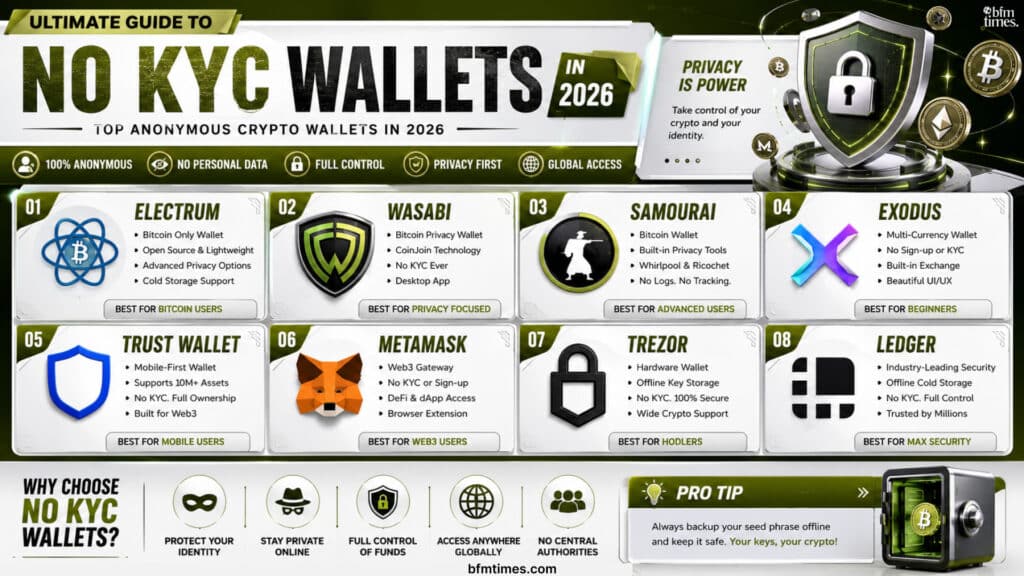
The table below summarizes the following anonymous crypto wallets, with the selection criteria being non-custodial design, security reputation, and active development.
Electrum
- Summary: Bitcoin wallet with advanced controls.
- KYC status: True, no KYC wallet
- Type: Desktop
- Supported assets: Bitcoin
- Security features: cold storage, multi-sig, and seed phrase.
- User experience: Advanced
- Risks/issues: Bitcoin only, phishing imitations.
- Conclusion: Good to know about Bitcoin users.
Wasabi Wallet
- Summary: CoinJoin privacy Bitcoin wallet.
- KYC status: No KYC
- Type: Desktop
- Supported assets: Bitcoin
- Security features: CoinJoin, Tor.
- User experience: Medium complexity.
- Risks/issues: CoinJoin fees.
- Conclusion: Good on-chain privacy.
Samourai Wallet
- Summary: The mobile Bitcoin privacy wallet has advanced.
- KYC status: No KYC
- Type: Mobile (Android)
- Supported assets: Bitcoin
- Security features: Whirlpool, Tor, encrypted backups.
- User experience: Advanced
- Risks/issues: Android-only
- Conclusion: Privacy-conscious power users.
Exodus
- Summary: Low-paying multi-asset wallet.
- KYC status: No mandatory KYC
- Type: Desktop & mobile
- Supported assets: BTC, ETH, and altcoins.
- Security features: local encryption, seed phrase.
- User experience: Easy to use.
- Risks/issues: Partially closed source.
- Conclusion: self-custody ease of use.
Trust Wallet
- Summary: Mobile wallet with DeFi and NFTs.
- KYC status: Does not have a KYC about wallet use.
- Type: Mobile
- Supported assets: Multi-chain.
- Security features: biometrics, private key ownership.
- User experience: Simple
- Risks/issues: dApp phishing.
- Conclusion: Mobile-first DeFi users.
MetaMask
- Summary: Ethereum and DeFi Browser Wallet.
- KYC status: No KYC wallet
- Type: Browser & mobile
- Supported assets: EVM chains, ERC-20, and ETH.
- Security features: Seed phrase, encryption.
- User experience: Hassle-free and security-conscious.
- Risks/issues: Browser exploits.
- Conclusion: Web3 standard and DeFi.
Trezor
- Summary: Open-source hardware wallet.
- KYC status: No KYC
- Type: Hardware
- Supported assets: significant cryptocurrencies.
- Security features: passphrase, PIN, offline key.
- User experience: Easy to use.
- Risks/issues: Physical device safety.
- Conclusion: Long-term cold store.
Ledger
- Summary: Hardware wallet ecosystem security.
- KYC status: No wallet-level KYC.
- Type: Hardware
- Supported assets: 5,000+
- Security features: secure element, offline storage.
- User experience: Simple
- Risks/issues: Data breach in the company in the past.
- Conclusion: Hardware security in the right way.
Top No KYC Wallet Comparison
| Wallet | Type | KYC Required | NonCustodial | Assets | Key Privacy Features | Best Use Case |
| Electrum | Desktop | No | Yes | BTC | Multi-sig, cold storage | Bitcoin self-custody |
| Wasabi | Desktop | No | Yes | BTC | CoinJoin, Tor | Transaction privacy |
| Samourai | Mobile | No | Yes | BTC | Whirlpool, Tor | Advanced users |
| Exodus | Desktop/Mobile | No | Yes | Multi-asset | Local encryption | Beginners |
| Trust Wallet | Mobile | No | Yes | Multi-chain | Key ownership | DeFi |
| MetaMask | Browser/Mobile | No | Yes | EVM chains | Seed phrase | Web3 |
| Trezor | Hardware | No | Yes | Multi-asset | Offline storage | Long-term holding |
| Ledger | Hardware | No | Yes | Multi-asset | Secure element | Cold storage |
Private Crypto Wallets With Strong Security
Privacy and good protection are available in private crypto wallets.
Core Security Concepts
- Seed word: Master recovery key.
- Private key: Evidence of possession.
- Multi-signature: Multi-approvals.
- Encryption: Data protection
- Hardware isolation: Offline security.
Self-custody and security are inseparable.
Wallets Without Verification: Platforms and Options
Wallets without verification include:
- Free-of-charge software wallets.
- Hardware wallets
- On-chain browser wallets
- Accountless mobile wallets.
KYC often manifests during the process of buying crypto through third-party services.
Custodial vs Non-Custodial Wallet Adoption Trends
The trends in adoptions refer to the relevance of no KYC wallets.
- Exchange failures and account freezes have augmented demand for self-custody.
- Non-custodial wallets are needed for DeFi development.
- The storage and trading wallets get further divided among users.
Trend insight: Stressful market conditions drive non-custodial adoption faster.
Asset Support and Blockchain Coverage in No KYC Wallets
Asset and blockchain support is one of the least considered when no KYC wallets are evaluated. Although privacy is the main factor, the usefulness of a wallet in practice depends heavily on the networks and tokens it supports.
Bitcoin-Focused Wallets
Privacy-first wallets are dominated by Bitcoin-centric wallets because Bitcoin has a transparent UTXO model and has well-established privacy tooling.
Bitcoin-centric crypto wallets that do not perform KYC will normally support:
- Original SegWit and Taproot addresses.
- Replace-by-fee (RBF)
- Coin control and UTXO management.
- Privacy tools: On-chain privacy: CoinJoin.
Users who prefer using these wallets are those who:
- Hold BTC long term
- Proactively administer the privacy of transactions.
- Enterprise smart contract risk avoidance.
The limitation is, however, self-evident: they are not compatible with decentralized finance or multi-chain assets.
Ethereum and EVM-Compatible Wallets
Ethereum-compatible wallets enhance functionality but introduce new privacy trade-offs.
Not frequently verified EVM-based wallets usually embrace:
- Ethereum mainnet
- Layer 2 networks (Arbitrum, Optimism, Base)
- Sidechains (Polygon)
- Thousands of ERC-20 tokens
The functions of these wallets are:
- DeFi participation
- NFT storage
- DAO governance
The downside is that smart contract interactions often expose metadata that can weaken privacy if users are not careful.
Multi-Chain Wallets
Multi-chain private crypto wallets also seek to achieve a trade-off between convenience and decentralization by supporting multiple blockchains through a single interface.
The common types of resources supported are:
- BTC
- ETH
- Major altcoins
- Stablecoins
- Tokenized assets
Multi-chain wallets are convenient, but they also increase the attack surface and complexity, making good security hygiene more vital.
Self-Custody and the Psychology of Responsibility
It does not just represent a technical change but a psychological change. The mental model involved is often underestimated by users who switch to no-KYC wallets after using custodial platforms.
From Account Ownership to Key Ownership
In custodial systems:
- Passwords can be reset
- Support teams exist
- Sometimes mistakes can be undone.
In non-custodial systems:
- The account is referred to as the seed phrase.
- Mistakes are permanent
- Responsibility is absolute
This change justifies the reason why most users are using layered wallet strategies, including:
- A long-term storage wallet.
- One wallet for DeFi
- One wallet of an experimental activity.
Operational Discipline
Seasoned users use crypto wallets without KYC as personal stores as opposed to applications:
- The creation of backups is instantaneous.
- Christening transactions are conducted.
- Software updates are checked.
- The wallets are based on risk profile.
Such an attitude has a significant negative impact on failure rates.
DeFi, dApps, and No KYC Wallet Integration
Decentralized finance relies almost entirely on non-custodial wallets.
Why DeFi Requires No KYC Wallets
DeFi protocols:
- Do not create accounts
- Do not verify identity
- Communicate directly with wallet addresses.
This position makes anonymous crypto wallets the default gateway to:
- Decentralized exchanges
- Lending protocols
- Yield farming
- NFT marketplaces
Nonetheless, DeFi also carries other risks:
- Smart contract exploits
- Front-end attacks
- Approval abuse
Wallet Permissions and Token Approvals
The most frequent error new users make is granting unrestricted consent to grant tokens.
Best practices include:
- Conducting regular reviews of approvals.
- Unassigning unutilized permissions.
- Keeping DeFi in different wallets.
There are no KYC wallets that provide freedom in DeFi, as they must also have active permission management.
Advanced Threat Models for Wallets Without Verification
Beyond elementary phishing, sophisticated users have to consider more sophisticated threat vectors.
Address Clustering and Behavioral Analysis
Blockchain analytics may:
- Cluster addresses
- Infer ownership patterns
- Determine transactional practices.
Mitigation strategies:
- Avoid address reuse
- Use multiple wallets
- Distinct identities between chains.
Supply Chain and Software Risks
The security of the wallet also relies on:
- Update delivery mechanisms
- Dependency integrity
- Open-source auditability
This is the reason why most of the advanced users choose:
- Deterministic builds
- Verifiable signatures
- Community-reviewed code
Hardware Wallet Threat Models
Hardware wallets lower the online risk, but cause:
- Physical theft risk
- Firmware trust assumptions
- Supply chain hijacking issues.
There is no ideal security model; risk has to be use case-matched.
Privacy vs Compliance: A Nuanced Reality
One of the most common assumptions is that there are no KYC wallets that are not regulated by any authority. In fact, this is more complex.
Wallets Are Tools, Not Identities
Wallet software itself:
- Fails to conduct identity checks.
- Does not monitor compliance
- Does not enforce reporting
However, the compliance requirements are as follows:
- Fiat on-ramps
- Centralized exchanges
- Tax reporting interfaces
Using crypto wallets without KYC does not eliminate legal responsibilities.
The Myth of Total Anonymity
No KYC wallets provide:
- Reduced data exposure
- Reduced repression to censorship.
They do not provide:
- Legal immunity
- Guaranteed anonymity
- Protection from user error
This distinction is important to know how to use them responsibly.
Enterprise, Journalistic, and Developer Use Cases
Although commonly regarded as retail users, professionals are increasingly using private crypto wallets.
Journalists and Activists
Privacy wallets are used to:
- Receive donations
- Protect sources
- Work in oppressive governments.
Developers
Developers rely on wallets without verification for:
- Testing smart contracts
- Deploying dApps
- Multi-chain identity management.
Security Researchers
Researchers with no KYC wallets use:
- Simulate attack scenarios
- Analyze protocol behavior
- Insist on operational separation.
These applications justify the privacy-preserving wallets.
Long-Term Outlook: Privacy Wallets as Core Infrastructure
No KYC wallets transitioned to infrastructure as blockchain adoption matures.
The developments expected include:
- Enhanced default privacy options.
- Better UX for self-custody
- Native multi-chain support
- Greater software and hardware integration.
Instead of going extinct under regulation, unverified wallets will likely still exist on regulated platforms, serving other purposes.
Risks and Considerations With No KYC Wallets
Legal Responsibility
Whether using a wallet or not, users would be required to adhere to tax and financial laws.
Operational Risks
- No password recovery
- Lost phrases of words in seed mean forever lost.
- No customer support
Security Threats
- Phishing
- Fake wallet apps
- Browser-based attacks
Discipline and education are mitigation measures.
How to Choose a No KYC Wallet
Consider:
- Non-custodial design
- Asset support
- Platform compatibility
- Open-source transparency
- Backup options
- Community reputation
Privacy Best Practices for Crypto Wallet Users
- Store seed phrases offline
- Large holdings should be done with hardware wallets.
- Avoid address reuse
- Verify wallet sources
- Separate wallets by purpose
- Learn about blockchain transparency.
Privacy & Security Feature Checklist
| Feature | Explanation | Why It Matters |
| Seed Phrase | Recovery key | Prevents loss |
| Encryption | Data protection | Prevents theft |
| Multi-Sig | Multiple approvals | Reduces single-point failure |
| Tor Support | Hides IP | Network privacy |
| Hardware Storage | Offline keys | Attack resistance |
No KYC Wallets in 2026+
Looking ahead:
- Wallets will be customizable and chain-neutral.
- Privacy settings can be turned into defaults.
- The hybrid custody models can be developed.
- Decentralization will still be anchored on self-custody.
Despite regulatory pressure, crypto wallets without KYC will remain essential infrastructure for permissionless finance.
Conclusion
There are no KYC wallets that are the foundation of crypto self-custody and privacy in 2026. These wallets enable users to choose among sovereignty, decentralization, and direct access to the blockchain, given that identification verification has been removed. Privacy, however, does not come without its share of responsibility. It is necessary to know about risks, security best practices, and the regulatory context.
With more oversight of financial systems, KYC-free crypto wallets will remain crucial in maintaining open, permissionless finance.
Frequently Asked Questions
Are no-KYC wallets safe?
They are secure when used correctly but require user responsibility.
Are no KYC wallets legal?
Generally, yes, but usage must comply with local laws.
Are transactions anonymous?
No. Blockchains are transparent; privacy technologies make them less traceable.
Disclaimer: BFM Times acts as a source of information for knowledge purposes and does not claim to be a financial advisor. Kindly consult your financial advisor before investing.