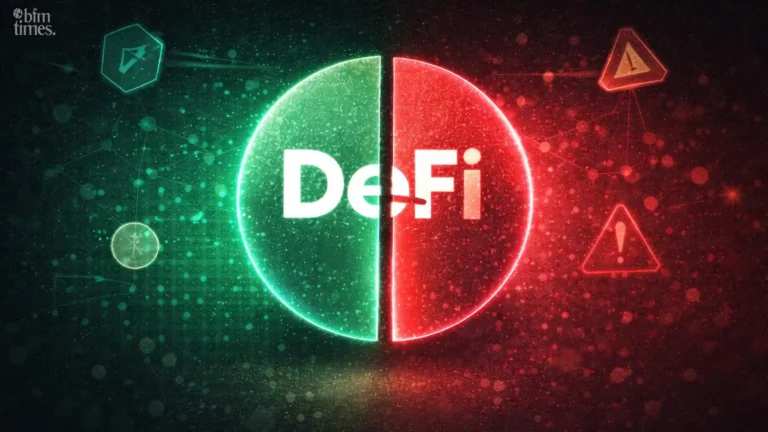
The benefits and risks of decentralized finance have turned out to be one of the most debated issues among crypto enthusiasts and blockchain investors. Decentralized Finance, or DeFi, is defined as financial services that are provided through blockchain networks and function without the traditional intermediaries, such as banks and brokers.
- The Fundamental Benefits of DeFi: Why Cryptocurrency Investors are Taking Notice
- Financial Access and Global Access.
- Openness and Confidence With Blockchain.
- Automated Smart Contracts and Programmable Finance.
- The Natural Hazards of Decentralized Finance.
- Vulnerabilities and Security Risks of Smart Contracts.
- Regulatory Uncertainty Regarding DeFi.
- Liquidity Risk and Market Volatility.
- Web 2.0 User Responsibility, Irrecoverable Assets.
- The Future of the DeFi Landscape: Matured DeFi?
- In conclusion: The Benefits and Risks of Decentralized Finance
The majority of DeFi apps are built on the Ethereum blockchain and utilize smart contracts to automate financing tasks, e.g., lending and borrowing, trading, and yield generation. Such decentralized systems enable their users to communicate directly with financial protocols via crypto wallets without involving centralized institutions.
To most crypto enthusiasts, the emergence of the benefits and risks of decentralized finance is a significant change in the functioning of the financial systems. Still, it is necessary to learn the benefits and dangers of decentralized finance since the aspects that can be defined as powerful in DeFi may pose a significant risk to investors.
Related: Can a Decentralized Network Be Censored? Vulnerabilities
The Fundamental Benefits of DeFi: Why Cryptocurrency Investors are Taking Notice
There are a number of benefits that contribute to the expansion of decentralized finance. Developers, traders, and long-term crypto investors are attracted to blockchain finance by these DeFi benefits, and blockchain finance is a new frontier in finance. This is the first section on the benefits and risks of decentralized finance.
Financial Access and Global Access.
Accessibility is one of the biggest benefits and risks of decentralized finance. Credit checks, identification, and minimum balances are often needed in traditional banking systems and can lock out millions of people from financial services.
DeFi eliminates most of these obstacles.
Anyone with:
- an internet connection
- a crypto wallet
- entry to blockchain networks.
is eligible to engage in DeFi projects.
Research by the World Economic Forum shows that decentralized finance could assist in increasing access to finance for more than 1.7 billion unbanked individuals globally. Source.
To crypto users, DeFi platforms offer:
- borderless lending and borrowing.
- International trading of cryptocurrency.
- stablecoin savings options
Such ease of access is among the main factors that make DeFi investment an ever-increasing trend all over the world.
Openness and Confidence With Blockchain.
Transparency is yet another significant benefit of DeFi. Conventional financial structures are dependent on in-house books that institutions operate, which require users to have faith in the system in which they deposit the money.
DeFi systems are different in their mode of operation.
The blockchain technology is a technology that stores transactions on public ledgers where anyone can check them. All trade, loans, or liquidity flows are recorded on-chain and are difficult to manage.
This openness will enable users to:
- Verify liquidity pools
- trace the transactions in public.
- analyze protocol activity
The fact that the system is open and verifiable leads to many investors considering DeFi as an open financial system.
Automated Smart Contracts and Programmable Finance.
One of the characteristics of DeFi is programmable finance, which is run by smart contracts.
Smart contracts consist of computer programs that automatically run transactions in case predetermined conditions are satisfied. Through this automation, middlemen are eliminated, and time wastage is minimized.
Examples include:
- immediate lending and borrowing.
- liquidity pool-based automated token swaps.
- Distribution of yield farming rewards.
A study commissioned by Stripe has found that decentralized finance infrastructure can be much faster in terms of settlement delays than a traditional financial system.
In the case of crypto traders, this effectiveness leads to quicker opportunities for DeFi investments and liquidity engagement.
Related: Can Smart Contracts Be Changed After Deployment?
The Natural Hazards of Decentralized Finance.
Although innovation and opportunity are present in DeFi, the benefits and risks of decentralized finance cannot be considered separately. There are several technical and financial risks that are introduced by the decentralized systems.
Vulnerabilities and Security Risks of Smart Contracts.
One of the most dangerous blockchain finance risks is the security vulnerability of smart contracts.
Since DeFi is built on automated code, all faults or bugs may be exploited by criminals. The hackers continuously study DeFi protocols in their pursuit of vulnerabilities.
The most prevalent attack techniques are
- flash loan exploits
- Coding errors in smart contracts.
- Oracle manipulation
- liquidity pool attacks
The Enterprise Ethereum Alliance points out that the bad design of smart contracts has been one of the biggest threats in decentralized finance.
Some of the protocols, even those that are audited, can have some unseen holes. That is why the benefits and risks of decentralized finance security have become a very important topic to developers and users. Source.
Regulatory Uncertainty Regarding DeFi.
Regulatory uncertainty is another issue that affects the risks and opportunities of decentralized finance.
Since DeFi is decentralized, governments have yet to decide how to regulate these systems. Of special concern to the authorities are the risks associated with:
- money laundering
- financial compliance
- consumer protection
The U.S. Department of the Treasury has published a study on the illegal finance risks of DeFi ecosystems.
With the changing global regulations, there is a possibility of new compliance regulations being introduced to decentralized finance platforms, which might transform the industry.
Liquidity Risk and Market Volatility.
Cryptocurrencies are volatile markets, and this volatility directly influences the DeFi platforms.
Numerous DeFi systems use crypto assets as security. The automation of liquidations is possible when market prices are plummeting through the lending platforms.
Common risks include:
- volatile changes in the cryptocurrency prices.
- liquidity shortages
- drip-down liquidations in bad times.
This volatility can increase both losses and gains to the investors who are engaging in DeFi investments. Source.
Web 2.0 User Responsibility, Irrecoverable Assets.
One of the distinctive attributes of decentralized finance is self-custody.
Instead of depending on the centralized institutions, users manage their assets with the help of their private keys and digital wallets.
But this does not exclude that users have a complete responsibility for security.
If a user:
- loses their private keys
- deposits money in the incorrect wallet.
- becomes the victim of phishing.
- The assets are not normally recoverable.
With DeFi platforms, account recovery or customer support is not provided, as in the case of banks.
Also Read: What are Public Keys?
The Future of the DeFi Landscape: Matured DeFi?
The decentralized finance sector is rapidly developing as creators and establishments strive to fill existing gaps.
The major trends that will influence the future are
- Better auditing of smart contracts.
- Better security monitoring tools for DeFi.
- enhancing the institutional uptake of blockchain finance.
- hybrid financial architecture of DeFi and conventional systems.
The goal of such developments is to minimize risks of blockchain finance and preserve the open and permissionless nature of DeFi, along with the benefits and risks of decentralized finance. Source.
In conclusion: The Benefits and Risks of Decentralized Finance
With the benefits and risks of decentralized finance, there are potential complications in the blockchain-based financial system.
DeFi also has some key benefits, such as financial accessibility, transparent financial transactions, and automated financial services. Simultaneously, it brings fresh problems like smart contract vulnerabilities, regulatory uncertainty, market volatility, and security that is controlled by the user.
To crypto investors and blockchain believers, these risks and benefits need to be understood to engage in the DeFi ecosystems.
The future of decentralized finance lies in better security practices, better infrastructure, and a responsible involvement of the global crypto community, and the success of such benefits and risks of decentralized finance will be determined in the long term.
Disclaimer: BFM Times acts as a source of information for knowledge purposes and does not claim to be a financial advisor. Kindly consult your financial advisor before investing.
What are the main benefits of decentralized finance (DeFi)?
DeFi offers benefits like global access, lower transaction costs, faster transfers, and financial services without banks.
What are the risks involved in DeFi investing?
DeFi carries risks such as smart contract bugs, hacking, market volatility, and lack of regulatory protection.
Why should crypto investors understand DeFi risks and benefits?
Understanding both helps investors make informed decisions and manage potential losses in the rapidly evolving crypto market.