Assuming you are attempting to build AI crypto trading bot in 2026, you are no longer writing scripts; you are actually creating an entire stack of decision-making that can compete in a hyper-fast, high-data market.
- Why Everyone Is Trying to Build AI Crypto Trading Bots Right Now
- Before You Build: What an AI Crypto Trading Bot Actually Is
- The Real Architecture Behind an AI Crypto Trading Bot
- 1. Data Layer
- 2. Strategy + AI Model Layer
- 3. Execution Engine
- 4. Risk Management System
- 5. Monitoring & Optimization Layer
- How to build AI crypto trading bot from Scratch
- Step 1: Define Your Trading Strategy First
- Step 2: Collect and Prepare Data
- Step 3: Choose Your Tech Stack
- Step 4: Build the AI Model
- Step 5: Connect to Exchange APIs
- Step 6: Backtest Before Going Live
- Step 7: Deploy and Monitor
- What Most People Get Wrong When They Build AI Trading Bots
- AI Day Trading vs Long-Term Bots: What Should You Build?
- How Advanced AI Bots Are Built in 2026
- Cost, Time & Complexity of Building a Real Trading Bot
- Should You Build or Use an Existing AI Bot?
This is not just a GitHub repo and a simple trading bot. Modern-day bots are a fusion of machine learning, execution code, and risk systems, and they are supposed to act as a disciplined trader AI.
We can deconstruct this as builders would think, in other words, systems first, code second.
Related: How to Use AI Trading Bots
Why Everyone Is Trying to Build AI Crypto Trading Bots Right Now
Crypto never sleeps. Literally.
Trading 24 hours a day in the global trades makes it inefficient and taxing to do manually. Automation was developed there, initially in simple scripts and currently in intelligent systems.
What changed?
- With AI models, it is possible to work with massive datasets in milliseconds.
- The retail traders can now access institutional tools.
- Exchanges have potent APIs for automation.
- The possibility of threat is ever-present (and risky).
We’ve shifted from:
“I’ll manually trade setups.”
to
Let my trader AI scan, decide, and execute faster than me.
That’s why demand to build AI crypto trading bot systems has exploded, not as a trend, but as infrastructure.
Before You Build: What an AI Crypto Trading Bot Actually Is
We will make it simpler, not dumb.
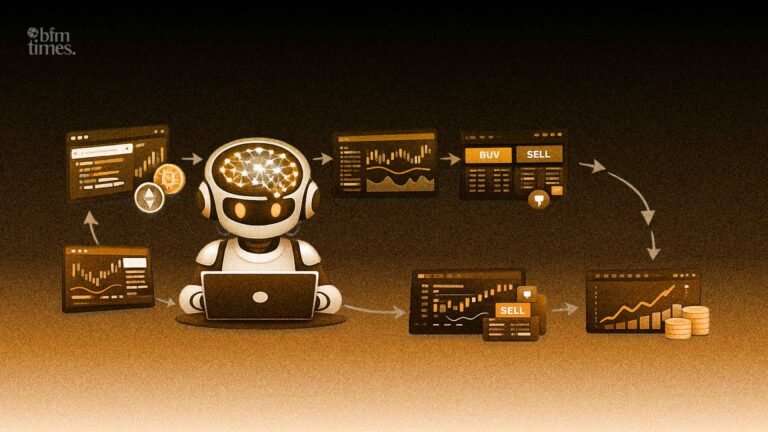
A build AI crypto trading bot powered by AI follows a loop:
Information for the decision maker to take action on feedback.
Data → Decision → Execution → Feedback
1. Data
- Price, volume, order books
- Indicators (RSI, MACD, etc.)
- Sentiment (Twitter, news)
- On-chain signals
2. Decision
- The AI model is a prediction of movement probability.
- Strategy defines when to act
3. Execution
- The bot makes buy/sell orders through the API.
4. Feedback
- Logs performance
- Updates model or parameters
Normal Bot vs AI Bot
Normal trading bot:
- Rule-based (if RSI < 30 → buy)
- Static logic
AI-powered bot:
- Learns patterns from data
- Fits in changing market conditions.
- Works well for AI day trading or dynamic strategies
So when you say you want to build AI crypto trading bot, you’re really building a system that learns and evolves, not just executes rules.
The Real Architecture Behind an AI Crypto Trading Bot
Most of the guides fail in this area; they do not take into consideration the actual system design.
A real trading bot is modular. Think of it like five interconnected layers.
1. Data Layer
This is your foundation.
Inputs:
- Binance, Coinbase Exchange APIs.
- Historical OHLCV data
- Order book depth
- Social sentiment APIs
If your data is bad, your AI is useless. Simple.
Modern bots even combine:
- On-chain metrics
- Whale wallet tracking
- Funding rates
In 2026, data edge = trading edge
2. Strategy + AI Model Layer
This is the brain.
Common approaches:
- Time series models → price prediction.
- Regression Models → probability scoring.
- Reinforcement Learning → dynamic decision-making.
Example:
The model predicts a “70% chance BTC goes up in the next 10 mins.”
Your strategy decides:
“Only act if confidence > 65% + volume spike”
That combination is what makes a real crypto trading bot.
3. Execution Engine
This is the point at which the majority of bots fail in real life.
It:
- Connects to exchange APIs
- Places orders
- Handles slippage & fees
- Adjusts for latency
Prediction is no good when it is going to be executed poorly.
4. Risk Management System
This is your survival layer.
In its absence, your bot will eventually explode.
Core components:
- Stop-loss logic
- Position sizing
- Capital allocation rules
- Max drawdown limits
Professional bots are more risk-oriented than profit-oriented.
5. Monitoring & Optimization Layer
This is where long-term edge is gained.
Includes:
- Trade logs
- Performance dashboards
- Model retraining
- Error tracking
A real trader AI is something that is never complete but is kept on developing.
How to build AI crypto trading bot from Scratch
Now we are really going to construct the systems to build AI crypto trading bot, builder style.
Step 1: Define Your Trading Strategy First
Respond to this question prior to touching code:
What is the inefficiency I am taking advantage of?
Options:
- Trend following
- Mean reversion
- Arbitrage
- Momentum scalping
Your AI model is not in conflict with the strategy; it supplements it.
Most newcomers are unsuccessful since they engage in coding without thinking.
Step 2: Collect and Prepare Data
You’ll need:
- Historical price data
- Real-time feeds
- Clean, structured datasets
Tasks:
- Remove noise
- Normalize data
- Align timeframes
Bad data = faked profits testing.
Step 3: Choose Your Tech Stack
A majority of the builders continue to use Python.
Core tools:
- pandas → data handling
- TA-Lib → indicators
- TensorFlow / PyTorch → AI models
You can also integrate:
- FastAPI → backend
- Docker → deployment
Step 4: Build the AI Model
Now the real work begins.
What you do:
- Train model on historical data
- Generate predictions (signals)
- Evaluate accuracy
Important:
Accuracy ≠ profitability
The model may be correct, but the execution cost will make the model lose money.
Step 5: Connect to Exchange APIs
Popular exchanges:
- Binance
- Coinbase
- Kraken
You’ll:
- Generate API keys
- Establish restrictions (trade, no withdrawals)
- Construct trustworthy request handlers.
Here your trading bot comes into existence.
Step 6: Backtest Before Going Live
Your simulation level is backtesting.
You:
- Run bot on past data
- Measure performance
- Identify weaknesses
Watch for:
- Overfitting
- Unrealistic assumptions
A majority of the bots perform well in backtests until they touch real markets.
Step 7: Deploy and Monitor
Now you go live.
Setup:
- Cloud servers (AWS, VPS)
- Continuous monitoring
- Alert systems
And here’s the truth:
Your first live version will not be profitable.
Iteration is the game.
Suggested; Free vs Paid Crypto Trading Tools
What Most People Get Wrong When They Build AI Trading Bots
This is where reality hits.
1. Overfitting Models
It is your model that is memorizing the past data rather than learning patterns.
Result:
Works in testing → fails in the real market
2. Ignoring Execution Latency
Any delay of a single second can destroy AI trading strategies.
Markets move fast. Your bot must be faster.
3. Weak Risk Management
No limit to loss = ultimate wipeout.
This is non-negotiable.
4. Blind Trust in AI
AI is not magic.
It:
- Misreads signals
- Fails in new market conditions
Smart builders always combine:
AI + rules + risk controls
AI Day Trading vs Long-Term Bots: What Should You Build?
Not all bots are built the same
AI Day Trading Bots
- High frequency
- Small profits per trade
- Needs extremely high performance.
Best for:
- Skilled developers
- Low-latency infrastructure
Swing / Position Bots
- Hold for hours/days
- Less sensitive to latency
- Easier to manage
Arbitrage Bots
- Exploit price differences
- Needs numerous interactions.
- Lower risk, but competitive
Tradeoff
- Speed → more complexity
- Accuracy → slower, more stable
Select according to your talents and not hype.
How Advanced AI Bots Are Built in 2026
Here is where it becomes interesting.
1. Multi-Agent Systems
Instead of one model:
- Sentiment is analyzed by one agent.
- One predicts price
- One manages risk
They collaborate.
2. Real-Time Learning
Bots do not train offline but update their strategy live.
3. Sentiment + On-Chain Integration
Modern bots combine:
- Twitter sentiment
- Whale wallet tracking
- Exchange inflow/outflow
This forms a more incisive market perception.
4. Hybrid Systems
The best bots combine:
- Rule-based logic
- AI predictions
- Human overrides
Such is what professional trader AI systems appear to be.
Cost, Time & Complexity of Building a Real Trading Bot
Let’s be honest.
Basic Bot
- Time: 2 to 6 weeks
- Cost: $500 to $5,000
- Features: simple automation
Intermediate AI Bot
- Time: 2 to 4 months
- Cost: $10,000 to $50,000
Advanced System
- Time: 6 to 12 months
- Cost: $30,000 to $400,000+
Includes:
- AI models
- Infrastructure
- Optimization layers
Construction of a serious system is more reminiscent of a startup than a side project.
Also Read: Best AI Tools for Crypto Trading
Should You Build or Use an Existing AI Bot?
If your goal is:
Learning / Control
→ Build your own
→ You understand every layer
Profit / Efficiency
→ Use existing tools
→ Save time and complexity
The smartest approach?
Start simple → understand system → then scale.
Because when you build AI crypto trading botsystems properly, you’re not just trading.
You’re building an automated decision machine that competes in one of the fastest markets on earth.
Disclaimer: BFM Times acts as a source of information for knowledge purposes and does not claim to be a financial advisor. Kindly consult your financial advisor before investing.
How can I build an AI crypto trading bot in 2026?
You can build it by selecting a strategy using APIs training AI models and integrating automated trading logic.
What skills are needed to create an AI trading bot?
Skills required include programming data analysis machine learning and understanding of crypto markets.
Is building an AI crypto trading bot difficult?
It can be complex for beginners but becomes manageable with the right tools frameworks and learning resources.
Which language is best to build AI trading bots?
Python is the most popular due to its AI libraries and ease of use.
Do I need AI to build a crypto trading bot?
No, but AI improves prediction accuracy and automation capabilities.